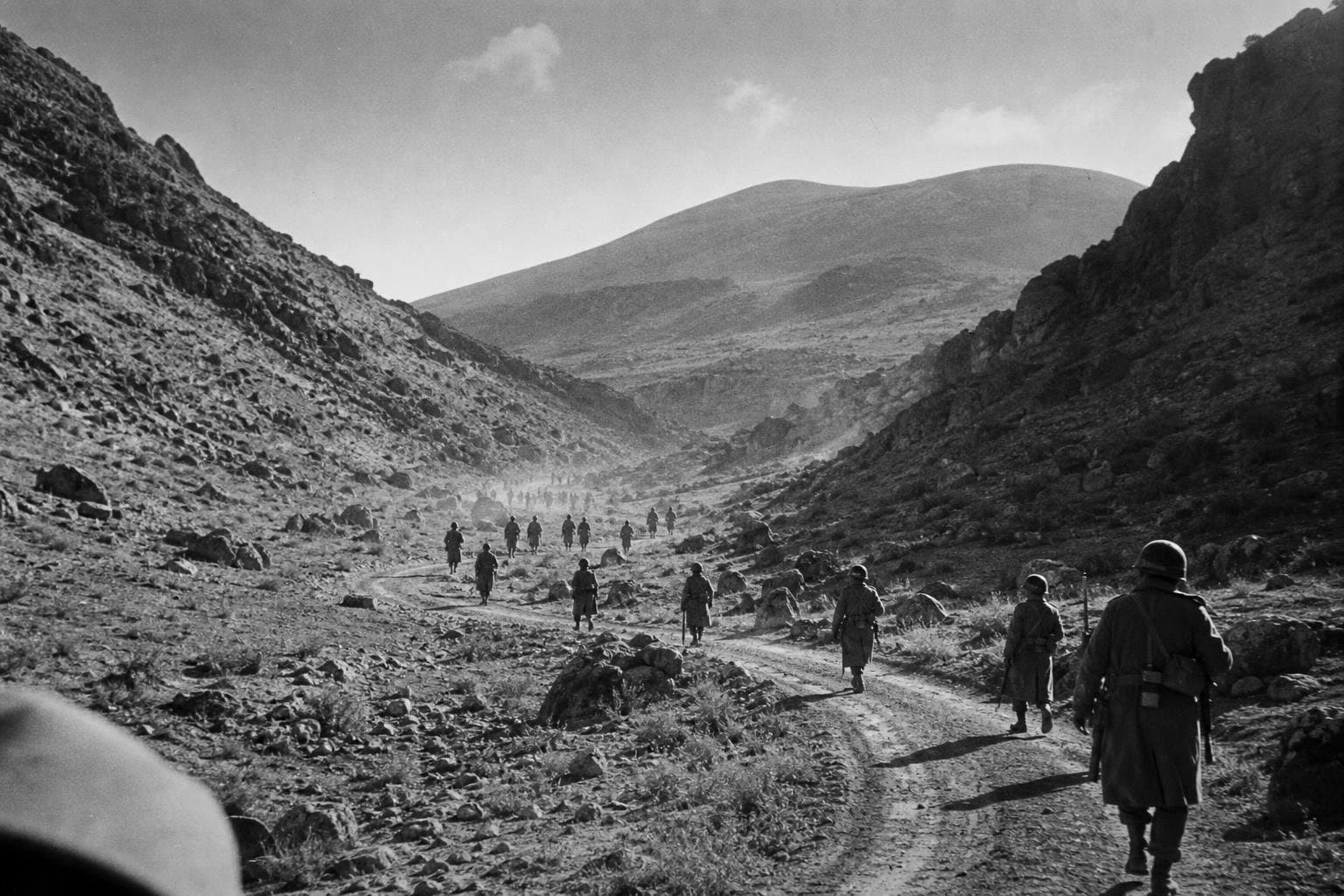

I covered the armor doctrine failure at Kasserine in an earlier issue — the mismatch between what American tank crews trained to do and what the Tunisian desert actually demanded. What I want to revisit here is the layer underneath the tactical failure: the command structure that made the defeat at Kasserine almost structurally inevitable, and the specific fix that turned things around before the campaign ended.
The defeat in late February 1943 was humiliating by any measure. As the aso.rocks account of El Guettar describes it, American troops had been "outgunned, outmaneuvered, and routed" — and German commanders who had watched it happen expected more of the same when they moved against U.S. positions a month later. That expectation was reasonable. It was also wrong. The question worth asking is why it was wrong, and what changed in the four weeks between Kasserine and El Guettar.
The Problem Wasn't Courage — It Was Fredendall
Maj. Gen. Lloyd Fredendall commanded II Corps during Kasserine, and his performance has been analyzed extensively. But the most damning detail isn't tactical — it's architectural. Fredendall positioned his command post roughly 70 miles behind the front, in an elaborate underground bunker that his engineers spent weeks constructing while his forward units were starved of engineering support. He issued orders in a private code that his own subordinates struggled to decode. He bypassed the chain of command to give direct orders to battalion commanders, cutting out the division commanders in between.
This isn't hindsight. The dysfunction was visible to observers at the time. What Kasserine exposed was that Fredendall had built a command system optimized for his own comfort and control rather than for the transmission of accurate information. When the German attack came, the fog of battle hit a headquarters that was already operating in self-imposed fog. Units received contradictory orders, reserves were committed piecemeal, and the corps never developed a coherent picture of what was happening.
The terrain and the enemy were real problems. But Operation Torch placed thousands of inexperienced American troops into contact with battle-tested German forces for the first time — a structural disadvantage that a functional headquarters might have managed, and a broken one could not. Kasserine was where that gap became undeniable.
Eisenhower's Fix: One Decision, Not a Doctrine Revision
Eisenhower's response to Kasserine was not a new training program or a revised armor doctrine. It was a personnel decision. He removed Fredendall and replaced him with George Patton, who took command of II Corps on March 6, 1943.
Patton's methods were blunt. He fined soldiers for uniform violations. He drove to forward positions personally. He was, by most accounts, exhausting to work for. But the organizational effect was immediate: the command post moved forward, orders flowed through the proper chain, and subordinate commanders knew exactly what was expected of them. Whether Patton's personality was the cause or the vehicle for this change is a legitimate question — but the structural result was a corps that could process information and act on it.
The El Guettar engagement on March 23 tested that directly. When roughly 50 tanks of the 10th Panzer Division rolled into the valley expecting the Americans to break, they found prepared positions, coordinated anti-tank fire, and a corps that held. The Germans had not changed. The American command system had.
What the Campaign Actually Proved
WW2 Depot's analysis of Operation Torch frames the North Africa campaign as the place where Eisenhower learned coalition command and American forces absorbed the hard lessons of modern war — mastering the difficult business of moving armies by sea, landing them on hostile shores, and coordinating British and American forces under one broad plan. That framing is broadly right, but it risks making the learning sound passive — as if experience itself was the teacher.
The more precise lesson is that Kasserine revealed a specific failure mode: a commander who had insulated himself from bad news, and a headquarters structure that converted uncertainty into paralysis. The fix was not more training or better equipment. It was removing the person who had built the broken system and replacing him with someone who understood that a corps commander's job is to maintain situational awareness, not to manage his own comfort.
That lesson keeps reappearing. Britannica's account of the Tunisia campaign situates Kasserine within a broader Allied effort to close the ring around Axis forces — a campaign that ultimately forced a quarter of a million German soldiers to surrender. That outcome required the command system to actually function. The French command system in 1940 failed for structurally similar reasons — not because French soldiers couldn't fight, but because the headquarters couldn't process bad news fast enough to respond. MacArthur's Korea command, as I wrote in May, built in the same insulation from unwelcome intelligence.
The pattern is consistent enough to be a diagnostic: when a headquarters produces confused, contradictory, or delayed responses to a developing crisis, the first question isn't what the enemy did. It's who built the command system, and what they optimized it for.


