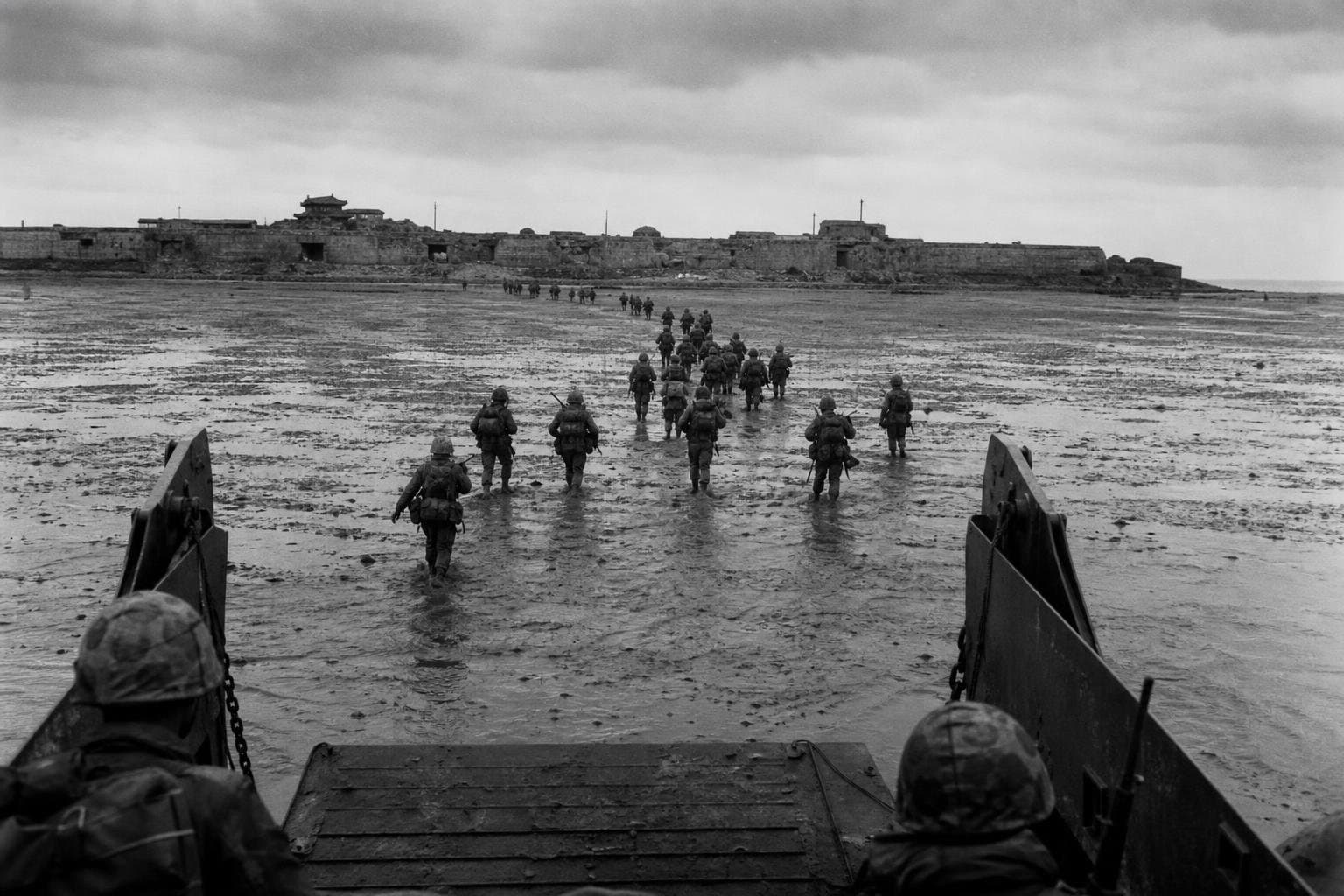

The tides at Inchon rose and fell more than thirty feet. Twice a day, the Yellow Sea retreated entirely, leaving miles of thick mud between any landing force and the shore. The harbor channel was narrow, twisted, and laced with islands. The seawalls along the waterfront meant Marines would need ladders just to get off their landing craft. Naval planners catalogued the hazards and concluded the site was operationally untenable.
MacArthur heard all of this and chose Inchon anyway — and he was right. But the story of why he was right, and what that success cost, is more complicated than the legend allows.
I covered the structural aftermath of Inchon in a previous issue: how the landing's success validated MacArthur's command style in ways that made the Chinese intervention nearly inevitable. What's worth examining here is the operational logic of the landing itself — what made it work, what the risks actually were, and why "audacity" is too clean a word for what happened on September 15, 1950.
The Trap Was Also the Point
By early August 1950, UN forces had been compressed into a shrinking defensive perimeter around the port of Pusan. The North Korean People's Army had driven south with speed and weight, capturing Seoul within days of crossing the 38th parallel and pushing the defenders into what became the Pusan Perimeter. American commanders understood that a single major breakthrough could end the war in catastrophe.
MacArthur had been thinking about an amphibious landing since July. He and the Joint Chiefs selected the 1st Marine Division and the 7th Infantry Division as the core landing force, designated X Corps and commanded by Major General Edward M. Almond — MacArthur's own chief of staff, a command relationship that would generate its own problems later.
The choice of Inchon was MacArthur's personally. His advisors' objections were real and well-founded. The tides dictated a narrow operational window; landing craft that entered at high tide could find themselves stranded when the water receded. The seawalls required improvised equipment. The approaches funneled ships into a killing ground. Every feature that made Inchon a poor target was, MacArthur argued, a reason the North Koreans wouldn't defend it seriously.
That argument was correct. The very conditions that made Inchon improbable as a landing site were the conditions that produced strategic surprise. The North Koreans had not fortified the port heavily precisely because competent military planners had concluded no one would attack there. MacArthur was betting that his enemy's operational logic was sound — and exploiting it.
What the Tides Actually Permitted
Before dawn on September 15, Marines from the 1st Marine Division moved toward Wolmi-do, a fortified island controlling the approaches to Inchon. Naval gunfire and aerial bombardment had preceded the assault. The Marines took the island by midmorning — and then had to wait. The tide had gone out. Miles of mud now separated them from the city.
After a naval bombardment on September 14, the Marines assaulted Wolmi Island on the 15th, then took Inchon itself in the late afternoon. The operational sequence was dictated entirely by the tidal schedule — not by tactical opportunity, not by the enemy's dispositions, but by the Yellow Sea's twice-daily rhythm. MacArthur had not overcome the tides. He had planned around them precisely enough that they became a constraint he could manage rather than one that would destroy him.
That distinction matters. The landing worked because the planning was meticulous about the one thing MacArthur publicly dismissed — the physical conditions. The audacity was real. So was the staff work underneath it.
The Success That Foreclosed Caution
Seoul fell to UN forces shortly after the landing. The broken North Korean army was chased toward the Yalu River, and MacArthur promised the troops would be home by Christmas. The Pusan Perimeter, which had seemed like the edge of disaster two months earlier, was now irrelevant. The operational reversal was total and swift.
What Inchon did to MacArthur's institutional standing is where the story turns dark. A commander who had overruled his experts and been vindicated spectacularly was now, by the internal logic of military organizations, nearly impossible to check. When Major General Oliver P. Smith slowed his Marines' advance toward the Chosin Reservoir — stockpiling supplies, keeping units within supporting distance, scraping out an airstrip at Hagaru-ri against his superiors' impatience — he was doing exactly what the situation required. He was also doing exactly what Inchon's success had made harder to justify up the chain of command.
Smith's caution saved his division. The broader command culture that Inchon had reinforced contributed to the conditions that nearly destroyed it.
The landing at Inchon was a genuine operational achievement. MacArthur read the enemy's logic correctly, planned around physical constraints he publicly belittled, and produced one of the most complete tactical reversals of the 20th century. The question worth sitting with is whether a success that immunizes a commander against institutional correction is, in the long run, a success at all.


