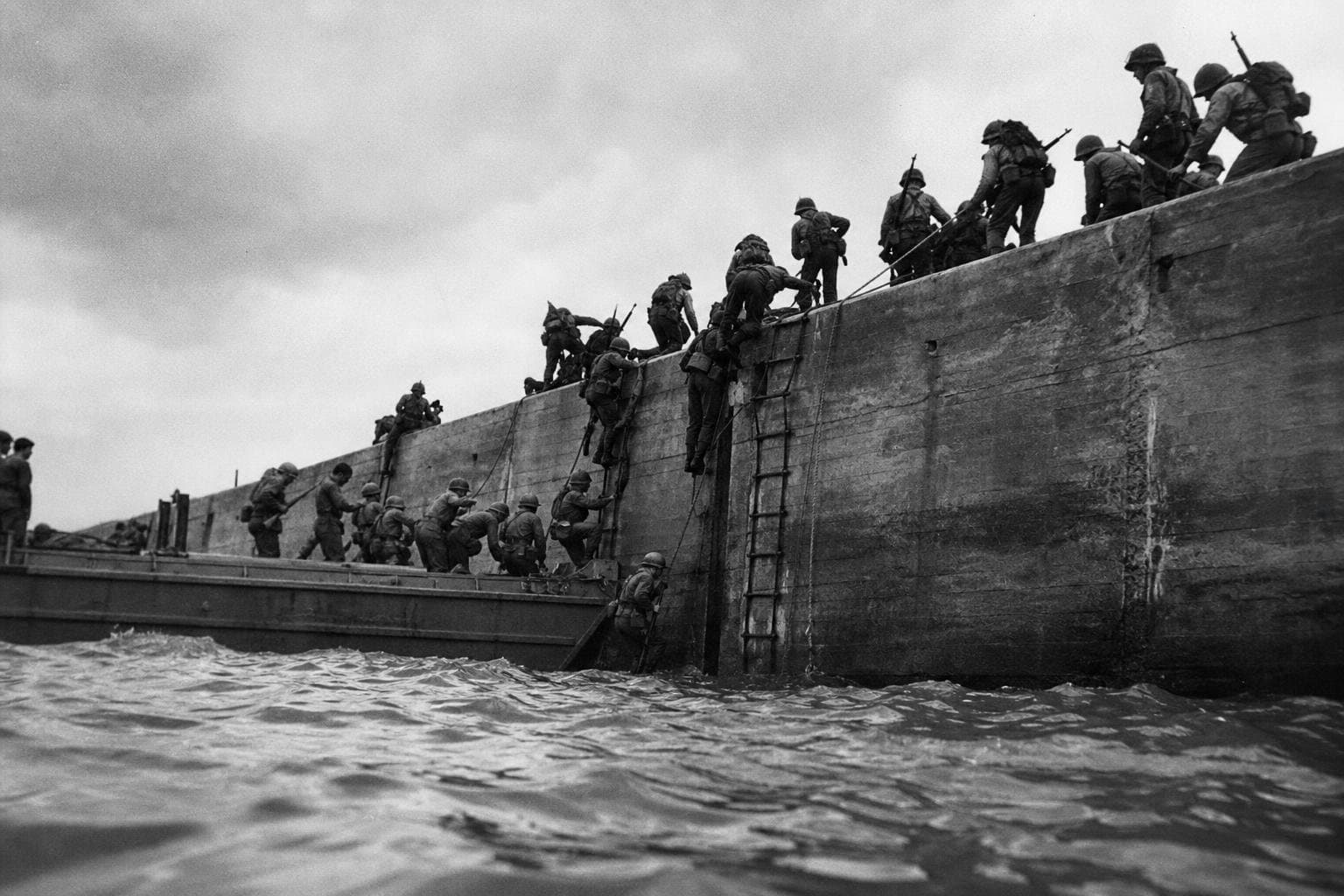

The Joint Chiefs of Staff sent two of their best officers to Tokyo in August 1950 to talk MacArthur out of it. Admiral Forrest Sherman and General J. Lawton Collins arrived with a list of objections so comprehensive it read less like a briefing and more like a professional intervention. The tidal variance at Inchon ran to roughly 10 meters — one of the most extreme in the world, leaving usable beach windows of perhaps six hours in every twenty-four. The approach channel was narrow and easily mined. Wolmi Island sat directly astride the harbor entrance and would have to be taken in a preliminary assault that would eliminate all surprise for the main landing. The port facilities were inadequate for sustaining a major operation. Any competent staff officer running through the checklist would have recommended against it.
MacArthur listened to all of this, then delivered what The Week's tactical analysis of the operation describes as a conviction that the very difficulty of Inchon was its greatest strategic asset: the North Koreans would never expect an attack there precisely because no rational planner would choose it. Sherman and Collins left unconvinced but unable to stop him. The landing went ahead on September 15, 1950. It worked.
What followed from that success is the more interesting story — and the more instructive one.
The Operational Logic Was Sound; the Intelligence Picture Was Thinner Than MacArthur Admitted
Strip away the theater and MacArthur's core operational argument holds up reasonably well. The Korean People's Army had committed the bulk of its strength to the Pusan Perimeter offensive. Britannica's account of the campaign notes that UNC forces had been pushed into a defensive line roughly following the Nakdong River, with reinforcements and supplies barely keeping pace with attrition. An amphibious landing at Inchon, cutting the KPA's main supply corridor through Seoul, would force a choice between continuing the Pusan offensive with severed logistics or turning to deal with a threat in their rear — a classic operational dilemma with no clean solution.
The 1st Marine Division and the Army's 7th Infantry Division were designated as X Corps under Major General Edward M. Almond, MacArthur's own chief of staff — a command appointment that would generate its own problems later. The preliminary naval bombardment on September 14 targeted Wolmi Island. According to a contemporary account of the landing's execution, the 3rd Battalion, 5th Marines landed on "Green Beach" and captured Wolmi-do in a matter of hours, with the 5th Regiment Marines following at "Red Beach" that evening and the 1st Marines landing simultaneously at "Blue Beach" — the first amphibious assault of that scale since Okinawa in 1945. The 1st Marine Division entered Seoul on September 25, and the 7th Division linked up with the Eighth Army at Suwon on the 26th.
What MacArthur did not advertise was how much the operation depended on intelligence gathered under conditions that were themselves improvised and hazardous. A blog account drawing on the memoir of Lieutenant Eugene Clark — published at Rest in the Vine — describes Clark being summoned to MacArthur's Tokyo headquarters in late August and tasked with obtaining "timely and accurate information on everything in and around" Inchon. Clark's account, as reproduced there, is a memoir source with all the attendant caveats: it is one participant's retrospective narrative, not a staff record. But the episode it describes — a small reconnaissance team operating covertly near the landing site in the weeks before D-Day — points to a genuine gap in the pre-operation intelligence picture that MacArthur's confident public posture tended to obscure. The operation was not as fully prepared as the postwar legend suggests. It succeeded in part because the KPA garrison at Inchon was, in fact, thin — a fact that could not be confirmed with certainty before the landing, only verified by the landing itself.
The KPA Collapse Was Real, but the Numbers Require Precision
After Inchon and the fall of Seoul, the KPA disintegrated as a conventional field force with remarkable speed. Britannica's campaign account puts KPA losses in August and September at 13,000 prisoners and 50,000 casualties — figures attributed to the encyclopedia's editorial synthesis rather than a single primary document, and worth treating as estimates rather than precise counts. The same source notes that approximately 25,000 KPA troops escaped northward as cohesive units, and another 10,000 remained in South Korea as partisans. These numbers matter because the postwar narrative of total KPA destruction shaped MacArthur's subsequent decision-making in ways that proved catastrophic.
The historycollection.com overview of the Korean War — a general-audience synthesis rather than a primary source — frames the broader arc: the war that had begun with approximately 75,000 North Korean troops surging across the 38th parallel on June 25 had, within three months, been reversed so completely that UN forces were approaching the Yalu River. That reversal was real. What it was not was permanent or unconditional, and the speed of the KPA's collapse appears to have convinced MacArthur that the war was essentially over — a conclusion the Chinese People's Volunteer Army would correct in November 1950 with considerable violence.
The Command Structure MacArthur Built Made the Next Disaster Structurally Available
The Inchon-Seoul operation introduced an organizational anomaly that deserves more attention than it typically receives. X Corps, the Inchon landing force, was not placed under General Walton Walker's Eighth Army — the theater's main ground command — but instead reported directly to MacArthur's Far East Command in Tokyo. The Library of the Marine Corps battle study guide for Operation Chromite treats the operation as a distinct command-and-control case study, a recognition that the organizational architecture of Inchon was as significant as its tactical execution. Almond's dual role as both X Corps commander and MacArthur's chief of staff concentrated authority in a way that made independent operational assessment difficult.
This mattered less at Inchon, where the operation was discrete and the objectives clear. It mattered enormously when X Corps was subsequently landed at Wonsan on the east coast for the drive toward the Yalu, operating in a separate command channel from the Eighth Army advancing up the west coast. The two forces were separated by the Taebaek mountain range with limited lateral communication and no unified ground command between them. When the Chinese intervention came in late October and November 1950, the absence of a single coordinating headquarters meant that neither Walker nor Almond had a complete picture of what was happening to the other, and MacArthur in Tokyo was receiving information filtered through two separate command chains that had every institutional incentive to report optimistically upward.
This was not an accident of geography. It was a command architecture MacArthur chose, and it reflected the same instinct that had produced Inchon: a preference for bold, centrally controlled operations that bypassed the friction of conventional command hierarchy. At Inchon, that instinct produced a genuine operational success. Applied to the subsequent advance, it produced a command system that made coordinated response to the Chinese intervention structurally difficult — not impossible, but harder than it needed to be.
The issue of what MacArthur knew about Chinese intentions before November 1950 remains genuinely contested among historians. What is less contested is that the command structure he built was poorly suited to processing and acting on ambiguous warning intelligence. An earlier issue of this publication examined how MacArthur constructed institutional conditions that made ignoring the Chinese almost inevitable; Inchon is the origin point of that architecture, the moment when a command style that worked brilliantly in one context got locked in as the template for everything that followed.
What the Victory Actually Proved — and What It Didn't
The standard reading of Inchon is that MacArthur's audacity vindicated itself: he was right, the doubters were wrong, and the operation's success demonstrated the value of bold operational thinking against institutional caution. There is something to this. The Joint Chiefs' objections were not wrong on the tactical merits — the tidal conditions, the narrow channel, the inadequate port facilities were all real problems — but they were weighted too heavily against the operational opportunity. MacArthur correctly identified that the KPA's overextension created a window, and he correctly judged that the window would not stay open indefinitely.
But the lesson Inchon actually taught — if read carefully — is narrower and more conditional than the legend suggests. The operation succeeded because several things happened to be true simultaneously: the KPA garrison at Inchon was thin, the preliminary bombardment suppressed the Wolmi Island defenses sufficiently, the 1st Marine Division executed the assault with professional competence, and the broader KPA command was too committed to the Pusan offensive to respond effectively. Remove any one of those conditions and the operation becomes considerably more costly, possibly catastrophic.
The parallel with other Allied amphibious operations is instructive here. The National WWII Museum's analysis of Operation Torch — the first major U.S. amphibious landing of the Second World War — emphasizes how much that operation's ultimate success depended on factors outside the planners' control, including a negotiated arrangement with Vichy French forces that could easily have gone the other way. Inchon shared that structural feature: the plan was bold, but its margin for error was thin, and several of the variables that determined the outcome were not fully within MacArthur's control.
MacArthur drew from Inchon the lesson that bold operational conceptions overcome tactical obstacles through the force of surprise and audacity. What Inchon actually demonstrated was that bold operational conceptions can work when the enemy is overextended, the intelligence picture is roughly accurate, and the executing force is capable — and that none of those conditions can be assumed in advance. The difference between those two lessons is the difference between a commander who understands what made a specific operation succeed and one who has simply confirmed his prior beliefs.
The Chinese intervention three months later did not refute Inchon. It revealed what Inchon had concealed: that MacArthur's operational confidence had outrun his institutional capacity to process information that contradicted it. The landing at Inchon was a genuine achievement. The question worth sitting with is whether it was the kind of achievement that makes the next disaster more likely — because it teaches the wrong people, including the man who planned it, that they already know how wars work.


