


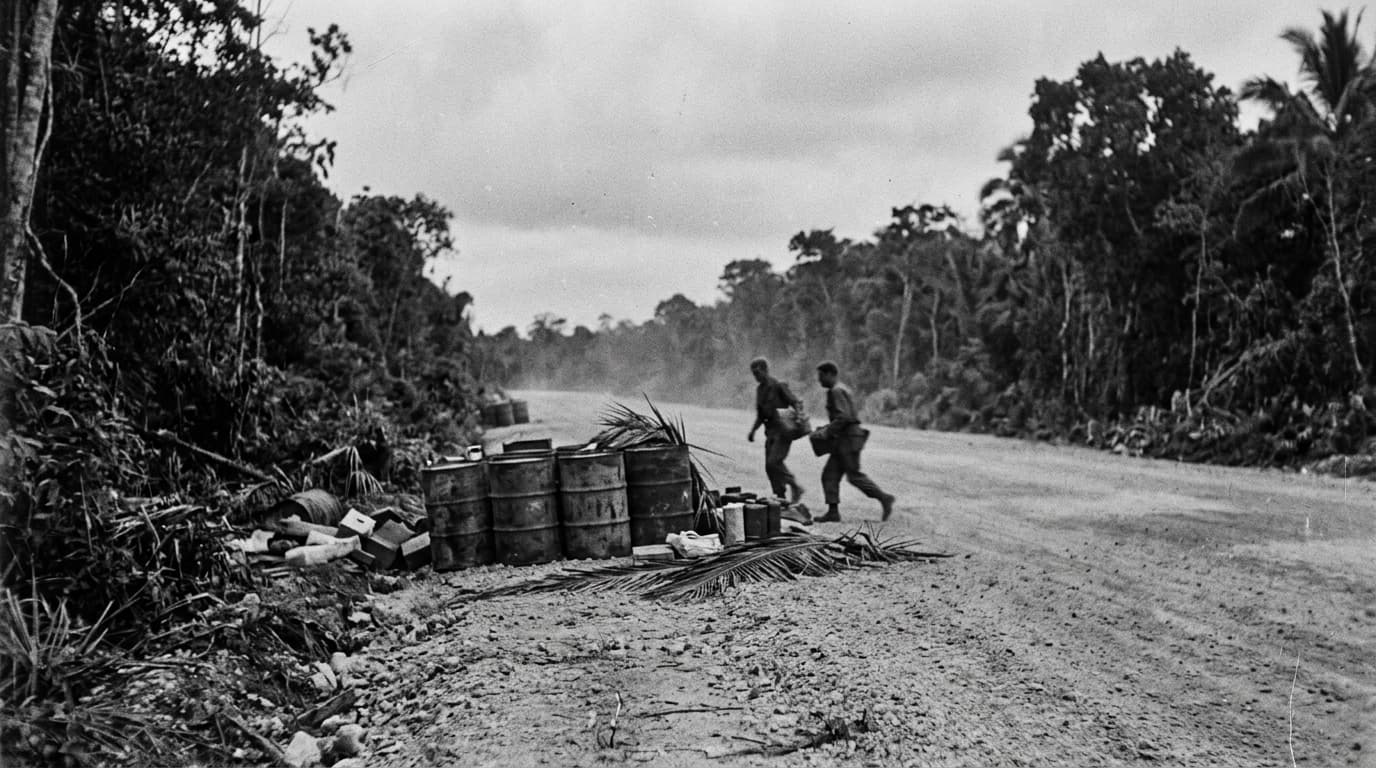

The airfield was the point. Everyone understood that. The Japanese built it; the Marines seized it in August 1942; both sides bled for six months trying to hold or retake it. What the popular narrative skips is the part that actually determined the outcome: neither side could consistently supply the forces fighting over it, and the Americans lost that race more slowly than the Japanese did.
That asymmetry — not tactical brilliance, not Midway's momentum — is what decided Guadalcanal.
The Americans Arrived Undersupplied and Stayed That Way
Operation Watchtower was assembled in weeks, on a shoestring, against the objections of commanders who thought it premature. The Library of the Marine Corps battle study catalogs the operational record under its alternate nickname — "Operation Shoestring" — which tells you what the planners thought of their own logistics picture.
The Marines landed on August 7, 1942. Two days later, the naval disaster at Savo Island — three U.S. cruisers sunk, an Australian cruiser crippled — sent the transport fleet withdrawing before it had finished offloading. The 1st Marine Division was left on a contested island with partial supplies, no naval cover, and an airfield they'd seized but couldn't yet fly from. They dug in and started rationing.
What followed was less a campaign than a sustained logistics emergency on both sides.
The Tokyo Express Was a Symptom, Not a Solution
The Japanese response — destroyer runs down the Slot at night, too fast for air interdiction — became famous as the "Tokyo Express." Britannica's account notes that these destroyer squadrons ferried troops and supplies throughout the battle. What the legend obscures is how inadequate the method was for the scale of force Japan was trying to sustain.
Destroyers optimized for speed carry far less cargo than transports. The Japanese were running men and ammunition in, but not enough food, not enough heavy equipment, not enough medical supplies. Their ground forces on Guadalcanal were progressively starving. The October offensive — the major Japanese push to retake Henderson Field — was launched by troops who were already malnourished and operating without adequate artillery support, in part because the logistics chain couldn't move heavy weapons efficiently enough.
I'd argue this is the structural fact the Midway narrative crowds out: Japan's defeat at Guadalcanal wasn't primarily a consequence of losing four carriers in June. It was a consequence of being unable to solve a supply problem across six months of trying. The carrier losses mattered — they constrained Japanese air cover for the supply runs — but the logistics failure had its own independent weight.
Henderson Field as a Supply Node, Not Just a Prize
The Americans had one advantage the Japanese couldn't replicate: once Henderson Field was operational, it became a logistics asset in its own right. Aircraft flying from Henderson could interdict Japanese supply runs during daylight, which forced the Tokyo Express to operate at night, which reduced its efficiency, which worsened Japanese supply shortfalls. The airfield was simultaneously the objective and the tool that made the objective defensible.
That feedback loop — hold the field, use the field to degrade enemy supply, enemy supply failure weakens enemy attacks on the field — is the actual mechanism of the American victory. It's a logistics story wearing a combat story's clothes.
The parallel to other supply-war failures is instructive. Military Machine's survey of consequential logistics collapses (published April 21, 2026) places the Stalingrad airlift in the same analytical category: a force that needed roughly 700 tons of supplies daily receiving a fraction of that, with predictable results. Guadalcanal's Japanese garrison faced a slower version of the same arithmetic.
What the Historiography Tends to Flatten
The Midway-as-turning-point framing isn't wrong — it's incomplete. Midway ended Japanese offensive initiative in the Central Pacific. Guadalcanal ended Japanese offensive initiative in the South Pacific, and it did so through attrition that was fundamentally logistical. The two campaigns are causally linked but analytically distinct.
The contested question in the secondary literature is how much the Savo Island disaster actually mattered in the long run — whether the early supply shortfall was decisive or whether American industrial capacity would have overwhelmed the Japanese position regardless. That debate remains open. What isn't contested is that the Marines spent the first weeks of the campaign on short rations, and the Japanese spent the last weeks of it on shorter ones.
Watch the archival record on Japanese ground force strength assessments from late 1942 — declassified operational documents from that period show the gap between Japanese troop numbers on paper and effective combat strength. That gap is the supply war made visible.