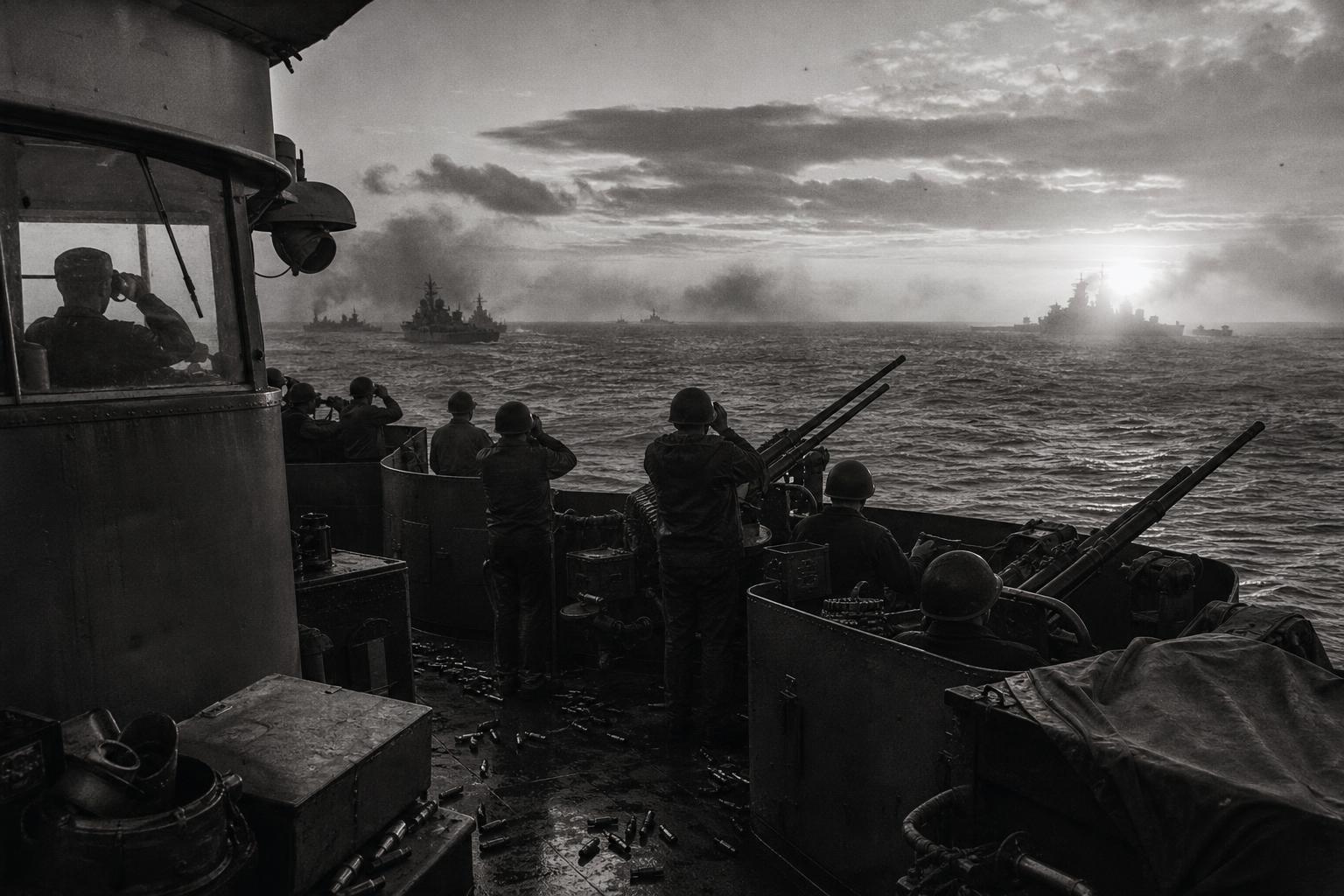

At dawn on 25 October 1944, six American escort carriers, three destroyers, and four destroyer escorts off Samar looked up and saw four Japanese battleships, six heavy cruisers, two light cruisers, and eleven destroyers closing on them out of San Bernardino Strait — a strait that was supposed to be covered by the most powerful fleet in the Pacific (laserdefenselab.com). That fleet, Admiral William Halsey's Third Fleet, was two hundred miles north, hunting a Japanese carrier force it had every reason to believe was the main event.
The popular version of this story casts Halsey as the man who took the bait — vain, aggressive, and tricked by a decoy he should have seen through. The documentary record is less satisfying and more interesting. It shows a commander working from a fragmented command structure, a genuinely successful enemy deception, and a piece of ambiguous signal traffic that historians still argue about eighty-two years later. None of that excuses what happened off Samar. But the "Halsey was fooled" narrative skips past the structural problem that made the fooling possible in the first place.
Two Fleets, Two Bosses, No Switchboard Between Them
The command arrangement at Leyte Gulf is the least cinematic part of the battle and arguably the most consequential. Halsey's Third Fleet answered to Admiral Chester Nimitz. Vice Admiral Thomas Kinkaid's Seventh Fleet, covering MacArthur's landing force, answered to MacArthur. The two fleets operated in the same waters during the same battle under entirely separate chains of command, with no single admiral empowered to direct both (laserdefenselab.com). This wasn't an oversight born of the battle's chaos — it was how the Pacific War had been organized from mid-1944, when MacArthur's southern push and Nimitz's central Pacific drive converged on the Philippines as two separate axes of advance that had never been fully merged into one unified theater command (en.wikipedia.org)).
That split meant Kinkaid and Halsey each had a partial picture of the battlespace and had to infer the other's intentions rather than receive orders from a common source. When Halsey turned his fast carriers and battleships north to chase Ozawa, Kinkaid assumed — reasonably, given radio discipline and the layout of the fleets — that someone had left a covering force at San Bernardino Strait. Nobody had made that explicit. The command architecture had no mechanism to force the question to a resolution before it mattered.
The Decoy Worked Exactly as Its Own Commander Intended
Here the record is unusually clean, because the man who ran the decoy told American interrogators exactly what he'd been trying to do. Vice Admiral Jisaburo Ozawa's carrier force sailed south in October 1944 not to fight and win but to be found and destroyed — a sacrifice play meant to pull the American carriers away from San Bernardino Strait so Kurita's battleship force could reach the landing beaches unmolested. Ozawa said so directly to the United States Strategic Bombing Survey in Tokyo a year after the battle: "The main mission was all sacrifice" (actionreporthistory.com).
This is worth pausing on, because it's a memoir-adjacent source with an obvious limitation: Ozawa is describing his own intentions after the fact, to his former enemies, with the benefit of knowing how the battle turned out. His account of the plan's design is corroborated by the operational facts — he kept radio silence until the 22nd or 23rd, then broke it specifically to draw attention, and he committed barely half his normal air complement because roughly 150 planes had already been stripped from his carriers and sent to Formosa on Admiral Toyoda's orders (actionreporthistory.com). That stripping-down is a hard fact, independent of Ozawa's postwar framing, and it confirms his force genuinely wasn't built to win a carrier battle. What's contested, or at least untestable, is exactly how much Ozawa personally believed in the plan's odds — he told interrogators he gave it a 50-50 chance of working and "hadn't much confidence," which is the kind of thing a defeated admiral might say either because it was true or because it reads better in hindsight.
What isn't in doubt is that the plan worked on Halsey. Third Fleet's own action reports show American search planes found Ozawa's force on the afternoon of 24 October, and by the next morning carrier strikes were underway against it in what the Navy's own photograph archive calls the Battle off Cape Engaño (actionreporthistory.com).
What Halsey Knew When He Turned North
This is where hindsight does the most damage to clear thinking, so it's worth reconstructing the sequence as it would have looked from Halsey's bridge rather than from a historian's desk. The day before, on 23–24 October, American submarines and carrier aircraft had savaged Kurita's Center Force in the Sibuyan Sea, sinking the battleship Musashi and damaging the heavy cruiser Myoko badly enough to force it out of the fight, while the submarine Darter had already sunk Kurita's flagship Atago in the opening torpedo attack off Palawan (edgepedia.org). Kurita's force turned away west after the air attacks — and then, less visibly to American eyes, resumed its eastward course toward San Bernardino Strait (edgepedia.org). Halsey had watched Kurita retreat. He had not watched him turn back around.
Against that backdrop, a fresh carrier force appearing to the north looked like the real main body — the decisive target a carrier admiral had spent two years of war being trained to pursue. Halsey's own reputation, built on the aggressive Marshall and Gilbert Islands raids of early 1942 and his conviction that "hesitation killed more men than audacity," predisposed him toward exactly this read of the situation (militarychronicles.com). That's a reasonable account of his instincts, not an excuse for the outcome — but it matters for judging the decision that he had genuinely plausible information suggesting Kurita was no longer a live threat, not that he carelessly ignored a known danger.
The disputed moment comes later. Third Fleet records show the force had already drawn three carrier task groups and six battleships north before, at 1115 on 25 October, the battleships turned back — while, in Halsey's own words, Task Force 34 was "within 42 miles of the crippled Northern Force," close enough that it never brought Ozawa's ships under gunfire (actionreporthistory.com). Historians still disagree about how much that recall owed to a garbled or ambiguously worded message from Nimitz versus Halsey's own reassessment once Kinkaid's distress calls from Samar reached him. The primary sources settle the timeline and the distance; they don't settle the internal decision-making that produced the turn.
The Bill Came Due at Samar
While Halsey's battleships steamed north and then wheeled back south, Kinkaid's "weakest units" — the six escort carriers, three destroyers, and four destroyer escorts of Taffy 3 — were the only thing standing between Kurita's battle line and the landing force in Leyte Gulf (laserdefenselab.com). The cost of that gap wasn't limited to Samar. The day before, off Sibuyan, Japanese air attacks had already destroyed the light carrier USS Princeton and killed 233 men aboard the light cruiser Birmingham when Princeton's secondary explosions tore through the ship alongside her (edgepedia.org). On the Japanese side, the Imperial Navy's losses across the full battle ran, by Britannica's accounting, to three battleships, one large carrier, three light carriers, six heavy cruisers, four light cruisers, and eleven destroyers — a tally that left the Combined Fleet effectively finished as an offensive force for the rest of the war (britannica.com).
The Lesson Isn't About One Admiral's Judgment
It's tempting to resolve Leyte Gulf into a morality tale about Halsey's ego, and there's no shortage of postwar writing that does exactly that. The documented record supports a narrower and less flattering conclusion about the system rather than the man: a theater split between two independent chains of command, run by officers reporting to different four-star bosses an ocean apart, created a seam that a well-designed Japanese decoy found and exploited almost by instinct. Halsey made a defensible read of incomplete information inside a command structure that gave him no obligation to confirm his assumptions with the officer whose landing force depended on them. Ozawa's sacrifice played the role he designed it for. The men on Taffy 3's flight decks paid for the gap between two fleets that were never, in any formal sense, one navy that morning.


