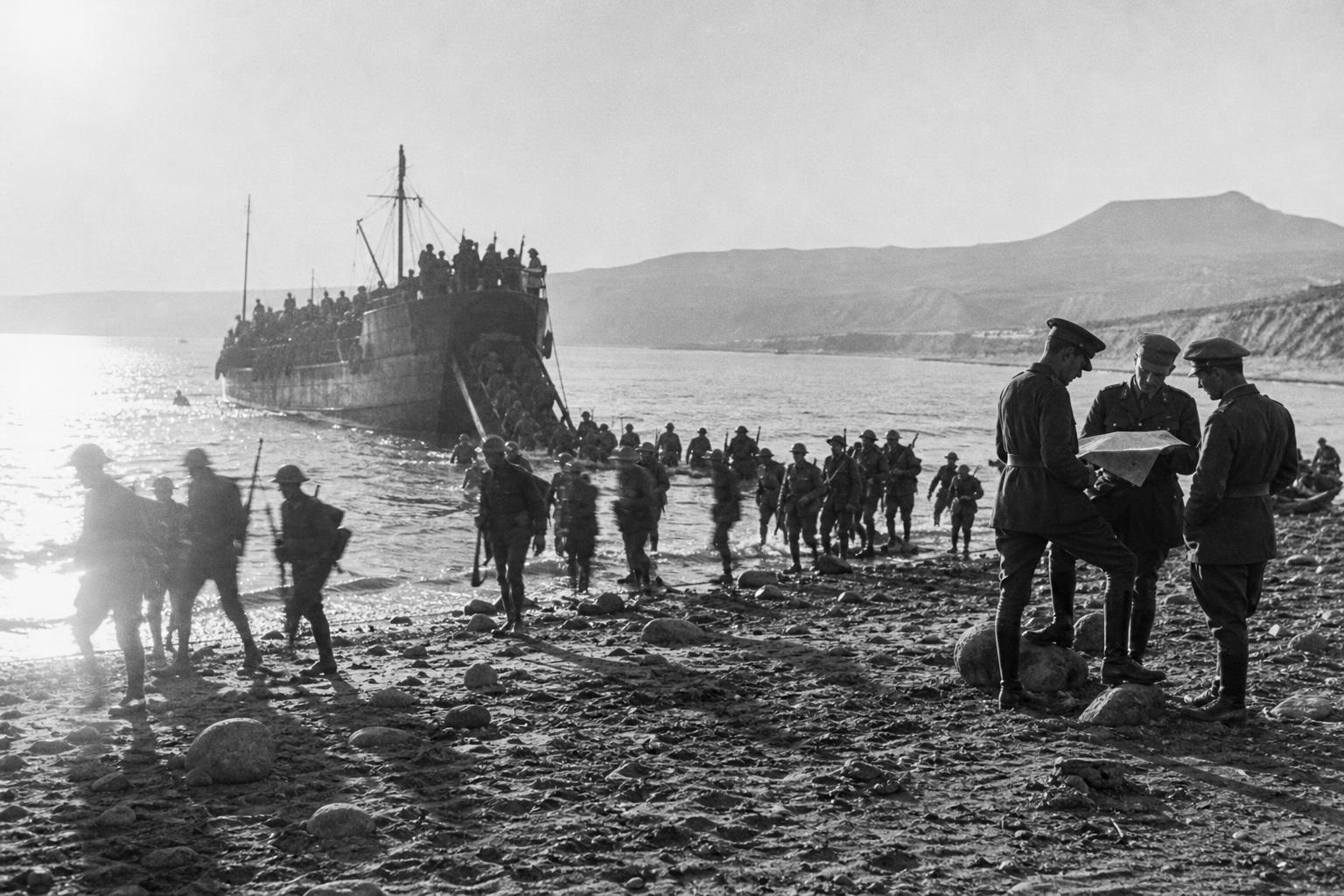

On the night of 8 August 1915, New Zealand, British and Gurkha troops stood on the summit of Chunuk Bair, looking down at the Dardanelles — the one position from which the entire campaign's strategic prize was visible. A few miles north, at Suvla Bay, a freshly landed British corps sat on a dry salt lake and advanced, in the words of one detailed reconstruction of the week, "hesitantly," while its commander stayed aboard his command ship and declined to press his divisional officers forward (ICWWM). Those two facts, sitting a few miles and a few hours apart, are the whole campaign in miniature. Gallipoli is remembered as a story about bad terrain, Turkish resilience, and a doomed concept. It deserves at least as much scrutiny as a story about what happens when an amphibious operation has no single hand on the wheel.
A Naval Plan That Became a Land War by Accident
The campaign did not start as a landing operation at all. The initial scheme, pushed through the British Admiralty under Winston Churchill, was a purely naval attempt to force the Dardanelles with a fleet bombardment and minesweeping, aiming to knock Constantinople — and Ottoman Turkey — out of the war without committing troops (Indian Naval Despatch Foundation). That February–March 1915 naval attempt ran into mines, mobile howitzers, and fixed shore batteries working in combination, lost three battleships, and was called off. Only after the surprise of a purely naval solution was gone did planning shift to a land invasion of the Gallipoli peninsula to seize the high ground above the Narrows — meaning the amphibious assault that followed was conceived as a fallback to a failed plan, launched against defenses that now knew exactly where the threat was coming from (Charles Ellingworth).
This sequencing matters for how we judge the generals who came after. Sir Ian Hamilton did not design an amphibious assault from first principles against an undefended coast. He inherited a compromised, telegraphed operation against a peninsula the enemy had months to fortify, with troops — Australian and New Zealand units among them — who were redirected to the task largely because they happened to be staging through Alexandria en route to the Western Front rather than because they were purpose-built for it (Ellingworth). None of that excuses what followed. It does mean the campaign's failure cannot be laid entirely at the feet of command decisions made after 25 April; some of the structural damage was done at the drawing-board stage, before a single boat launched.
Suvla Bay Shows What Fragmented Command Actually Looks Like
The August offensive, intended to break the stalemate that had calcified since the April landings, is the clearest test case for command fragmentation as an operational cause of failure rather than a narrative flourish. Hamilton's plan had three moving parts: diversionary attacks at Helles and Lone Pine, a night breakout from Anzac Cove toward the Sari Bair ridge, and a fresh corps landing at Suvla Bay under Lieutenant General Sir Frederick Stopford, tasked with taking the surrounding hills and linking up with the Anzac force (ICWWM). Three separate axes, three separate commanders, operating on a timetable that depended on all of them moving fast and in coordination against an enemy with a unified chain of command.
The Ottoman side did not have that problem. When the German general Otto Liman von Sanders judged his local commander too slow in responding to the New Zealand foothold on Chunuk Bair, he gave a 34-year-old lieutenant colonel, Mustafa Kemal, command of roughly six divisions across the entire Anafartalar sector in a single stroke (ICWWM). One commander, one sector, one decision. The Allied side could not match that kind of consolidation because its forces at Anzac, Helles, and Suvla answered to different corps structures that Hamilton's headquarters was meant to synchronize from a distance — and distance, in this campaign, consistently meant delay.
Stopford's conduct at Suvla is the sharper individual case, and a recent close reading of Hamilton's diary makes a specific and troubling point about it: before the 54th Division had even been tested in combat, Stopford had already written to Hamilton describing it in terms borrowed wholesale from the 53rd Division's earlier, disappointing performance — "a lack of attacking spirit" — and proposed putting the 54th into trenches rather than using it for the planned attack (Jack Burgoyne). This is worth sitting with, because it is not a case of a commander misreading intelligence about the enemy. It is a commander pre-judging his own troops' willingness to fight based on a different unit's record, and shaping their employment around that assumption before they had a chance to prove or disprove it. Hamilton pushed back, objecting that the 54th was being discounted on insufficient evidence, and Stopford did subsequently agree to attempt an advance on Kavak Tepe — so the judgment was contested and partially revised, not simply imposed (Burgoyne). But the fact that it needed contesting at all, in the middle of the one week that decided the campaign, is itself the finding. A reader should treat this account as a close analytical reading of Hamilton's diary — a single, interpretive source — rather than a settled verdict on Stopford's character; it describes a specific documented exchange, not a comprehensive judgment of his generalship.
Was Failure Actually Inevitable? Historians Don't Agree
The popular shorthand for Gallipoli — distraction from the real war, romantic folly by Churchill, execution botched by "donkey generals" — is contested rather than settled among people who have studied the campaign closely. One retrospective argument holds that the strategic logic of forcing the Dardanelles was sound, even urgent, given that Turkey's entry into the war had cut off Russia's only ice-free supply route to its allies, and that a committed push during the original naval attempt's weather window "could have carried the day" at a fraction of the cost later paid on land (Ellingworth). That is one writer's counterfactual judgment, not a documented certainty, and it should be read as such. Academic treatment of the campaign in Jenny Macleod's volume for Oxford's Great Battles series takes a different and more cautious framing, presenting Gallipoli not as a single verdict but as a story that has meant "different things to different people" — an inspirational founding myth in Turkey, a glorious failure in British and Anzac memory, a story quietly abandoned in Ireland — precisely because no single causal account of the defeat has achieved consensus (Jenny Macleod, Oxford University Press).
What is not contested is the geography that made the landing itself a matter of chance as much as planning: the beach at Anzac Cove, where the ground rises steeply almost from the waterline, gave the defenders an advantage that a landing a mile in either direction would not have granted (Ellingworth). Terrain and contingency did real work in this campaign. So did command structure. The two explanations are not competitors; they are both true at once, and reducing Gallipoli to either "the ground was impossible" or "the generals were fools" flattens an operation that failed for layered, compounding reasons.
The Casualty Count Is a Lesson in Itself
Even the campaign's cost resists a clean number, and that is worth stating plainly rather than picking whichever figure sounds most dramatic. The Australian government's official account, drawing on Charles Bean's official history alongside later academic work, puts Ottoman dead or died-of-disease at 66,000 to 86,692, British and Indian forces at 22,613 to 27,736, and Australian dead at 7,594 to 8,709, explicitly noting that "sources differ in their definition of a casualty" and that most Turkish figures in particular are estimates (Anzac Portal, DVA). A separate regional memorial account gives a different total — some 490,000 Allied personnel engaged, more than 250,000 Allied casualties including 56,000 dead, and a comparable Turkish toll of roughly 250,000 casualties with 65,000 to 87,000 killed (ww1hull.com). The ranges overlap but do not match, and neither source claims precision the underlying records don't support. That is not a failure of research; it is what happens when wartime record-keeping, disease deaths, and contested methodologies collide a century later. Treat any single Gallipoli casualty figure you encounter as an estimate tied to a specific counting method, not a fact.
What to Watch For
Gallipoli's institutional afterlife is still being argued over rather than closed. The campaign's role in shaping Turkish national identity around Mustafa Kemal, and separately around Anzac Day commemoration in Australia and New Zealand, continues to generate fresh scholarly and popular reassessment each anniversary cycle — watch for how the 2027 Anzac Day commemorations and any accompanying archival releases frame the Suvla command failures specifically, since that is the thread historians have been least willing to resolve into a single verdict. The deeper lesson for anyone studying amphibious operations isn't that Gallipoli was destined to fail. It's that a plan split across naval and land command, then split again across three uncoordinated beachheads, built its own friction into the operation before the Ottoman defenders fired a shot in anger.


