


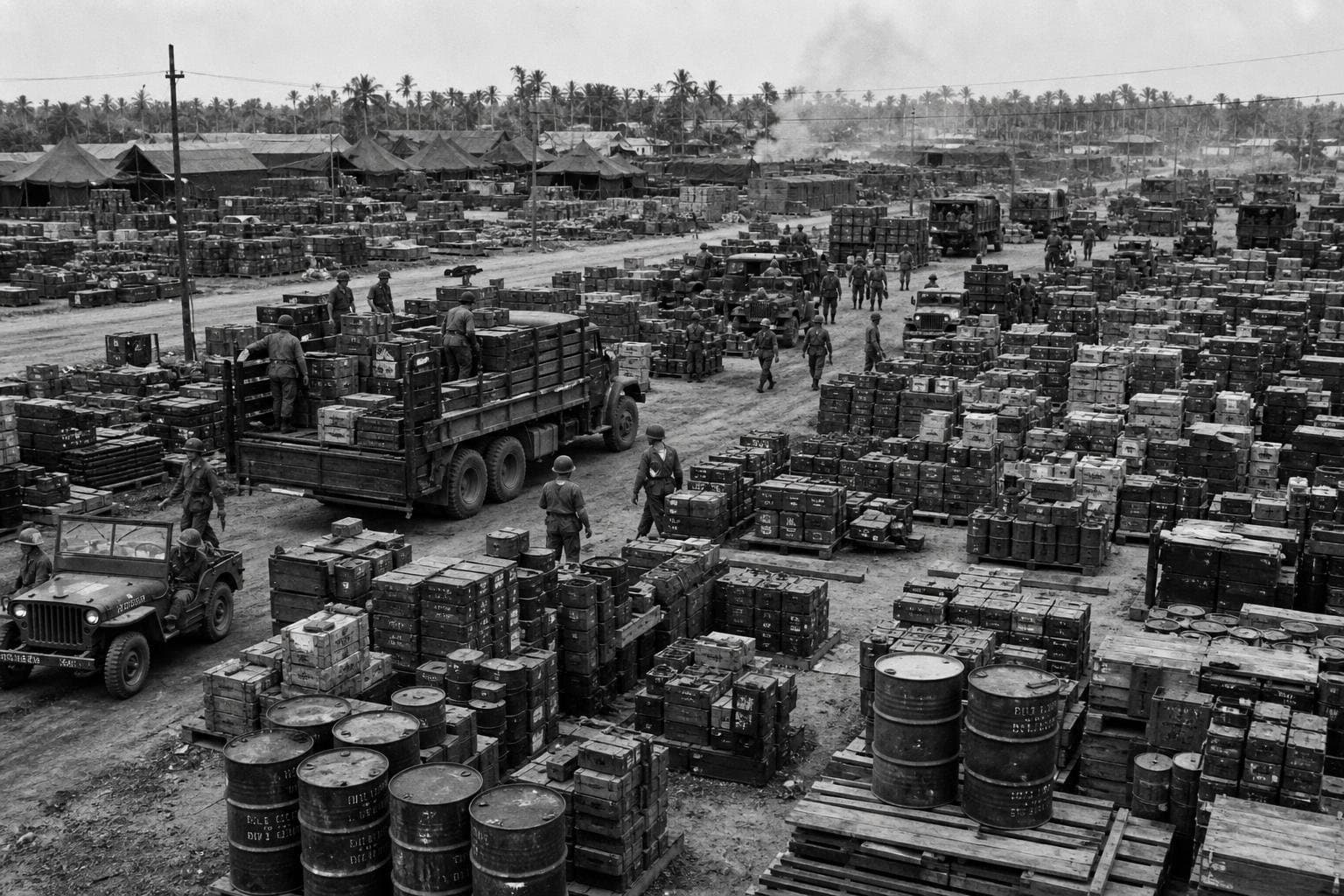

The same lesson keeps getting rediscovered. Armies plan for the battle; they forget to plan for the supply chain that makes the battle possible. A new doctoral thesis on Red Army rear-area operations, a reassessment of Sherman's marches, and a detailed study of the Falklands campaign all landed in the past few weeks — and all three circle the same structural problem from different angles.
Here's what the recent scholarship is actually saying.
1. The Red Army's logistics system was improvised under fire — and that's what made it work
A doctoral thesis recently deposited at the University of East Anglia argues that the Soviet Main Directorate of the Rear — the institutional backbone of Red Army supply from August 1941 to May 1945 — was not a pre-war creation. It was built during the German invasion, drawing on Tsarist precedent and evolving through 1942–43. The thesis contends this improvised system may have been the single most important factor enabling the USSR to conduct continuous, front-wide operations at scale. The counterintuitive implication: doctrinal flexibility under crisis produced a more functional logistics architecture than peacetime planning had.
2. Sherman's "modern" logistics were actually early modern — and the distinction matters
A recent analytical paper argues that Sherman's March to the Sea has been systematically misread. The foraging-column method — dispersed units living off the land, systematic requisition, deliberate devastation for political coercion — was standard European practice between roughly 1550 and 1810. What was genuinely new was the articulation point: Sherman's archaic operational method terminated at a modern industrial supply base (the ocean at Savannah, the rail net at Goldsboro). Strip that terminus away, and the method fails. The paper cites Bentonville, March 1865, as the proof case: when the enabling conditions broke down, Sherman reverted immediately to conventional supply. The lesson isn't that foraging is innovative; it's that the handoff between operational method and strategic base is where campaigns are actually won or lost.
3. The Falklands supply chain was more precarious than the victory narrative suggests
A detailed reassessment of Privratsky's logistics study makes the case that British victory in 1982 was operationally improbable in ways the standard account obscures. The strategic supply line ran 4,300 miles from Portsmouth to Ascension Island — a staging point with one jetty capable of handling one or two small commercial ships — then a further 3,600 miles to a logistics loitering area outside Argentine air range. The British didn't have a logistics system designed for this; they assembled one. The analysis frames this as a case study in expeditionary improvisation under constraint, not a demonstration of institutional competence.
4. Russia's slow advance in Ukraine has a century of operational theory behind it
A recent analysis tracing Russian operational thought from Svechin to Gerasimov argues that territorial speed was never the primary metric for the Russian General Staff. The intellectual tradition running through Tukhachevsky, Triandafillov, and Ogarkov prioritizes the progressive destruction of the enemy's operational system over rapid seizure of ground. The piece notes that prior to the fall of Pokrovsk and Konstantynivka, CSIS reported Russian advances of roughly seventy and fifty meters per day respectively — figures that look like failure against WWII benchmarks but may reflect deliberate operational logic. Whether that logic is actually being executed competently is a separate question the analysis leaves open.
5. The US Army's current readiness gaps echo structural problems, not just equipment gaps
A Parameters summer 2026 article by Richard D. Hooker Jr. argues the Army remains optimized for counterinsurgency at the expense of high-intensity ground combat. The specific gaps named: field artillery, electronic warfare, and short-range air defense. The argument is structural — bloated staffs and personnel policies — rather than purely technological. This is contested ground within Army doctrine circles, but the framing connects directly to the logistics and force-structure questions the other scholarship raises.
The thread connecting all five: the gap between what an institution plans for and what it actually needs to sustain. That gap tends to close under fire, at enormous cost