


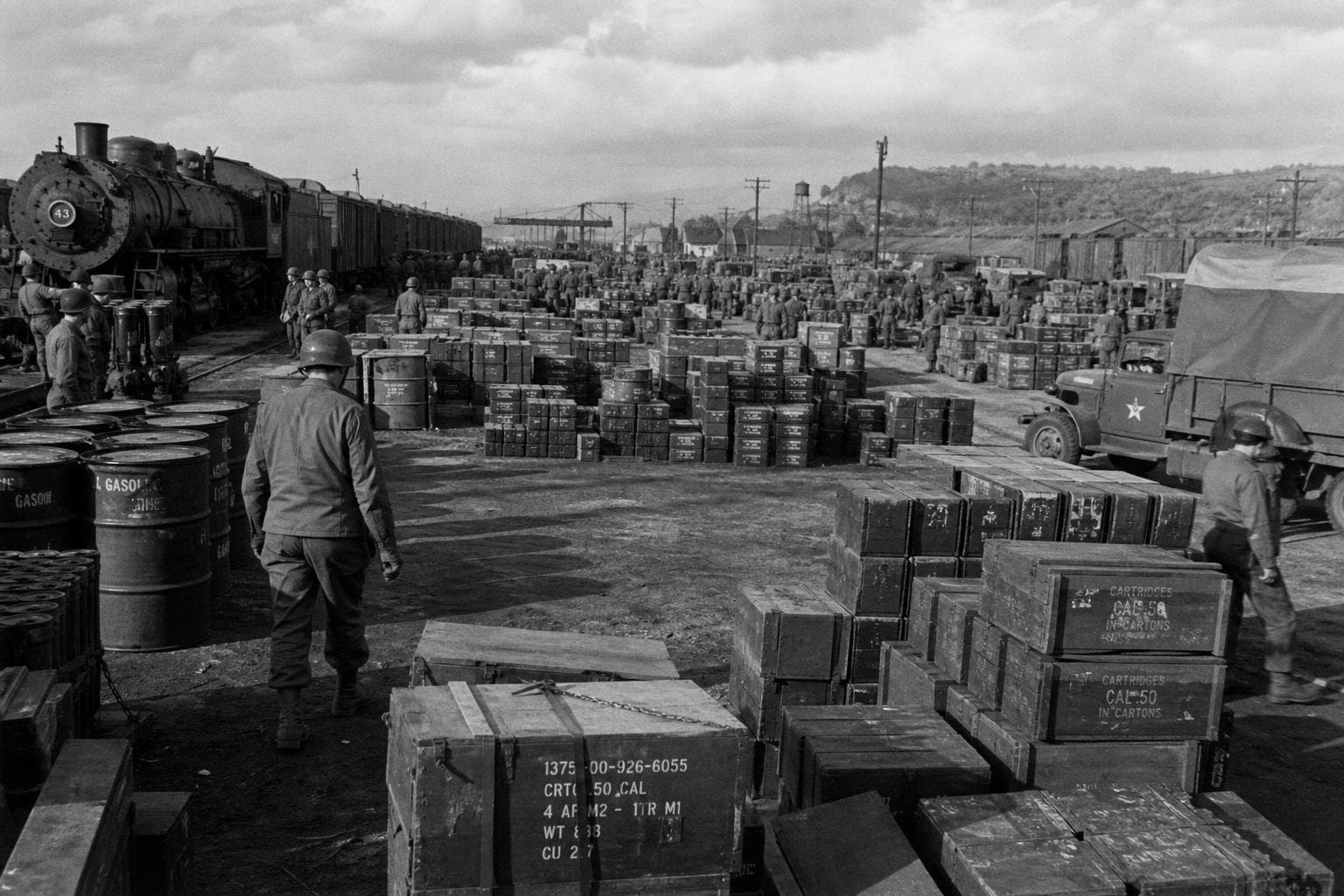

The standard military history narrative treats logistics as the unglamorous backstory to the "real" campaign. The sources that have crossed my desk recently suggest the opposite: in most of the cases historians keep revisiting, the operational outcome was already determined by the supply system before the first engagement.
Here are five patterns — drawn from recent scholarship — where logistics wasn't a supporting factor. It was the deciding one.
1. The Red Army Built Its Rear Logistics During the Invasion, Not Before
The most counterintuitive finding in a recent doctoral study of Soviet rear-area logistics from the University of East Anglia is that the Main Directorate of the Rear — the organizational spine of Soviet supply — was only created on 1 August 1941, weeks after Barbarossa began. The method of fighting the war had been theorized in the interwar period; the method of sustaining it was improvised under fire, drawing on Tsarist precedent and evolving through 1942 and 1943. That the Red Army eventually sustained continuous linked operations across the entire Eastern Front width is, on this reading, more remarkable than the operational victories themselves.
The institutional lesson: doctrine and logistics development can be radically decoupled, and armies can survive that gap — but only if they have the industrial base and time to close it.
2. Sherman's "Innovation" Was Actually a Medieval Method Fitted to a Modern Terminus
A recent white paper from Edge Induced Cohesion makes a sharp argument: Sherman's foraging columns were not an invention. Dispersed columns living by requisition, systematic collection under command authority, deliberate devastation for political coercion — all of this was standard European practice from roughly 1550 to 1810. What was genuinely new was the articulation point: both marches terminated where a modern industrial supply system waited (the ocean at Savannah, the rail net at Goldsboro). The archaic method worked because a modern base caught it at the end.
The failure mode is visible at Bentonville, March 1865, where the enabling conditions broke down and Sherman immediately reverted to conventional supply. The "innovation" was load-bearing only when the conditions held.
3. The Falklands: Strategic Logistics So Constrained That Victory Shouldn't Have Been Possible
A recent analysis drawing on MGen Privratsky's study of Falklands logistics lays out the geometry: 4,300 miles from Portsmouth to Ascension Island, then another 3,600 miles to the operational loitering area, through a single jetty capable of handling one or two small commercial ships. The larger supply vessels couldn't approach the combat zone at all — Argentine air range forced them to loiter 200 miles short. The author's conclusion is direct: British victory was more improbable than previously assessed, and the logistics picture was worse than the battlefield accounts convey.
The pattern here is the inverse of the Red Army case: a force with a mature logistics doctrine operating at the absolute edge of its physical reach, where any single failure in the chain would have been unrecoverable.
4. German Logistics Doctrine Made Barbarossa's Collapse Structurally Inevitable
Covered in depth in a prior issue — but the core point bears restating in this context: the Wehrmacht's logistics system was designed for a short war against a proximate enemy. It had no institutional answer to the question of what happens when the enemy doesn't collapse on schedule. The supply tail couldn't reach Moscow not because of bad luck but because the doctrine assumed it would never need to. That's a different kind of failure than the Falklands — not a force operating at the edge of its reach, but a force that never calculated where its reach ended.
5. The U.S. Army Has Been Relearning the Same Lesson Since the Civil War
A July 2026 piece from the U.S. Army Sustainment Command traces the institutional lineage from early supply lines to the modern sustainment enterprise. The through-line is less triumphant than the framing suggests: each major conflict required rebuilding logistics capacity that had atrophied in peacetime. The lesson isn't that American logistics is strong — it's that it keeps having to be rediscovered.
**The Pattern Underneath