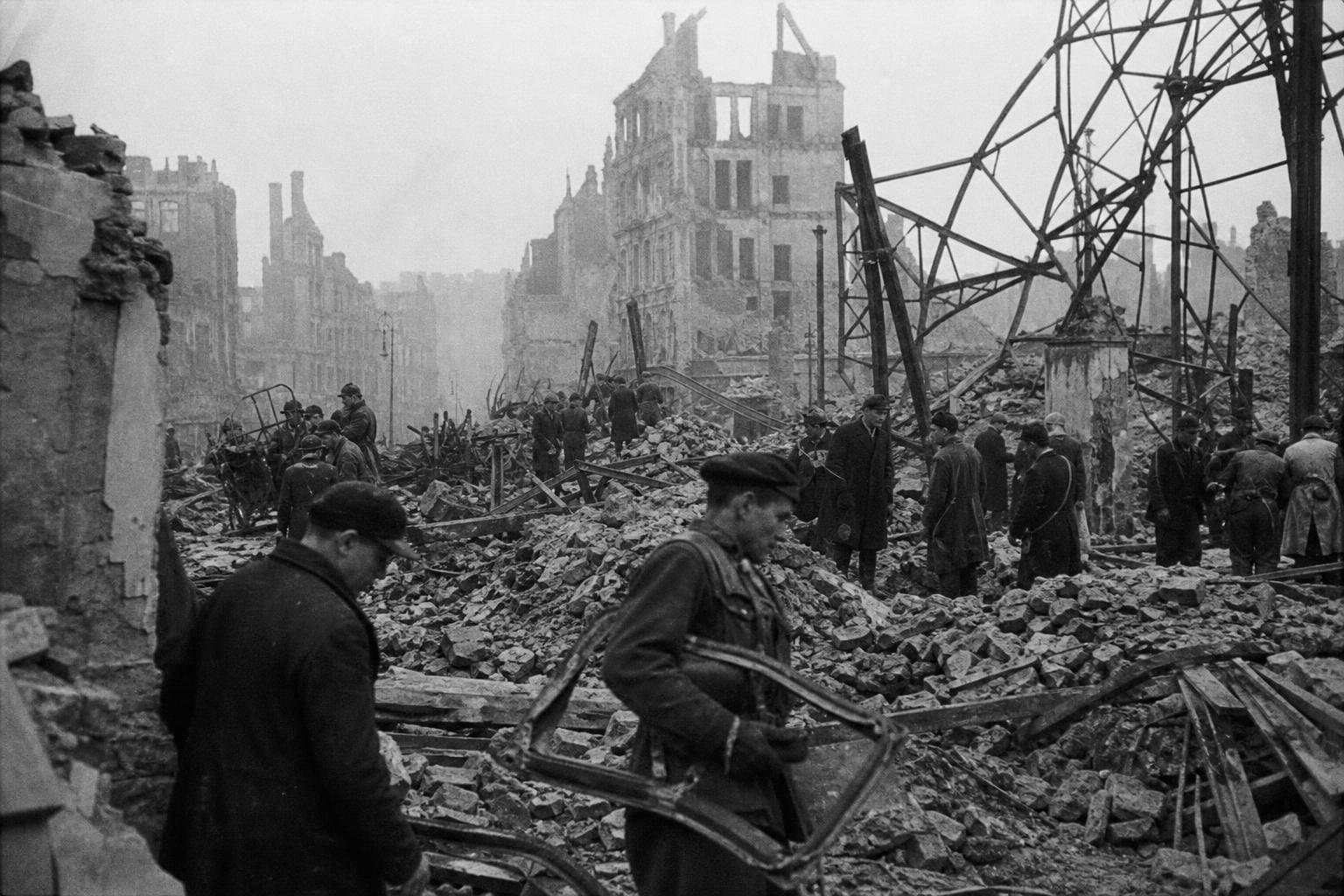

The firestorm that consumed Dresden on the nights of February 13–14, 1945 produced one of the most contested casualty figures in modern military history. Not because the evidence is unusually thin, but because the numbers were almost immediately recruited into arguments that had nothing to do with historical accuracy. Understanding what actually happened at Dresden requires separating the operational record from the propaganda war that followed — and recognizing that both sides of that propaganda war had reasons to lie.
What the Bombing Was and Wasn't
By February 1945, RAF Bomber Command had been conducting area bombing of German cities for years under a doctrine that Britannica's account of strategic bombing describes as aimed at destroying industrial production and undermining civilian morale — a deliberate shift from the earlier pretense of precision targeting. The USAAF nominally preferred daylight precision raids against infrastructure, though in practice the distinction blurred considerably as the war progressed. Dresden was a joint operation: the RAF struck at night on February 13, the Americans followed with daylight raids on February 14.
Dresden had rail yards, military workshops, and was a significant logistics node in a Germany whose eastern front was collapsing. It also had a large refugee population fleeing the Soviet advance. Whether it was a legitimate military target, a war crime, or something in the uncomfortable middle has been argued ever since — but the argument has been consistently muddied by the casualty figures attached to it.
The Numbers Were a Battlefield
The death toll estimates for Dresden have ranged from around 22,000 to over 500,000, depending on who was doing the counting and why. The upper end of that range — figures like 135,000 or 250,000 — originated largely with Nazi propaganda that recognized immediately Dresden could be turned into an Allied atrocity story. That apparatus inflated the numbers and distributed them to neutral countries. After the war, those inflated figures migrated into Western discourse through a combination of genuine confusion, Cold War politics, and revisionist histories that leaned heavily on sources that were either fabricated or unverifiable.
The actual historical record is considerably more constrained. A 2010 commission of German historians, working from Dresden city archives, burial records, and contemporary documentation, concluded that the death toll was most likely between 22,700 and 25,000. This is not a minor revision — it's a reduction by a factor of five to ten from the figures that circulated for decades. The commission's methodology distinguished between confirmed deaths, estimated deaths from incomplete records, and the bodies that were never recovered. That distinction matters enormously: as WarCosts notes in its analysis of WWII casualty accounting, official counts, estimates, and ranges are not interchangeable — conflating them is how a historical event becomes a political weapon.
None of this makes 25,000 deaths less catastrophic. It means the catastrophe should be understood accurately.
The Institutional Logic That Made Dresden Possible
The harder question isn't whether Dresden was justified — it's how the RAF's area bombing doctrine reached the point where a city of that size, in the war's final months, could be targeted without serious institutional resistance.
Strategic bombing theory had promised since the interwar period that air power could break civilian morale and collapse industrial production, potentially winning wars without the grinding attrition of ground combat. By 1945, the evidence that this theory worked was, at best, mixed. As CDR Salamander's analysis of strategic bombing doctrine observes, the fundamental problem throughout the campaign was accuracy — and the standard compensation for inaccuracy was volume. Hundreds of thousands of civilians burned, starved, or crushed under rubble in exchange for railroad junctions and ball-bearing factories whose destruction rarely delivered the promised strategic effect.
German aircraft production had actually increased through much of the bombing campaign — a point The Conservative Historian makes pointedly — and civilian morale, while damaged, had not produced the popular pressure on Nazi leadership that theorists had predicted. The bombing continued anyway, partly from institutional momentum, partly because stopping it would have required admitting the doctrine's limits, and partly because the RAF had built an entire command structure — aircrew, logistics, training pipelines — around area bombing. Organizations don't easily abandon their reason for existing.
Arthur Harris, commanding Bomber Command, believed in the doctrine with a conviction that made him resistant to evidence that complicated it. That's not stupidity — it's a recognizable institutional pathology. The information available to him in early 1945 included genuine uncertainty about how much longer Germany could hold out and genuine belief that continued bombing might accelerate collapse. Hindsight makes the moral calculus look cleaner than it was. What it doesn't excuse is the absence of serious internal challenge to a doctrine whose premises were increasingly questionable.
What the Debate Actually Reveals
Dresden became the focal point for the moral reckoning of strategic bombing not because it was the worst example — the Tokyo firebombing of March 1945) killed far more people, and it receives a fraction of the historical attention — but because it was European, because Germany's postwar rehabilitation made its civilian dead more sympathetic to Western audiences, and because the inflated casualty figures gave critics a number large enough to anchor an argument.
The real lesson of Dresden is institutional: a doctrine adopted under one set of conditions — the Blitz, the need to demonstrate that Britain could strike back, genuine uncertainty about how else to damage German war production — persisted long past the point where its premises held. The question worth asking isn't whether Harris was a war criminal. It's why the command culture that produced area bombing never developed a serious mechanism for asking whether it was working.
That question didn't get answered in 1945. It still hasn't been answered cleanly.


