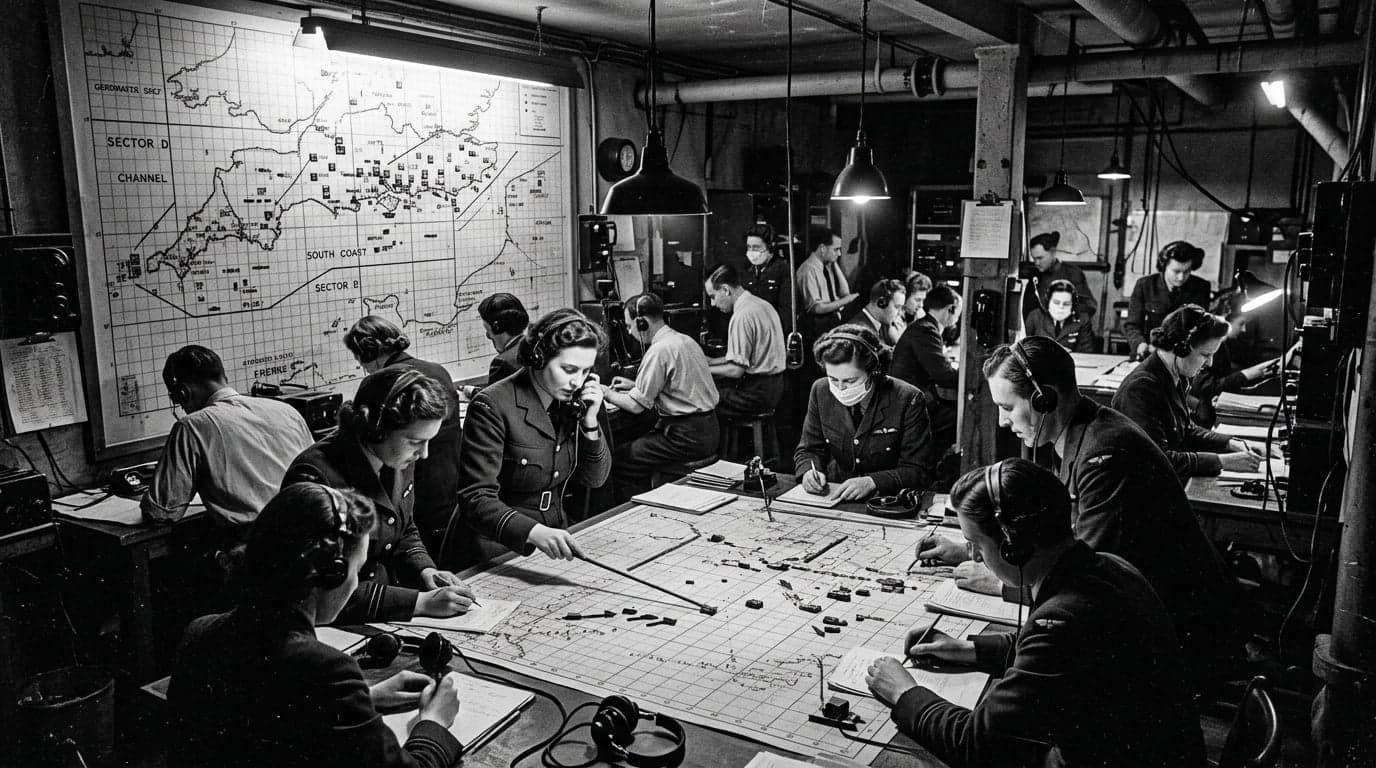

The standard account of the Battle of Britain is essentially a film poster: Spitfires banking over white cliffs, a handful of exhausted young men against the massed might of the Wehrmacht's air arm. It is a story about aircraft and courage, which means it is a story that misses the point almost entirely.
The RAF didn't win in the summer of 1940 because its pilots were braver or its planes were better. It won because one man had spent four years building something the Luftwaffe didn't know existed and couldn't figure out how to destroy once they found it: an integrated air defense system that turned radar returns into scrambled squadrons in under four minutes. The Luftwaffe came to Britain expecting to fight an air force. They found themselves fighting a nervous system.
The Luftwaffe's Actual Problem Was Strategic Incoherence, Not Tactical Failure
Start with what the Germans were trying to accomplish, because the popular account gets this wrong too.
Göring's "Eagle Day" directive of August 2, 1940 called for destroying British air power through a series of massive blows — a few concentrated strikes that would break Fighter Command and open the way for Operation Sea Lion. The theory was sound enough on paper. The execution revealed a command that had never seriously gamed out what "destroying the RAF" actually required.
The Luftwaffe's air war doctrine had been built around concentrated close air support of ground forces. It was a system optimized for the campaign just completed — France, Poland, the Low Countries — where the air battle was a prelude to armored exploitation and the enemy's command structure could be disrupted by speed and shock. Against Britain, there was no ground campaign to support. The Luftwaffe was being asked to fight a strategic air war with a force designed for operational support, and the high command's indecision over which specific aim to pursue produced repeated shifts in targeting strategy: first coastal shipping, then RAF airfields and infrastructure, then aircraft factories, then — fatally — cities.
Each shift reset the attrition clock. Each shift gave Fighter Command a partial reprieve. The decision to begin bombing London in early September 1940 is often described as a blunder, and it was, but the blunder had been baked in from the start. A command that couldn't decide whether it was trying to destroy the RAF's aircraft, its airfields, its pilots, its production capacity, or its civilian morale was never going to achieve any of those objectives systematically.
What the Germans needed was a sustained, methodical campaign against Fighter Command's ground infrastructure — the sector stations, the communications network, the operations rooms. They came closest to achieving something decisive in late August and early September, when attacks on 11 Group's airfields guarding southeast England and the approaches to London were genuinely straining the system. Then they shifted to London. The pressure came off.
What the RAF Was Actually Defending: The System Dowding Built
Here is where the standard account needs the most correction.
Air Chief Marshal Hugh Dowding had been building Fighter Command's defense architecture since 1936. His prewar contributions were arguably more important than his wartime command decisions. As the senior RAF officer for research and development before taking command of Fighter Command, he pushed for modern monoplane fighters and for radar. When he became Fighter Command's first commander, he immediately began constructing what would become the most sophisticated air defense system in the world.
The system worked like this: Chain Home radar stations along the coast detected incoming raids. That information fed into a network of underground control centers and operations rooms, connected by protected telephone cables. Sector controllers used the radar picture — supplemented by the Royal Observer Corps tracking aircraft once they crossed the coast — to vector squadrons toward intercepts. As historian Williamson Murray later assessed, Dowding had built "an effective air defense system that altered the entire context within which air forces operated" — a judgment the blog post quotes directly from Murray's work.
The key insight was what the system accomplished operationally: it allowed Fighter Command to husband its resources. Squadrons didn't have to fly standing patrols waiting to spot incoming raids. They could sit on the ground, conserving aircraft hours and pilot fatigue, and scramble when the radar picture showed a raid forming. Against a numerically superior enemy, this was the difference between a sustainable defense and a war of attrition the RAF would lose.
Chain Home itself had significant physical limitations — the transmitter towers ran to roughly 360 feet, the receiver towers to around 240 feet, and the whole system was fixed, coastal, and dependent on long wavelengths that made it unsuitable for airborne use. It was a landscape-scale installation, not a portable technology. But for its intended purpose — watching the approaches to Britain and buying time for controllers to react — it was exactly sufficient. The Luftwaffe knew the radar towers existed. What they consistently underestimated was how effectively the information was being processed and acted upon.
The Hurricane Did the Work; the Spitfire Got the Poster
The aircraft question is worth addressing directly, because the mythology here has real analytical consequences.
RAF Fighter Command deployed approximately 32 Hurricane squadrons compared to 19 Spitfire squadrons during the battle, though these numbers fluctuated with losses, re-equipment, and unit transfers. The Hurricane was slower than the Spitfire and less glamorous, but it was more numerous, more stable as a gun platform, and easier to repair. The Imperial War Museums estimates that the Hurricane was responsible for more than 60% of German losses during the battle; the Royal Air Force Museum goes further, indicating that Hurricanes destroyed more enemy aircraft than all other British air and ground defenses combined.
A note on those figures: air combat victory statistics from this period should be read as estimates, not precise accounting. Multiple pilots could fire at the same aircraft; German planes that limped back to France before crashing might be claimed by one pilot and not appear in German loss records as a combat casualty. The broad pattern — Hurricanes providing the mass of the defensive effort — is well-supported, but the specific percentages carry methodological uncertainty that the sources themselves acknowledge.
The tactical division of labor that emerged — Hurricanes targeting bomber formations while Spitfires attempted to engage the Messerschmitt Bf 109 escorts — was never as clean in practice as it sounds in retrospect. The chaos of combat, the limitations of radio communication, and the speed of engagements meant that the neat division often broke down. What the division does illustrate is something more important: Fighter Command was trying to manage a system, not just win individual engagements. Destroying bombers before they reached their targets mattered more than scoring kills on fighters. The Luftwaffe's Bf 109s, constrained by fuel range, couldn't loiter over England long enough to force a decisive engagement on their terms.
This fuel constraint was structural and the Germans knew it. The Bf 109's limited endurance over England — roughly 20 minutes of combat time over London — meant that bomber formations were frequently left without escort at the most vulnerable moments. It also meant that Luftwaffe fighter pilots were fighting with one eye on their fuel gauges, which is not a condition that produces aggressive tactical decision-making.
Why the Luftwaffe Couldn't Close the Deal Even When It Was Winning
The closest the Germans came to breaking Fighter Command was the period from late August through early September 1940, when sustained attacks on sector stations in 11 Group's area were degrading the ground infrastructure that made Dowding's system work. Operations rooms were damaged. Telephone lines were cut. Sector controllers were working under direct attack. The system was stressed in ways that radar returns and scramble times don't fully capture.
Even so, the analysis that Fighter Command could have withdrawn to the Midlands, out of German fighter range, and continued the battle from there is worth taking seriously — not as a comfort, but as a structural observation. The Bf 109's range limitation wasn't just a tactical inconvenience; it was a strategic ceiling on what the Luftwaffe could achieve. Destroying 11 Group's airfields in Kent and Surrey would have been a serious blow, but it would not have destroyed Fighter Command. The RAF had depth. The Luftwaffe's reach did not.
The pilot attrition question is more genuinely contested. Strength reports from the period show Fighter Command's serviceable aircraft actually increasing through the summer — Hurricane serviceables went from roughly 282 in early July to 405 in early September, reflecting both production increases and repair capacity — but pilot experience and exhaustion are harder to quantify. The loss of experienced pilots, particularly section and flight leaders, degraded tactical effectiveness in ways that raw aircraft numbers don't show. This is the area where the battle was genuinely close, and where the shift to bombing London in early September provided the most consequential relief.
Göring's decision to redirect attacks to London is usually attributed to Hitler's order to retaliate for a Bomber Command raid on Berlin. That framing — the emotional reprisal that threw away a winning position — is probably too clean. The Luftwaffe's targeting had been incoherent from the start. The shift to London was consistent with a command that had never committed fully to the systematic destruction of Fighter Command's infrastructure. It was less a blunder than the culmination of a strategic approach that had never been coherent enough to succeed.
What the Battle Actually Teaches
The Battle of Britain is frequently cited as evidence for the decisive role of technology — radar wins the day. That reading is too narrow. Chain Home was a necessary component, but the system Dowding built was an organizational achievement as much as a technical one. Radar returns are useless without the command-and-control architecture to act on them in time. The protected telephone cables, the underground operations rooms, the trained controllers, the Observer Corps — these were the connective tissue that turned raw detection into vectored intercepts.
The Luftwaffe's failure was, at bottom, a failure of systems thinking. They had superior aircraft in some respects, experienced pilots, and numerical advantage. What they lacked was a coherent theory of what they were trying to destroy and a command structure capable of pursuing it consistently. They attacked shipping, then airfields, then factories, then cities — and achieved decisive results at none of them.
Dowding, characteristically, was relieved of command in November 1940, shortly after the battle he had won. The institutional politics that produced that outcome are their own story. But the system he built outlasted him, and the lesson it embodies is still underappreciated: in a war of attrition against a determined defender, the side that manages its resources most efficiently — not the side with the most impressive individual weapons — tends to win. The Spitfire is the icon. The operations room is the reason.


