



The standard account of the Battle of Britain credits radar, the Spitfire, and Fighter Command's nerve. What it underweights is octane. As War on the Rocks details, high-octane aviation fuel gave RAF pilots a horsepower margin over Luftwaffe opponents that made a measurable difference in individual engagements — and that advantage existed because Jimmy Doolittle spent the interwar years bridging operational, technical, and industrial expertise in ways no single institution could have mandated. The fuel was there in 1940 because someone had done unglamorous supply-chain work a decade earlier.
The pattern is worth holding onto: the decisive logistical innovation is rarely the weapon. It's the thing that gets the weapon where it needs to be, reliably, under fire.
The Last Mile Is Still the Killing Ground
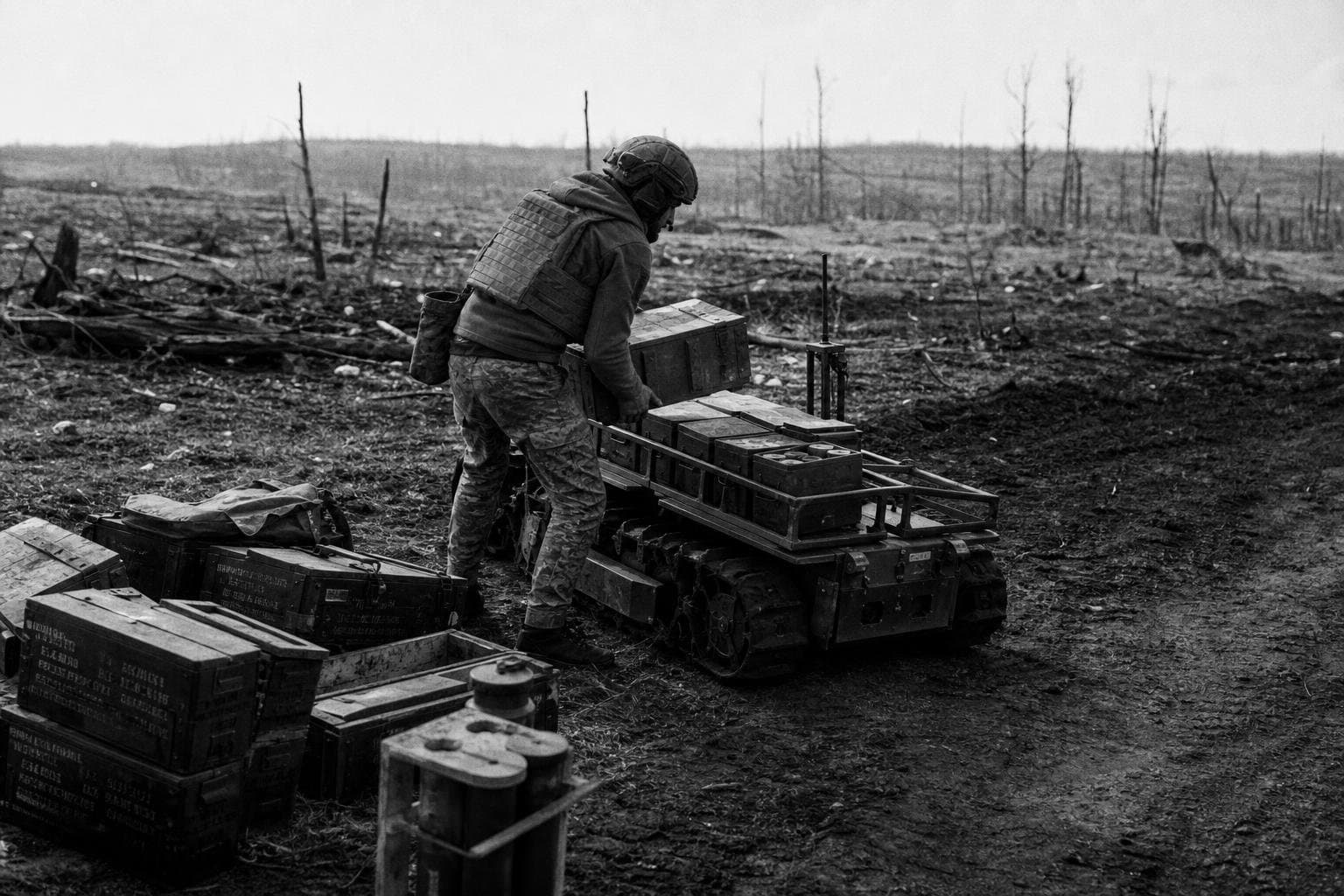
Ukraine is running the same experiment in real time. By August 20, 2026, Ukrainian ground robots had completed more than 100,000 frontline missions — roughly one sortie every three and a half minutes. The headline number is the combat footage: an uncrewed surface vessel ferrying a ground robot across the Black Sea to raid Kinburn Spit. The operational reality is less cinematic. In the 3rd Assault Brigade's dedicated ground-robot battalion, approximately 19 of every 20 missions involve logistics or casualty evacuation. Combat accounts for about 2 percent.
That ratio matters. The problem these robots are solving is the same one that plagued every army that ever tried to sustain dispersed infantry under observation: large trucks reach rear distribution points, but the final kilometers to forward positions require progressively smaller vehicles — pickups, ATVs, soldiers on foot — each transfer creating a detectable pattern that reconnaissance can exploit. A parallel War on the Rocks analysis of contested logistics frames this as the "last unmanned mile" problem, one that applies equally to a Pacific scenario where U.S. forces cannot assume uncontested access to supply lines.
Doolittle's contribution wasn't a fighter plane. It was making sure the fighters could fly at full power when it counted. Ukraine's ground robots aren't primarily a weapons system. They're a labor-substitution mechanism for the most dangerous stretch of the supply chain — the stretch where soldiers used to die carrying ammunition.
The lesson that transfers across eras isn't about any specific technology. It's that the side willing to do serious institutional work on the unglamorous final link in the supply chain tends to arrive at the decisive moment with more options than the side that didn't.