


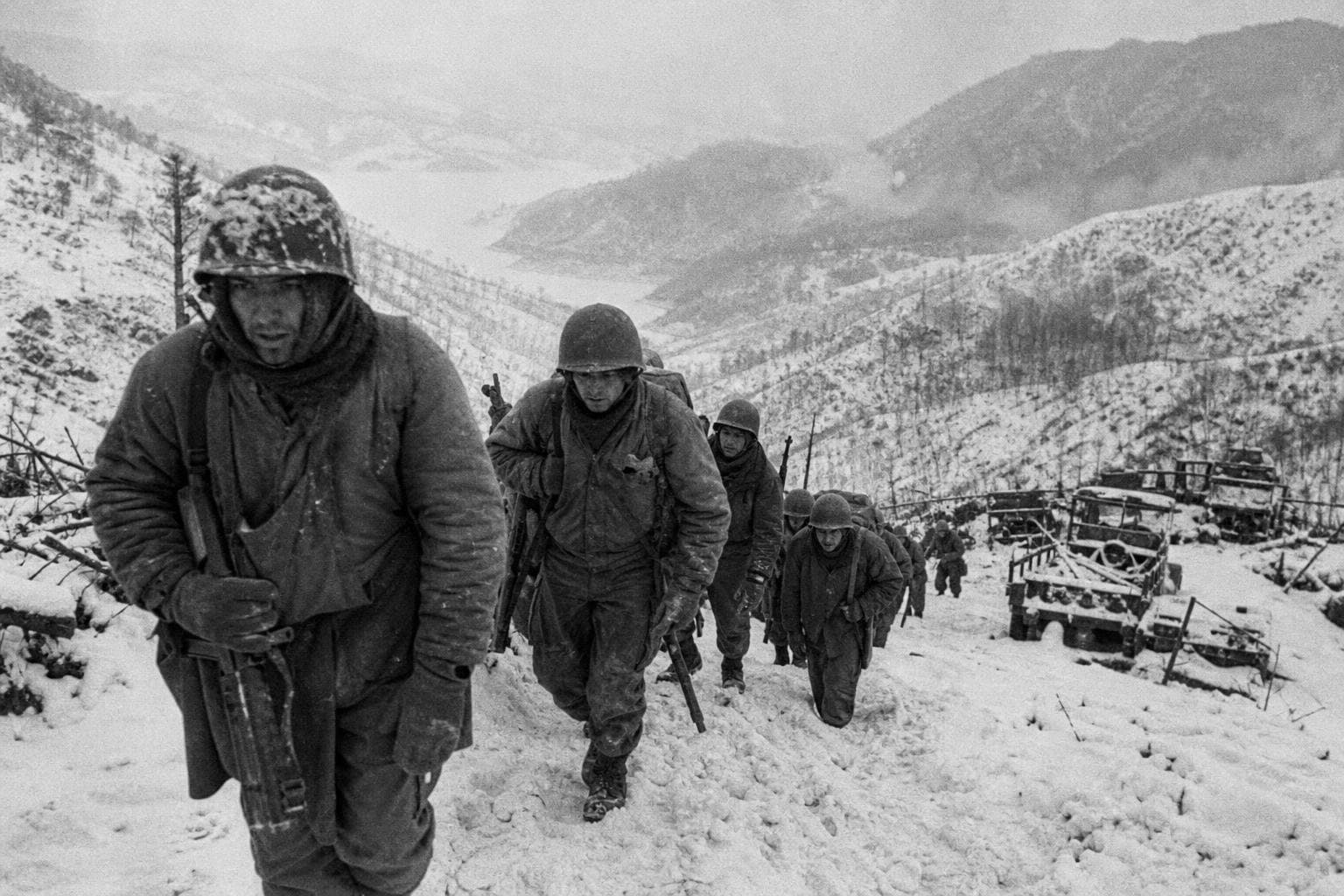

Seventeen days in temperatures that fell to roughly minus 35 degrees Celsius will do strange things to an army's equipment and to its mythology in equal measure. Weapons jammed. Blood plasma froze solid in the bottle. And somewhere in the mountains of northeastern Korea in late November 1950, a Marine division that outside observers assumed was finished instead fought its way out, bringing its wounded, its vehicles, and its dead with it. That's the story everyone knows. The parts worth slowing down on are the ones where the record gets fuzzier — how the trap got set in the first place, and how large the forces actually were on either side of the wire.
The Trap Was Set by Confidence, Not Incompetence
By October 1950, United Nations forces had reversed North Korea's invasion so completely that commanders were planning for the war to end by Christmas. The 1st Marine Division, part of X Corps, pushed north toward the Chosin Reservoir through deteriorating winter weather, part of a broader advance that had UN troops "dispersed and overconfident" as they neared the Yalu River, per the Australian government's Anzac Portal. That overconfidence wasn't stupidity in the abstract — General Douglas MacArthur had just pulled off the Inchon landing two months earlier, an operation whose success had made rapid, aggressive advance look like the obvious doctrine rather than a gamble, per Britannica. The information environment mattered more than any single commander's judgment: China's People's Volunteer Army crossed the Yalu at night, on foot, specifically to avoid air detection, and by late November had massed in the mountains around the reservoir without being picked up by American reconnaissance. Whether that reflects a failure of intelligence collection or a failure to act on ambiguous signals is a distinction historians still argue, and the sourcing available here doesn't resolve it cleanly — it's worth naming as a live dispute rather than picking a side.
X Corps, which included the Marine and Army divisions advancing in the northeast, also operated largely independent of the main UN force further west, which meant its already thin forces were spread across difficult, compartmented terrain with no lateral support if things went wrong. Things went wrong on November 27, when the Chinese Second Offensive struck X Corps directly, encircling the 1st Marine Division along with attached Army units near the reservoir.
The Troop Numbers Everyone Cites Aren't as Settled as They Sound
The figure repeated in nearly every account of Chosin — roughly 120,000 Chinese troops against a UN force a fraction that size — comes up consistently across sources, but it's worth flagging that this is a contested estimate rather than a hard count. Some tabulations put Chinese 9th Army strength at closer to 60,000, a revision significant enough to change how lopsided the encirclement actually was. UN strength is generally put at around 30,000, under Major General Edward Almond, with the Marine division itself commanded by Major General Oliver P. Smith. I'd treat the headline "120,000 versus a division" framing as the outer bound of the estimate range rather than a settled figure — the range itself tells you something about how fog-of-war conditions on both sides persisted well past the shooting.
Casualty accounting is similarly layered. Figures circulating for the campaign put UN losses at roughly 10,500 battle casualties plus another 7,300 cold-weather casualties in the Marine division alone — a distinction that matters, because combat losses and frostbite/exposure losses were tracked and reported differently, and conflating them overstates what the Chinese actually inflicted in direct combat. Chinese losses are generally cited around 52,000, a number traced to a 1988 official PLA estimate rather than a contemporaneous UN count — which means it reflects what Beijing was willing to acknowledge decades later, not a verified battlefield tally. Both figures should be read as estimates with a methodology attached, not interchangeable hard numbers.
The Outcome Both Sides Could Claim, for Different Reasons
The campaign ended with the entire X Corps evacuated by sea from Hungnam, and the Chinese achieved their strategic goal of driving the UN out of North Korea entirely — a reversal severe enough that by January 1951 CPV forces had pushed UN lines roughly 400 kilometers south, retaking Seoul in the process, per Anzac Portal. But the Chinese did not achieve the narrower objective Mao had set for the 9th Army: destroying the 1st Marine Division outright, per Britannica. Both of those things are true simultaneously, and the popular memory of Chosin tends to collapse them into a single triumphant narrative about Marine resilience. The strategic picture was a UN defeat. The tactical and institutional picture — a surrounded division extracting itself largely intact — is the part that became legend, and the part worth separating from the war it was embedded in.