



The popular story of the Battle of Britain runs something like this: British scientists invented radar, the Luftwaffe didn't know about it, and so German pilots flew into a trap they couldn't see. Clean, satisfying, and incomplete enough to be misleading.
The Germans knew radar existed. They had their own. What they failed to understand — and what the RAF had spent years building — was that Chain Home wasn't primarily a detection technology. It was an information-processing system, and the distinction matters enormously for understanding why the defense held.
The System Behind the Stations
Robert Watson-Watt demonstrated the practical use of radar to detect aircraft in 1935, and by July of that year he could locate aircraft consistently at a distance of roughly 140 kilometers. That's the part that gets remembered. What gets less attention is what happened to that information once it existed.
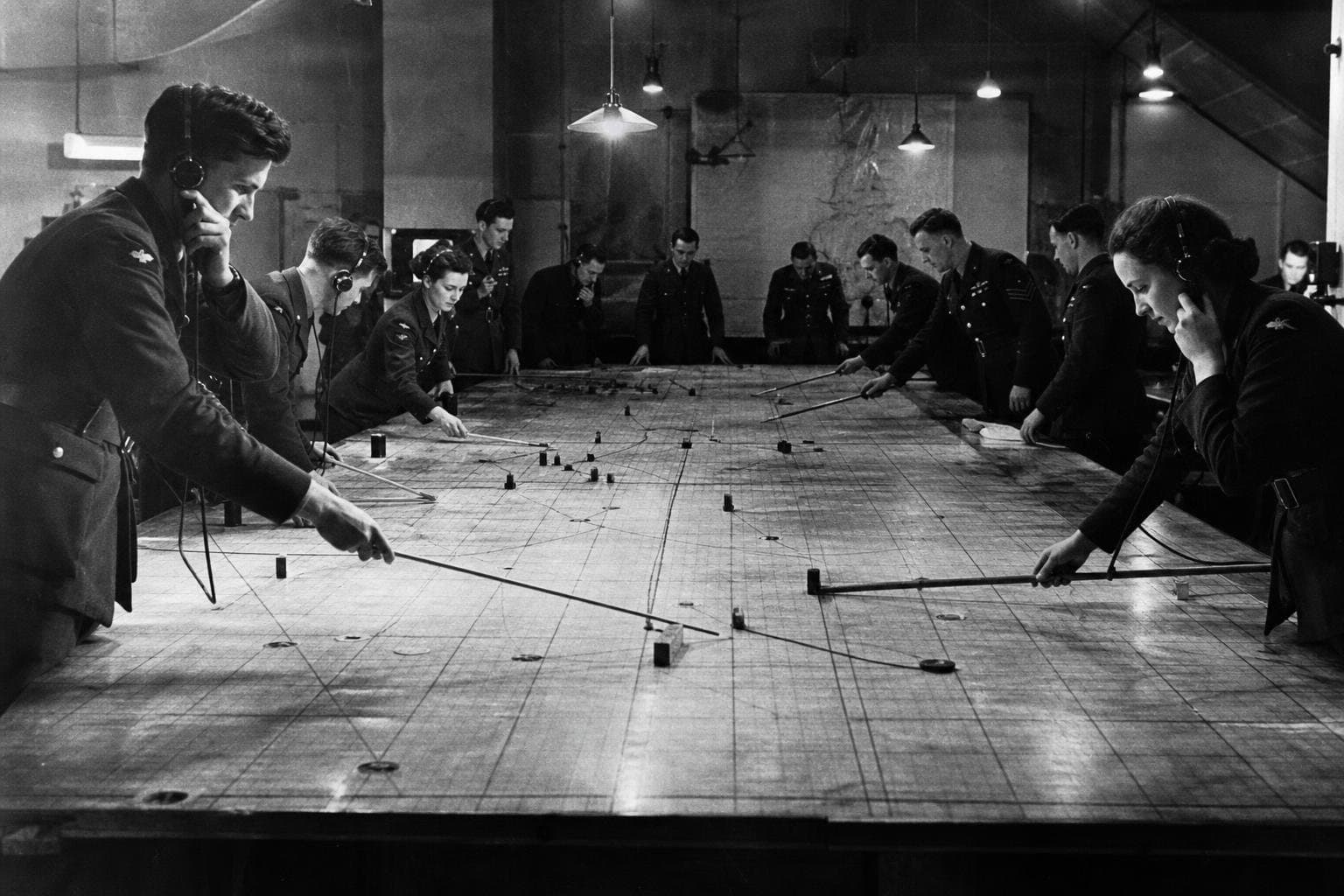
Chain Home stations, which went into 24-hour operation before the war and remained operational throughout it, fed detection data into a command-and-control network that routed information from radar operators through filter rooms, to group headquarters, to sector controllers, and finally to pilots in the air. The chain of custody for that information — who received it, how quickly, and what authority they had to act on it — was as important as the radar signal itself.
This is the part that resists the Great Man narrative. Watson-Watt gets the biography; the filter room operators who translated ambiguous radar returns into actionable intercept vectors get a footnote, if that. But a radar network without a processing system is just expensive antenna infrastructure.
What the Luftwaffe Actually Faced
The Battle of Britain ran from July through September 1940, following the fall of France and the Dunkirk evacuation. The strategic logic from the German side was coherent: destroy RAF Fighter Command's ability to operate, establish air superiority over the Channel and southern England, and create conditions for a cross-Channel invasion. Victory for the Luftwaffe, as Britannica's account notes, would have exposed Britain to an army then controlling French ports only miles away.
What the Luftwaffe's planning didn't adequately account for was the asymmetry of the information environment. German pilots crossing the Channel were flying into a defended zone where their approach was being tracked, their numbers estimated, and intercept vectors being calculated before they reached the English coast. RAF controllers could, in principle, husband their fighters — keeping squadrons on the ground until the intercept geometry was favorable, rather than scrambling everything at the first contact and exhausting pilots and fuel on standing patrols.
In principle. The execution was messier, and historians disagree about how effectively the system actually functioned under sustained pressure. The Luftwaffe's attacks on radar stations and sector airfields in mid-August came close to degrading the network seriously enough to matter. Whether Fighter Command was genuinely near collapse before the German shift to bombing London is one of the more contested questions in the campaign's historiography — and anyone who tells you the answer with confidence is probably working from memoir accounts that have their own agendas.
The Institutional Bet That Paid Off
What's underappreciated about Chain Home is that it represented a specific institutional choice made years before the battle. The British could have invested in a more technically sophisticated radar system — Chain Home operated at relatively low frequencies and had real limitations in measuring target altitude accurately. They chose instead to get an imperfect system operational and integrated into a command structure, rather than wait for a better one.
That's a genuine decision that could have gone the other way, and it's worth crediting as a decision rather than inevitable wisdom. The alternative — a more capable radar still in development when the Luftwaffe arrived — would have been worse than the flawed system that actually existed and was actually connected to the people who needed its output.
The lesson isn't that early warning technology wins battles. It's that early warning technology connected to a functioning command system, staffed by trained operators, and integrated into a doctrine for how to act on the information — that combination changes the operational calculus. The radar was the visible part. The rest was organizational.
Churchill's famous line — "Never in the field of human conflict was so much owed by so many to so few" — pointed at the pilots. Rhetorically correct. Analytically incomplete. The few who flew were multiplied in effectiveness by a larger system that told them where to go. That system didn't emerge from genius. It was built, tested, staffed, and maintained by people whose names don't appear in the famous speeches.
That gap — between what the narrative celebrates and what the operational record shows — is where the actual history lives.