
The standard account of Operation Barbarossa runs something like this: Germany came astonishingly close to winning, was undone by Hitler's strategic meddling, the Russian winter, and Soviet stubbornness. It is a narrative that flatters everyone involved — the Wehrmacht gets credit for near-genius, Hitler absorbs blame for the failure, and the Soviets get to be heroic survivors rather than near-catastrophic victims of their own intelligence apparatus. The problem is that this account obscures the more interesting and more damning story: Barbarossa was not a campaign that almost worked and then went wrong. It was a campaign whose foundational assumptions were wrong before a single soldier crossed the frontier on June 22, 1941.
This publication has examined the logistics dimension of Barbarossa before — the supply line piece and the Wehrmacht's culmination point both traced how German operational doctrine carried the seeds of its own defeat. What those pieces left open was the question of how the strategic miscalculation and the Soviet intelligence failure interacted — how two separate systems of self-deception reinforced each other to produce a catastrophe of almost incomprehensible scale.
The Plan Assumed a Soviet Union That Did Not Exist
German planners expected the campaign to be completed within months through a series of vast encirclement battles that would destroy the Red Army west of the Dvina and Dnieper rivers. The underlying assumption was that the Soviet state was brittle — that once the frontier armies were shattered, the political structure would collapse and resistance would dissolve. Hitler's own ideological framework made this almost axiomatic: a Bolshevik state run by what Nazi racial theory considered an inferior people could not sustain organized resistance against a modern German army.
This was not merely Hitler's delusion. It was embedded in the operational planning. The attack entailed 3 million men, 600,000 vehicles, and half a million horses advancing in three columns along a front of almost 2,000 miles — a front that widened as the attackers pushed eastward. The force was enormous by any historical standard, but it was sized for a short campaign, not a sustained one. Ammunition, fuel, and spare parts were calculated against an optimistic timeline. There was no serious logistical provision for a war that lasted into winter, because the plan did not contemplate one.
The review of Timothy Manion's recent study in The Past makes a point worth dwelling on: much of the historiography of Barbarossa has been so focused on German failure modes — overextended supply lines, Hitler's interference, the climate — that it has systematically underweighted the Soviet side of the equation. The Red Army, despite the decimation of its officer corps during Stalin's purges and its catastrophic early losses, was a more formidable opponent than German planning credited. That planning failure was not a tactical error. It was a structural one, rooted in ideological assumptions that the intelligence picture could not correct because the ideology prevented the intelligence from being read clearly.
The Logistics Problem Was Visible Before the Invasion
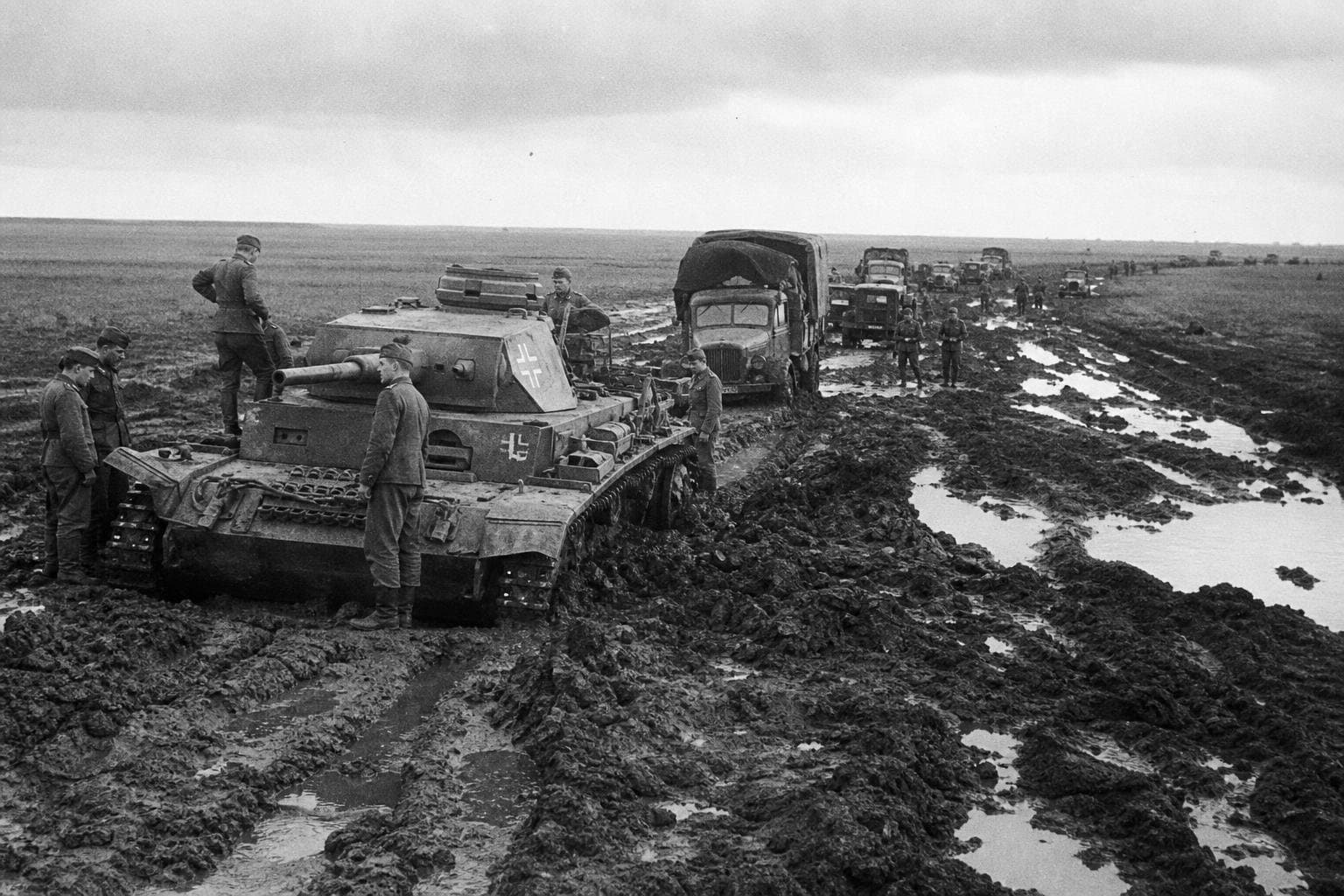
What makes the logistics failure particularly striking is that it was not invisible at the time. The evidence was available to anyone doing the arithmetic. A front of nearly 2,000 miles that widened as it advanced would require supply lines of corresponding length — and the Soviet road and rail network west of Moscow was sparse, in poor condition, and built to a different gauge than German rolling stock. The Wehrmacht would need to either repair and convert captured rail lines or rely on road transport across terrain that turned to mud in autumn and froze in winter.
The fuel consumption problem surfaced almost immediately. Erroneous estimates for fuel consumption — 60,000 litres daily for a 200-tank Panzer regiment — turned into 120,000 and then 180,000 litres daily under actual operating conditions. The wear and tear on vehicles was similarly underestimated. Panzergruppen 2 and 3 advanced 320 kilometers at a daily rate of 64 kilometers until June 27, but that rate shrank to 20 kilometers a day in early July. The 8th Panzer Division's daily advance rate dropped from 75 kilometers before June 26 to 32 kilometers in the first half of July. These are not the numbers of a campaign proceeding on schedule.
The Luftwaffe was experiencing its own version of the same problem. The 2nd Air Fleet, Army Group Center's air support, had approximately 170 single-engine fighters, roughly the same number of bombers, and 120 ground attack planes — operational losses were compounded by maintenance problems at improvised forward airstrips and crew fatigue that the system refused to recognize as a constraint. The blitzkrieg model depended on combined arms coordination; when the air component degraded, the ground component lost a force multiplier it had no substitute for.
None of this was unforeseeable. The German army had operational research capabilities. Staff officers could run the numbers. The problem was that the numbers, if taken seriously, would have required either abandoning the campaign or fundamentally redesigning it — and neither option was politically available. The plan existed because Hitler wanted it to exist, and the planning apparatus shaped its assumptions to produce a plan that could be approved.
The Smolensk Warning That Wasn't Processed
The Battle of Smolensk, fought from July to September 1941, is the clearest early indicator of how badly the foundational assumptions had failed. German forces managed to encircle and capture the city, but Soviet resistance slowed them enough to affect later operations — and that delay gave the Red Army more time to regroup while forcing Germany to deal with stretched supply lines and heavier losses than the campaign timeline had budgeted.
The standard framing treats Smolensk as a German victory with complications. The more accurate framing is that Smolensk was a warning that the campaign's core assumption — rapid Soviet collapse — had already been falsified, and that the German command structure processed this warning as a temporary friction rather than a structural signal. A common mistake is to treat Smolensk as just another German victory. Germany won territory, but the battle exposed the limits of German speed and planning, and demonstrated that Soviet resistance could absorb enormous blows and keep fighting.
This is where the Clausewitzian framework becomes analytically useful rather than merely rhetorical. Clausewitz argued that an offensive inherently weakens as it advances — due to casualties, overextended supply lines, and the need to garrison conquered territory — and that the attacker must eventually stop and revert to the defense when their forces equal the defender's remaining strength. The culmination point is not a failure of nerve; it is a structural feature of offensive operations. Clausewitz had derived this principle partly from his direct observation of Napoleon's 1812 campaign, and he argued that Napoleon had reached his culmination point at Smolensk — 260 miles west of Moscow — and failed to recognize it.
Hitler was, in a grim sense, repeating Napoleon's error with better documentation available. The Wehrmacht reached its own version of that culmination point somewhere in the late summer of 1941, and the command structure — for reasons that were partly institutional and partly a function of Hitler's personal authority — could not process the signal.
The Kiev Detour and the Decision That Foreclosed Moscow
In September 1941, Hitler weakened Army Group Center to encircle a Soviet force in and around Kiev — a force that presented no immediate threat to the German advance on Moscow. The result was spectacular in tactical terms: the capture of over 600,000 prisoners. It was also, in operational terms, the decision that made reaching Moscow before winter effectively impossible.
The historiographical debate here is genuine and worth naming rather than papering over. Some historians argue that the Kiev encirclement was strategically rational — that leaving a large Soviet force on the flank of Army Group Center's advance toward Moscow was genuinely dangerous, and that the prisoner count represented a real degradation of Soviet capability. Others argue that the delay was fatal regardless of its tactical logic, because the campaign was already operating on a timeline that had no margin for major diversions. The Britannica account of the 1941 campaign reflects the general consensus that the Eastern Front became the largest and most destructive theater of the war — but the question of whether different decisions in September 1941 could have changed the outcome remains genuinely contested.
What is less contested is the structural point: the Kiev decision was made by a command system that had not updated its assumptions after Smolensk. Hitler and the OKH were still, in September 1941, operating within a mental model in which the Soviet Union was close to collapse and one more decisive blow would end organized resistance. The intelligence picture did not support this. The operational data — slowing advance rates, fuel consumption overruns, vehicle attrition, Luftwaffe degradation — did not support it. But the plan had been built on that assumption, and the institutional momentum of a plan already in motion is a powerful force against revision.
What the Soviet Intelligence Failure Actually Explains
The Soviet side of the equation is, as Manion's study notes, frequently either inflated or left unexamined. Stalin received multiple warnings of the impending invasion and systematically discounted them — a failure of intelligence processing that has generated its own substantial historiography. The standard explanation is that Stalin feared provocation, that he trusted the Molotov-Ribbentrop Pact as a genuine strategic arrangement, and that his purge of the Red Army's senior officer corps had created a command culture too frightened to deliver unwelcome assessments.
All of this is probably true to varying degrees. But it is worth noting that the Soviet intelligence failure and the German strategic miscalculation were, in a sense, mirror images of each other. Both systems were distorted by ideological assumptions that prevented accurate processing of available information. Hitler's ideology told him the Soviet state was brittle; Stalin's position told him that showing weakness by preparing visibly for an attack he had been warned about would invite the attack he was trying to avoid. Both men were, in different ways, prisoners of frameworks that made the incoming data unreadable.
The result was a collision of two self-deceptions on an almost incomprehensible scale. The Eastern Front ultimately accounted for the majority of military and civilian casualties in Europe and determined the fate of Nazi Germany. That outcome was not produced by genius on either side. It was produced by the


