
The standard account of Operation Barbarossa's failure runs something like this: the Germans were winning until the Russian winter arrived, froze their engines, and stopped them outside Moscow. It's a satisfying story. It's also, in important respects, a convenient one — convenient for German generals writing memoirs after the war, and convenient for anyone who prefers weather to institutional failure as an explanation.
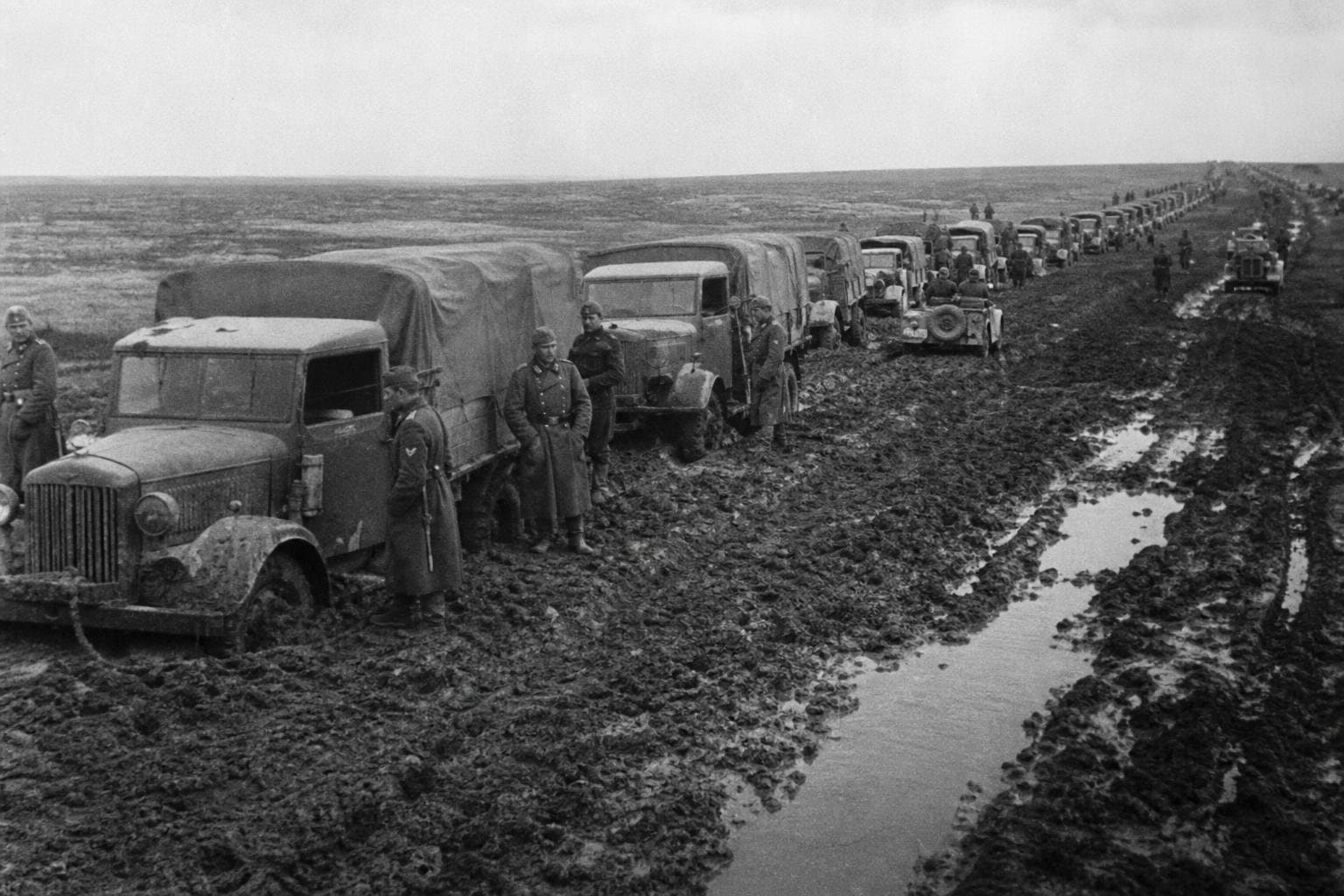
The logistics collapse that doomed Barbarossa was not caused by frost. It was caused by a planning architecture that assumed the campaign would be over before the supply system's structural limits became visible. When the campaign wasn't over, those limits became catastrophic. The winter was the revealer, not the cause.
This matters because the distinction between "we were beaten by nature" and "we built a system that couldn't sustain what we were asking it to do" has direct implications for how you understand the campaign — and for how you evaluate the decisions made at every level of the German command.
The Plan Assumed Its Own Success
Operation Barbarossa commenced on June 22, 1941, with approximately three million German soldiers, supported by thousands of tanks and aircraft — the largest invasion in history at that time. The operational concept was built around speed: deep armored penetrations would encircle Soviet forces before they could withdraw, the Red Army would be destroyed west of the Dnieper and Dvina rivers, and the campaign would be concluded before autumn.
That timetable was not incidental to the logistics plan. It was the logistics plan. German supply doctrine in 1941 was calibrated for short, decisive campaigns — the model that had worked in Poland, France, and the Balkans. The Wehrmacht's motorization rate was, by most historical accounts, substantially lower than the popular image of a mechanized force suggests; a large proportion of German divisions still relied on horse-drawn transport for supply. This was a known constraint, not a surprise. The assumption was that it wouldn't matter because the campaign would be short.
When the campaign wasn't short, the constraint became the campaign.
Smolensk and the First Warning
The Battle of Smolensk) in the summer of 1941 was the first major signal that the timetable was slipping. The encirclement battles that German doctrine depended on were working — Soviet forces were being surrounded and captured in enormous numbers — but they were taking longer than planned, and the armored spearheads were outrunning their supply lines in the process.
This is the operational paradox that runs through the entire campaign: the tactical successes were themselves logistically destructive. Every encirclement battle that the panzers won required them to halt and wait for infantry to close the pocket, during which time fuel and ammunition consumption continued while forward momentum stopped. The supply system, already strained by distance and the poor road and rail infrastructure of the western Soviet Union, could not keep pace with the tempo that armored doctrine demanded.
The Smolensk battle also introduced a pattern that would recur: Soviet counterattacks that, while often tactically unsuccessful, forced the Germans to commit reserves and consume supplies that had been allocated for the next phase of the advance. The Red Army in 1941 was taking catastrophic losses — the scale of Soviet casualties in the encirclement battles of that summer was staggering — but it was not collapsing in the way German planning had assumed. New formations kept appearing. The front kept requiring supply.
The Strategic Argument That Burned the Fuel
In late July and August 1941, Hitler made the decision to redirect Army Group Center's armored forces — specifically the panzer groups that had been driving toward Moscow — south toward Kiev and north toward Leningrad, rather than continuing the direct advance on the Soviet capital. This decision has generated enormous historiographical controversy. German generals, particularly in their postwar memoirs, argued that the diversion cost them Moscow and therefore the war. Hitler's defenders, such as they are, have argued that the Kiev encirclement was operationally necessary to secure the flanks.
What both sides of this argument tend to underweight is the logistics dimension. The debate over Moscow versus Kiev is often framed as a question of strategic vision. It was also, inescapably, a question of fuel, ammunition, and vehicle maintenance. The panzer forces that drove south to Kiev and then had to reverse course and drive north again for the resumed Moscow offensive — Operation Typhoon — were doing so with equipment that had been in continuous operation for months, over roads that destroyed vehicles at rates the German maintenance system could not absorb.
By the time Bock's armies resumed the advance on Moscow on October 2, 1941, they achieved another enormous encirclement at Vyazma, capturing an estimated 600,000 Soviet troops. But the Vyazma battle wasn't completed until late October. The German troops were exhausted. The autumn rains had turned the roads to mud — the rasputitsa, the "quagmire season" — which paralyzed wheeled transport. And fresh Soviet forces kept appearing in front of them.
The generals on the spot, according to Britannica's account of the later actions, were divided: some wanted to halt and establish a winter line; Bock wanted to press on, believing the Soviets were near collapse; Brauchitsch and Halder tended to agree. Hitler made no objection. The temptation of Moscow, now visible on the horizon, was too great. This is a decision that looks like hubris in hindsight. At the time, given what German commanders thought they knew about Soviet reserves — and they consistently underestimated Soviet capacity to generate new formations — it was not obviously irrational. The intelligence picture was wrong, but it was the picture they had.
Two Rear-Area Systems, Two Different Philosophies
The asymmetry between German and Soviet logistics philosophy is worth examining directly, because it explains a great deal about why the campaign evolved the way it did.
Analysis of Soviet and German rear-area systems points to a fundamental structural difference: the Soviet system, for all its early chaos, was organized around centralized control of the entire rear area under unified authority, while the German system distributed logistics responsibility in ways that created coordination problems at scale. The Soviet approach — whatever its inefficiencies in peacetime — proved more adaptable to the demands of a war of attrition on a continental front.
The German Wehrmacht's logistics doctrine had been designed for, and validated by, short campaigns. It was optimized for the operational phase — getting supplies forward fast enough to sustain a rapid advance — rather than for the sustainment phase of a prolonged campaign. When Barbarossa became a prolonged campaign, the system was operating outside its design parameters.
The Soviet industrial evacuation is the other half of this equation. As German forces advanced deep into the western Soviet Union in 1941, Soviet industry was physically relocated eastward, beyond the Urals, in one of the most remarkable industrial mobilization efforts of the war. This was not an improvised response — Soviet planners had developed contingency frameworks for industrial relocation — but the speed and scale of execution under combat conditions was extraordinary. The relocated factories began producing again within months. German planning had assumed that the loss of the western industrial regions would cripple Soviet war production. It didn't, because the production capacity moved.
What the Frost Revealed
By November and December 1941, the German advance on Moscow had ground to a halt. The winter of 1941–42 was, according to Britannica's account, among the most severe in several decades. Frostbite cases decimated German troops who had not been issued winter clothing — a supply failure that was itself a product of the planning assumption that the campaign would be over before winter. Mechanized transport, tanks, artillery, and aircraft were paralyzed by temperatures for which they had not been winterized. Soviet forces, by contrast, were equipped for winter operations and, the sources note, tended to fight more effectively in cold conditions.
On December 2, a final German effort pushed some detachments into the suburbs of Moscow. The advance as a whole was stopped in the forests covering the capital.
The winter clothing failure is often cited as evidence of German overconfidence. That's accurate, but it's worth being precise about what kind of overconfidence. The German high command did not simply forget that Russia had winters. They made a planning decision — explicit or implicit — that winter clothing was unnecessary because the campaign would be concluded before winter. That decision was downstream of the timetable assumption, which was downstream of the logistics doctrine, which was downstream of the institutional experience of short, successful campaigns. The frost didn't create the failure. It exposed the accumulated weight of every prior assumption that had gone unexamined.
The Alibi Problem
German generals' postwar memoirs — Guderian, Halder, Manstein — converged on a narrative that attributed Barbarossa's failure to Hitler's interference (specifically the Moscow diversion), the Russian winter, and Soviet numerical superiority. These are sources with obvious agendas: men who lost a war explaining why it wasn't their fault. The memoirs are not worthless — they contain operational detail available nowhere else — but they require reading against the documentary record, not with it.
The logistics failure is harder to blame on Hitler or the weather. It was built into the campaign from the planning stage, by professionals who understood logistics and chose to assume the problem away. The assumption that the campaign would be short enough that supply constraints wouldn't matter was not Hitler's alone. It was the Wehrmacht's institutional bet, made by the same staff officers who later wrote the memoirs explaining why they lost.
This is the pattern that recurs across the campaigns covered in this publication — from French command culture in 1940 to MacArthur's intelligence architecture in Korea: institutions build systems that work within their assumptions, and when reality violates the assumptions, the system fails in ways that look like bad luck or enemy action but are actually structural. Barbarossa's logistics collapse was not a surprise that happened to a sound plan. It was the plan's hidden premise becoming visible.
The German army that crossed the Soviet border on June 22, 1941 was, by most operational metrics, the finest fighting force in the world at that moment. It was also operating a supply system that could not sustain what it was being asked to do for as long as it was being asked to do it. Those two facts coexisted. The second one decided the campaign.


