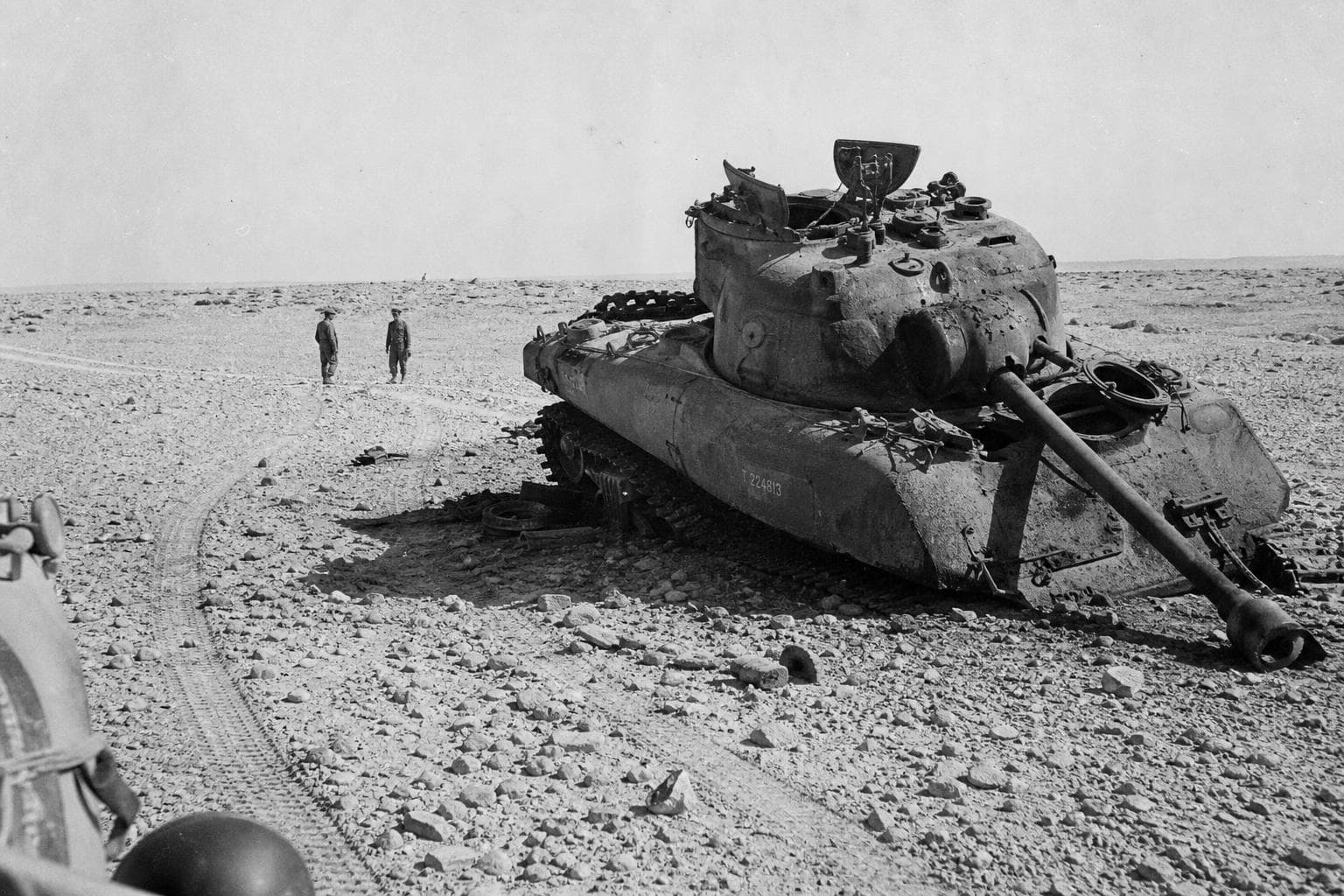

On the morning of February 19, 1943, elements of the U.S. II Corps were holding positions in the Kasserine Pass, a gap in the Grand Dorsal mountain range in central Tunisia. They had artillery, they had tanks, and they had been in theater for roughly three months. What they did not have was any coherent understanding of how to fight the kind of battle Rommel was about to bring to them. By nightfall, American forces were in full retreat, having lost the pass and left behind a wreckage of vehicles, guns, and men that would take weeks to account for.
Kasserine is usually told as a story about green troops meeting veteran Germans — the inevitable stumbling of a citizen army in its first serious engagement. That framing is not wrong, exactly. But it obscures the more important failure: the Americans arrived in North Africa with an armor doctrine that was structurally incapable of handling what the Afrika Korps actually did. The greenness of the troops accelerated the disaster. The doctrine made it nearly inevitable.
The Doctrine Arrived Before the Lessons Did
When the United States entered the war, its armored doctrine was still working through the implications of what Germany had done to France in 1940. The fall of France had alarmed American planners — Britannica notes that the U.S. lagged far behind major European states in tank technology and armored warfare doctrine, and that the French collapse was the shock that finally accelerated development. But acceleration is not the same as understanding.
The American solution was to build a lot of tanks fast and organize them into armored divisions designed for exploitation — punching through a broken line and driving deep into enemy rear areas. This was a reasonable reading of what German armor had done in France. It was a poor reading of how they had done it.
The critical element the Americans underweighted was the integration of tanks with antitank guns and infantry. A summary of British experience in the desert makes the point plainly: "The Allies' problem was that they did not fully understand or appreciate the use of combined arms, especially the concept of tanks and antitank guns working in concert." The British had learned this the hard way across two years of fighting in Libya and Egypt. The Americans arrived in Tunisia having read the reports but not absorbed the lesson.
The German method was to use tanks aggressively but not recklessly — drawing enemy armor onto prepared antitank screens, then exploiting the gaps created by that attrition. The Allies, by contrast, tended to treat tanks as the decisive arm and antitank guns as a supporting element. In practice, this meant American armor often charged into positions where German 88mm guns were waiting, with predictable results.
What Rommel Actually Did at Kasserine
The operation that produced the Kasserine disaster grew out of a command situation that was itself dysfunctional. A contemporary account of the Tunisia campaign notes that Rommel had proposed a major combined operation against Allied supply dumps and airfields in Algeria, striking before the British Eighth Army could close on Tunisia from the east — but received only minimal cooperation from General von Arnim, who commanded the separate Army Group Tunisia and had no intention of subordinating his forces to Rommel's scheme. What eventually happened at Kasserine was a reduced version of Rommel's original concept, executed with less coordination than he wanted.
Even the constrained version worked. The Afrika Korps moved through the pass and drove American forces back roughly 80 kilometers before British reserves and terrain finally stopped the advance. The retreat was not simply a matter of panic — though there was panic — but of units that had no effective response to the combined-arms pressure being applied to them. When German armor advanced, American antitank guns were often not positioned to engage effectively. When American tanks counterattacked, they did so without adequate infantry or artillery coordination, running into exactly the kind of prepared gun lines the Germans habitually established.
The II Corps commander, Lloyd Fredendall, bore significant personal responsibility for the disaster — his command post was absurdly distant from the front, his orders were confusing, and his relationships with subordinate commanders were poisonous. But attributing Kasserine primarily to Fredendall's failures is the Great Man explanation working in reverse: blaming the individual to avoid examining the system. The system was the problem. Fredendall was just the most visible symptom.
The Antitank Problem Was Doctrinal, Not Accidental
The specific failure that recurred throughout the Kasserine engagement — American tanks attacking without adequate antitank support, American infantry positions overrun because armor wasn't integrated into the defense — traced directly to how the U.S. Army had organized its armored forces.
American doctrine had separated the antitank mission from the armored division itself. Tank destroyer battalions were supposed to handle enemy armor, freeing American tanks for the exploitation role. In theory, this created a flexible reserve of antitank power that could be concentrated wherever the threat appeared. In practice, at Kasserine, it meant that the coordination between tanks, tank destroyers, infantry, and artillery that the situation demanded simply didn't happen — because the doctrine assumed these elements would be orchestrated by a command structure that, under the pressure of Rommel's attack, collapsed.
The British had arrived at a different solution through painful experience. The Africa Axis and Allied account describes how British armor doctrine evolved to recognize that cruiser tanks pushing through breaches needed infantry and antitank support to survive in depth — a lesson learned from repeated disasters in the Western Desert. The Americans had the British after-action reports. They had observers who had watched the desert fighting. What they had not done was restructure their doctrine and training around those observations before committing to combat.
This is the institutional failure underneath the tactical one. Armies learn from other armies' experiences all the time, but they learn selectively — absorbing the parts that fit their existing organizational logic and discounting the parts that would require expensive restructuring. The U.S. Army in 1942 had built an armor doctrine around exploitation and speed. Accepting the full implications of combined-arms integration would have required rethinking how armored divisions were organized, how tank destroyers were employed, and how commanders at every level were trained. That rethinking happened — but it happened after Kasserine, not before.
What the Defeat Actually Fixed
Eisenhower relieved Fredendall within days and replaced him with George Patton, whose contribution to the subsequent recovery was real but has been somewhat mythologized. Patton restored discipline and aggressive spirit to II Corps. He did not, by himself, solve the doctrinal problem. What solved the doctrinal problem was the remaining months of the Tunisia campaign, during which American units fought their way through the specific failures Kasserine had exposed.
By the time Tunisia fell in May 1943 and the Allies turned toward Sicily, American armor was operating with substantially better combined-arms integration than it had shown in February. The tank destroyer doctrine remained imperfect — it would continue to generate friction through the Italian and Northwest European campaigns — but the basic lesson about tanks needing infantry and artillery support to survive against prepared defenses had been absorbed at the unit level, if not always at the doctrinal level.
The historiographical debate about Kasserine tends to oscillate between two poles: the "green troops" explanation that emphasizes inexperience, and the "bad commanders" explanation that focuses on Fredendall. Both contain truth. Neither gets at the deeper issue, which is that the U.S. Army arrived in North Africa with a theory of armored warfare that had not been tested against a competent opponent, and that the theory was wrong in ways that cost lives before the institution was willing to revise it.
The pattern is not unique to 1943. Armies go to war with the doctrine they have, built around the last war they studied or the war they expected to fight. The gap between that doctrine and the actual battlefield is always paid for by the soldiers who encounter it first. At Kasserine Pass, American armor paid that tuition in full.
Watch the historiography here: Rick Atkinson's An Army at Dawn remains the most thorough English-language account of the Tunisia campaign, but serious reassessment of the doctrinal dimensions — particularly the tank destroyer question — continues in the Journal of Military History and at the U.S. Army Center of Military History. The command failures are well-documented; the institutional learning process that followed is less so, and that's where the more important story lives.


