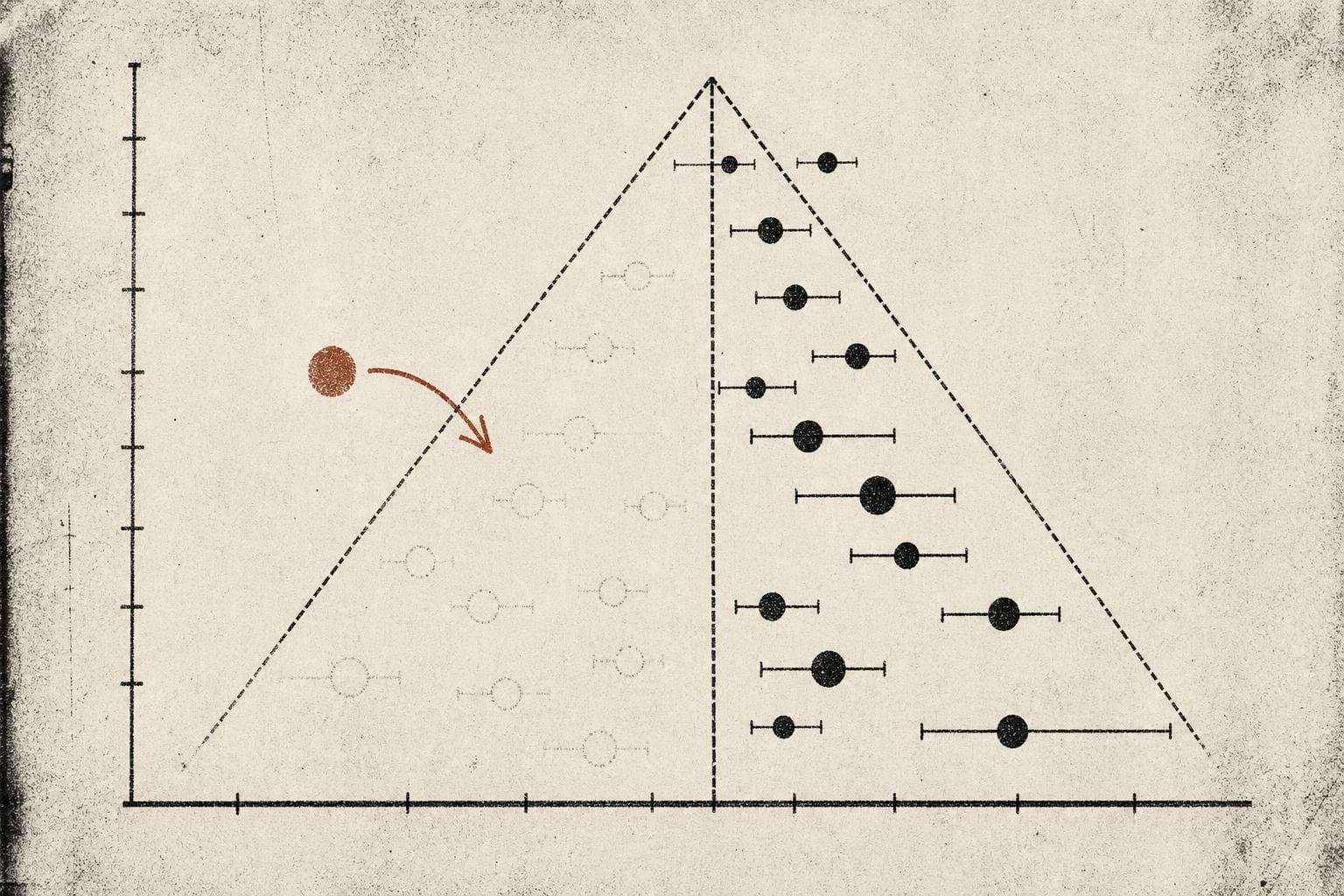

Imagine a drug that gets tested in twelve independent clinical trials. Three find a statistically significant benefit. Nine find nothing. If all twelve get published, the picture is clear: this drug probably doesn't work. But if the nine null results quietly disappear — filed away, abandoned, never submitted — the published record shows a treatment that works every time it's tested. The drug gets adopted. Patients take it. Guidelines recommend it.
This is publication bias, and it is not a hypothetical.
The mechanism is well-documented: studies with positive outcomes are published in the academic literature more frequently than those with negative outcomes. The causes are layered — journals prefer dramatic findings, researchers anticipate rejection and don't bother submitting, funding bodies move on. The result is a scientific literature that systematically overstates how well things work.
The Null Result Has a PR Problem
Here's the core asymmetry. A positive finding has a story: we tested this, it worked, here's how much. A null result has a much harder pitch: we tested this, nothing happened, and we're confident that nothing is real and not just a power problem. That second story requires the reader to trust your sample size, your controls, your statistical power — to believe that the absence of effect is genuine signal rather than noise. As The Conversation's statistician-author explains, "absence of evidence is not evidence of absence" — which is precisely why null results are so easy to dismiss, and why the phrase has become a kind of editorial escape hatch for rejecting them.
The null hypothesis significance testing framework makes this worse. A study that fails to reject the null doesn't prove the null is true — it just ran out of evidence to reject it. That epistemological nuance is genuinely hard to communicate, and journals aren't always patient with it. So the null result sits in a desk drawer, and the literature moves on without it.
Outcome Switching: The Subtler Problem
Publication bias has a quieter cousin that may be even more corrosive: outcome switching. This is what happens when a trial registers one primary endpoint, finds no significant result there, and then reports a different outcome — one that happened to reach significance — as though that were the original question. The trial gets published. The positive finding enters the literature. The original null result never appears, because technically, the paper isn't reporting on it.
A meta-epidemiological study published by the BMJ Group examined this phenomenon specifically in cohort studies of interventions, finding that outcome switching is a measurable, systematic pattern rather than an occasional lapse. This matters because cohort studies are often the evidence base for clinical decisions that precede randomized trials — they shape which interventions get taken seriously enough to test further.
A letter published in JAMA Oncology in May 2026 raised a related methodological concern: whether risk of bias should be assessed at the outcome level rather than the study level. The argument is that a single study can be rigorous on some endpoints and compromised on others — and that collapsing everything into a study-level quality rating obscures exactly the kind of selective reporting that drives publication bias in the first place.
The AI Interlude (and Why It Doesn't Solve the Structural Problem)
There's growing interest in using AI tools to detect and correct for publication bias earlier in the research pipeline. Applied Clinical Trials Online reported on AI applications designed to surface underrepresented findings, integrate contradictory evidence, and flag "positivity bias" in evidence synthesis — the tendency to weight confirming evidence more heavily than disconfirming evidence. The framing is optimistic: AI can see what human researchers miss.
That's probably true, to a degree. But AI tools that analyze published literature are still working with the distorted record. They can identify patterns of selective reporting within what exists; they cannot recover the trials that were never submitted. The desk-drawer problem is upstream of any analytical tool.
The more durable fixes are structural: mandatory trial registration before enrollment begins, required results reporting regardless of outcome, and journals that explicitly solicit null results. These exist in partial form. ClinicalTrials.gov requires registration. The BMJ and a handful of other journals have made commitments to outcome-neutral publication. The gap between policy and practice remains wide.
What the Missing Studies Are Telling You
The most important thing to understand about publication bias is that it doesn't just inflate effect sizes — it corrupts the prior. When a new trial is designed, researchers estimate the likely effect based on existing literature. If that literature is systematically optimistic, the new trial is underpowered from the start, designed around an effect that was never real. The bias compounds.
Reading any meta-analysis, any systematic review, any clinical guideline, you are reading a document shaped by studies that were never written. The null results that disappeared didn't just fail to contribute — they actively distorted everything that came after them. That's not a methodological footnote. It's the whole problem.


