


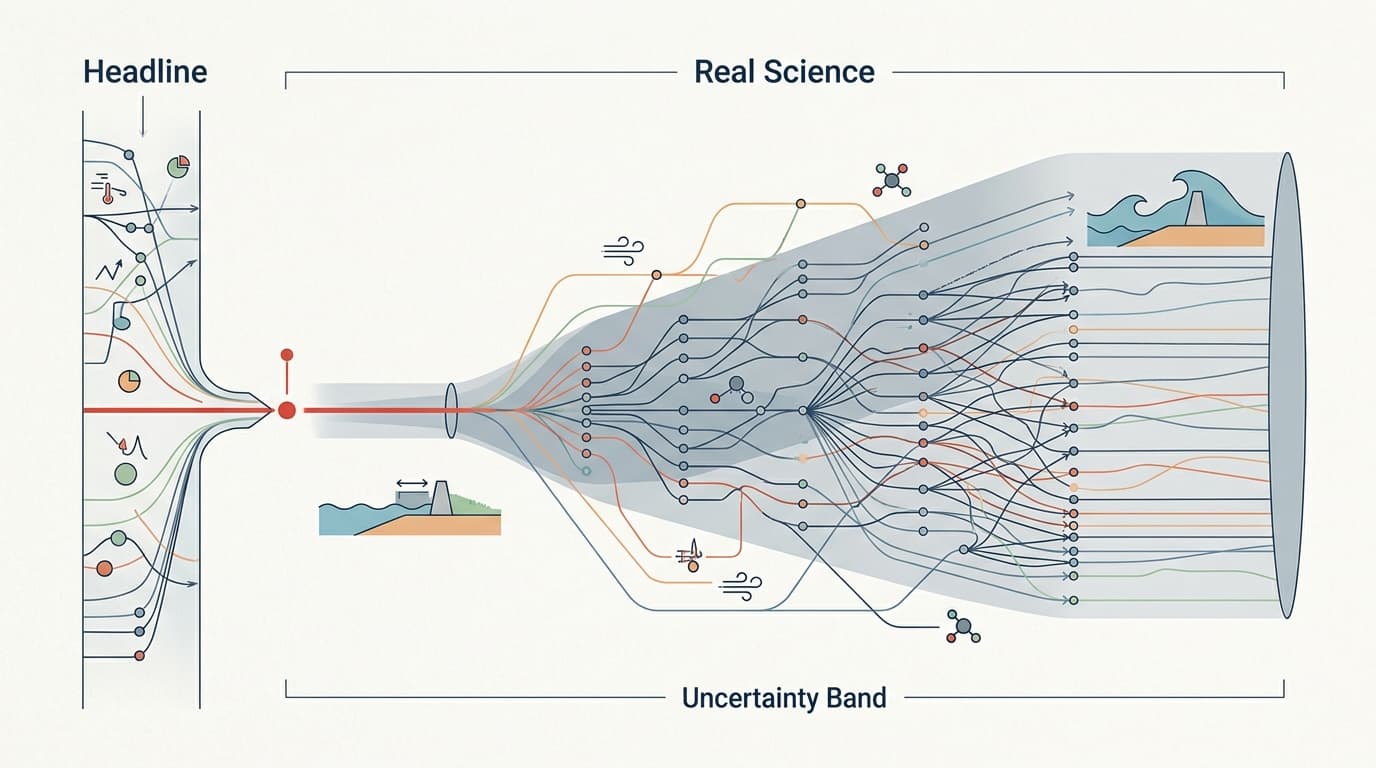

Every major climate report comes with a range. Not a point estimate — a range. The IPCC's equilibrium climate sensitivity figure, to take the canonical example, has carried an uncertainty band for decades. The headline writes itself around the midpoint. The band is where the actual argument lives.
This isn't a media criticism complaint. It's a methodological one. Climate models are ensembles — collections of slightly different simulations run with varied parameters to capture structural uncertainty about how the atmosphere, oceans, and carbon cycle interact. The spread across those ensemble members is the finding. Collapsing it to a single number for a headline doesn't simplify the science; it misrepresents what the science is actually saying.
The pattern suggests something worth sitting with: a wide uncertainty range on a climate projection isn't a sign that the models are weak. Often it's the opposite. A model ensemble that honestly propagates uncertainty through its assumptions is doing more rigorous work than one that produces a suspiciously tidy point estimate. Tight error bars on a complex system should raise eyebrows, not confidence.
Where this matters practically is in the policy translation. Adaptation planning — seawall heights, drought reserves, heat infrastructure — has to be designed against a range of futures, not a single expected value. When the uncertainty band gets stripped out of public communication, it quietly shifts the planning conversation toward the midpoint scenario, which may be neither the most likely nor the most consequential outcome to prepare for. The tails of a distribution are often where the decisions actually live.
I'd argue the more honest framing for any climate projection headline would treat the range as the lede: Models project X to Y degrees of warming under this scenario, and the reasons for that spread tell us something specific about what we don't yet know. That second clause — the reasons for the spread — is usually a tractable scientific question with a real answer. Cloud feedback parameterization. Ocean heat uptake rates. Carbon cycle responses to warming. Naming the source of uncertainty is more useful than pretending it doesn't exist.
The error bars aren't a hedge. They're the finding.