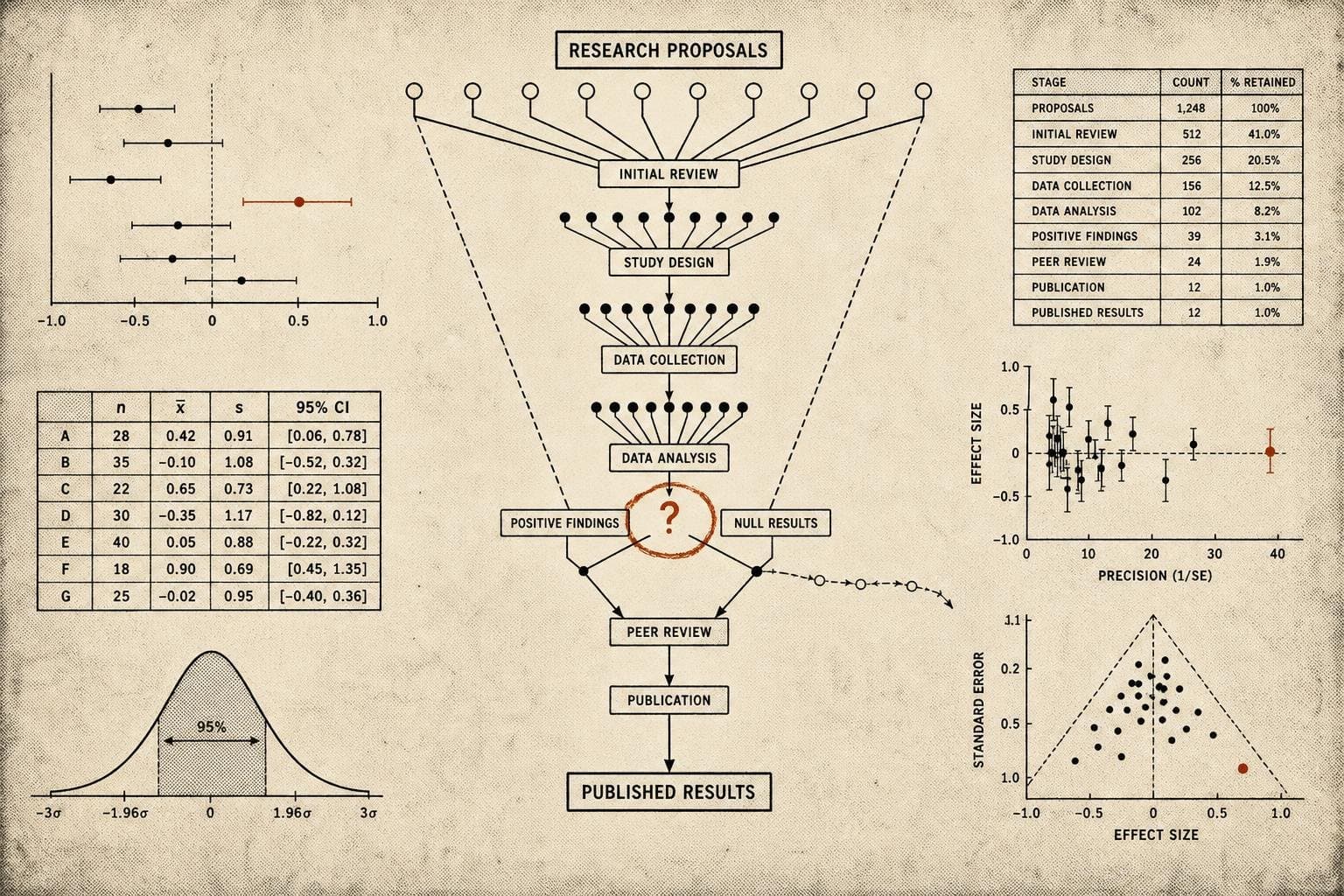

Here's a structural problem that rarely makes headlines: the same system that funds biomedical research also, quietly and systematically, rewards positive results. Not through explicit corruption — no one is handing out bonuses for statistically significant p-values — but through the accumulated logic of how grants get awarded, careers get built, and papers get published. The bias isn't a bug someone introduced. It grew from the architecture.
A new analysis published in the Journal of Global Health offers the most comprehensive look yet at how pervasive this problem actually is. Researchers developed an AI-driven framework they call MASTER — Meta-Analysis Screening, Transformation and Evaluation Review Agent — and used it to process 311,751 meta-analysis records, assembling what they describe as a large-scale structured database of the global evidence ecosystem. The scale is genuinely striking. Traditional secondary meta-analysis is, as the authors note, "highly labour-intensive, time-consuming, and difficult to update in real time." Doing this kind of panoramic audit by hand would take years; the AI framework compressed that into something tractable.
What the analysis found, at that scale, is a field-wide "transparency crisis" — a term the authors use deliberately. The sheer volume of published meta-analyses has made large-scale methodological auditing nearly impossible through conventional means. That opacity is itself a form of bias protection: when you can't audit the ecosystem, the ecosystem's distortions go unchallenged.
Short Funding Cycles Produce Safe Science
The structural driver underneath positive-results bias isn't greed or dishonesty. It's rationality operating inside a broken incentive system. A paper published this year in Nature Human Behaviour makes this case directly: contemporary academic structures progressively constrain high-risk and conceptually innovative research while rewarding "safe, tractable and easily evaluated outputs." The authors argue that "strategic conformity becomes a rational career path" — and they're right. When your next grant depends on demonstrating productivity from your last one, null results are a liability. A study that found nothing is harder to publish, harder to cite, and harder to build a funding narrative around.
This isn't a new observation, but the Nature Human Behaviour piece frames it with unusual clarity: scientific creativity, they argue, is not an individual trait but "an emerging property of a supportive academic landscape." Change the landscape, and you change what science gets done. The current landscape, structured around short funding cycles and productivity-based evaluation, systematically selects against the kind of exploratory work that doesn't know in advance what it will find.
The downstream effect is a literature that skews positive — not because researchers are fabricating results, but because the studies most likely to survive the full pipeline from funding to publication are the ones designed to confirm something plausible. Null results get filed away. Underpowered studies that happen to cross the significance threshold get submitted. The published record ends up being a curated highlight reel, not a representative sample of what was actually tested.
When Funding Priorities Shift, So Does the Science
The structural pressure on what gets funded has become more visible recently, and not in a reassuring way. Nature reported this week that the NIH is seeking to redirect research projects worth hundreds of millions of dollars from its infectious-diseases institute to military biodefense programs at the Department of Defense, according to NIH employees who spoke on condition of anonymity. The NIH and DOD have signed an agreement for the arrangement, with the NIH identifying projects to transfer before the fiscal year ends in September.
Whatever the policy rationale — and the NIH has offered one, framing it as untangling civilian public-health initiatives from defense priorities — the episode illustrates something important about how funding shapes research. When the money moves, the science moves with it. Researchers don't study what's most important in some abstract sense; they study what funders will pay for. And when funders' priorities are opaque, politically influenced, or rapidly shifting, the bias in the resulting literature becomes harder to trace and harder to correct.
A separate concern, flagged by Science-Based Medicine in August, is a proposed NIH change to how grant application scores are reported to applicants — a change critics argue would make it easier to obscure political manipulation of funding decisions. The NIH's peer review system has historically been one of its strongest defenses against exactly the kind of results-driven funding that produces biased literature. Eroding the transparency of that system doesn't just affect individual applicants; it degrades the signal that the entire research ecosystem depends on.
What the Audit Actually Tells Us
The MASTER framework's panoramic analysis matters precisely because it operates at a scale where individual study quality becomes less important than systemic patterns. When you can examine 311,751 meta-analyses simultaneously, you stop asking "was this particular study biased?" and start asking "what does the shape of the whole literature tell us?" That's the right question — and it's one that's been nearly impossible to answer until now.
The answer, at that scale, is uncomfortable. The evidence ecosystem has a transparency problem that compounds the funding problem: when the literature is too large to audit manually, biases accumulate without correction. The AI-driven approach the MASTER team developed is a methodological contribution worth watching — not because it solves positive-results bias, but because it makes the bias visible at a resolution we haven't had before.
Visibility is the prerequisite for correction. Watch for whether journals and funding bodies actually use tools like this to audit their own outputs — or whether the audit capability exists and the will to act on it doesn't.


