


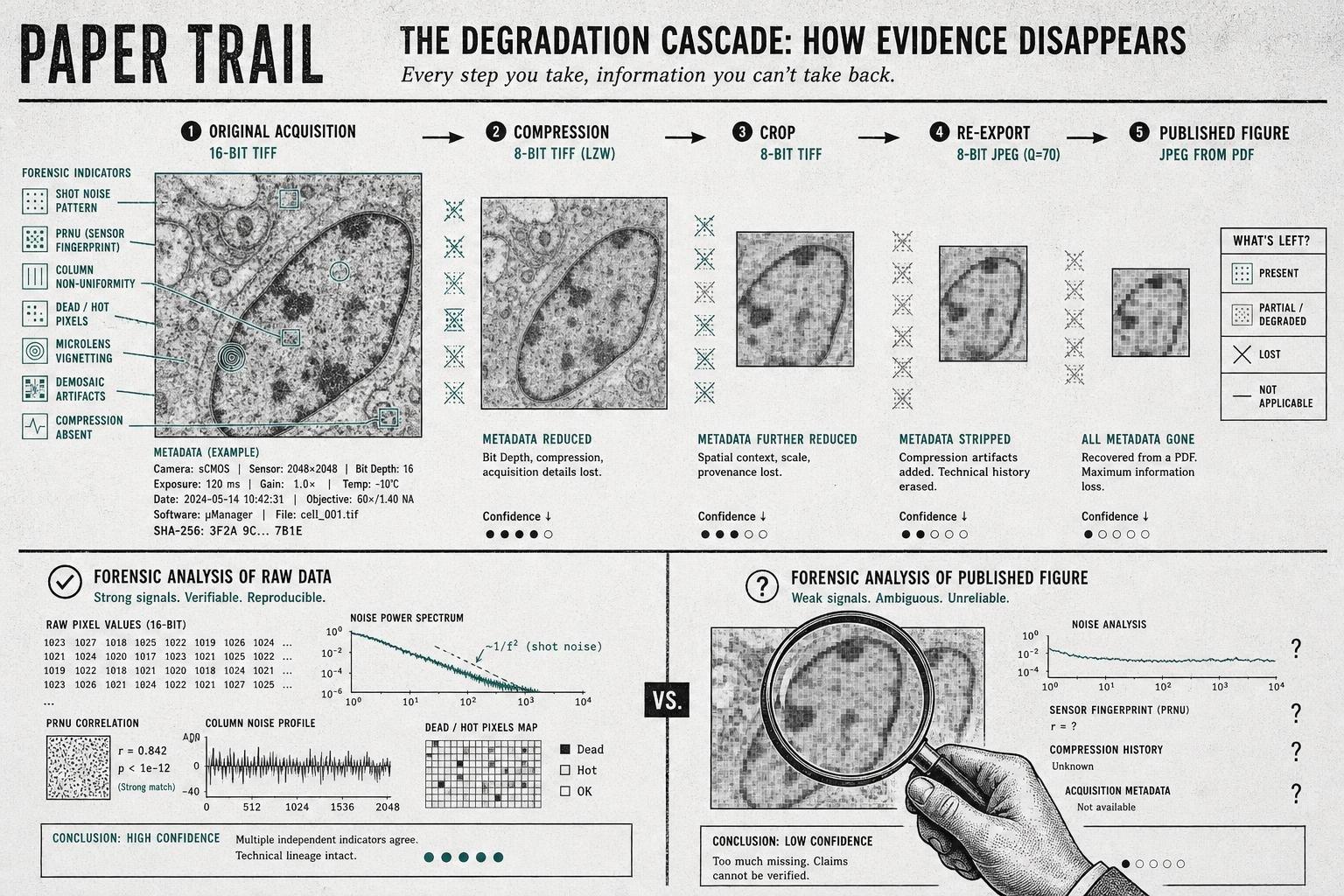

A short letter buried in a recent issue of Nature makes a point that sounds almost too obvious to need saying: you can't run a forensic check on a file nobody kept. The authors, writing from Macao Polytechnic University and the University of Macau, were responding to a Nature news report on AI tools being used to detect long-standing errors in published papers — and their argument was that those tools are only as good as the archives they have to work with (Nature correspondence). Give an algorithm a compressed, cropped, re-exported JPEG pulled from a PDF, and it can flag obvious duplication. Give it the original microscope output, the raw gel scan, the unprocessed FACS file, and it can tell you something closer to the truth.
That distinction is the whole story of where image-forensics-for-science actually stands right now, and it's worth separating from the more sweeping claims that tend to circulate about AI "catching" fraud.
What the Correspondence Actually Says — and Doesn't
The letter itself is thin by design — it's a reader response, not a study — but it points at something real: a Nature news piece (cited as Nature 656, 278–279; 2026) reported that AI tools are being used to surface long-standing errors in scientific papers, and the Macau authors' contribution is a single, pointed recommendation: journals and institutions should be preserving original research data specifically so that future, more capable integrity-checking tools have something authentic to check against (Nature).
Notice what that argument implies. If the fix were simply "run better detection software," the letter wouldn't need to exist. The bottleneck isn't the algorithm. It's upstream of the algorithm — it's whether a verifiable original ever gets saved in the first place. A detector trained to spot splicing artifacts, duplicated bands, or cloned regions is working against a published figure that has already been resized, recompressed, and stripped of metadata by the time it reaches a journal's server. Forensic software can still find plenty in that degraded version — but it's working with a copy of a copy, and some manipulation signatures simply don't survive the export pipeline.
The Detection Methods Themselves Are Still General-Purpose
It's worth being precise about what the underlying technology looks like, because "AI image forensics" gets used loosely. A recent workshop paper on multimodal detection of synthetic and manipulated content, presented at an ECCV forensics and disinformation workshop, describes a platform built to flag synthetic and doctored media across modalities (arXiv:2610.27974). That's useful context for understanding the class of tools in question, but it's a general media-forensics system — aimed at the broader synthetic-content and disinformation problem, not built or validated specifically on scientific figures like Western blots, microscopy panels, or flow cytometry plots. Science-integrity applications of this kind of architecture are plausible and are clearly part of what the Nature news item was gesturing at, but the workshop paper itself doesn't claim to have been tested against a corpus of manipulated journal figures. Treat it as evidence that the methodological building blocks exist, not as evidence that a specific tool is already auditing the literature at scale.
That gap between "the technology class exists" and "the technology has been validated on this exact problem" is precisely the kind of claim inflation that turns a modest methods paper into a headline about AI catching scientific fraud. It hasn't, yet, in any way the sources here can confirm. What's been proposed — explicitly, in the correspondence — is a preservation policy that would make such validation possible down the line.
The Fix Is Boring, Which Is Why It Might Work
If there's a lesson in how methodologically-minded researchers are approaching this, it's that the exciting part — the AI doing the catching — isn't actually where the leverage is. The leverage is in archival policy: mandating that raw, unprocessed image data gets deposited alongside a paper, the same way some journals already require raw sequencing reads or unprocessed statistical output. That's unglamorous infrastructure work, the kind that never makes a press release. But a detector pointed at an authentic raw file can check things a detector pointed at a processed PDF figure never will — pixel-level noise patterns, sensor artifacts, compression history — the fingerprints that get sanded off every time an image gets exported one more time for publication.
The thing to watch isn't the next forensic-AI demo. It's whether journals start treating raw image deposition as a submission requirement rather than a suggestion — because that's the decision that determines whether any future detector has anything real to examine.