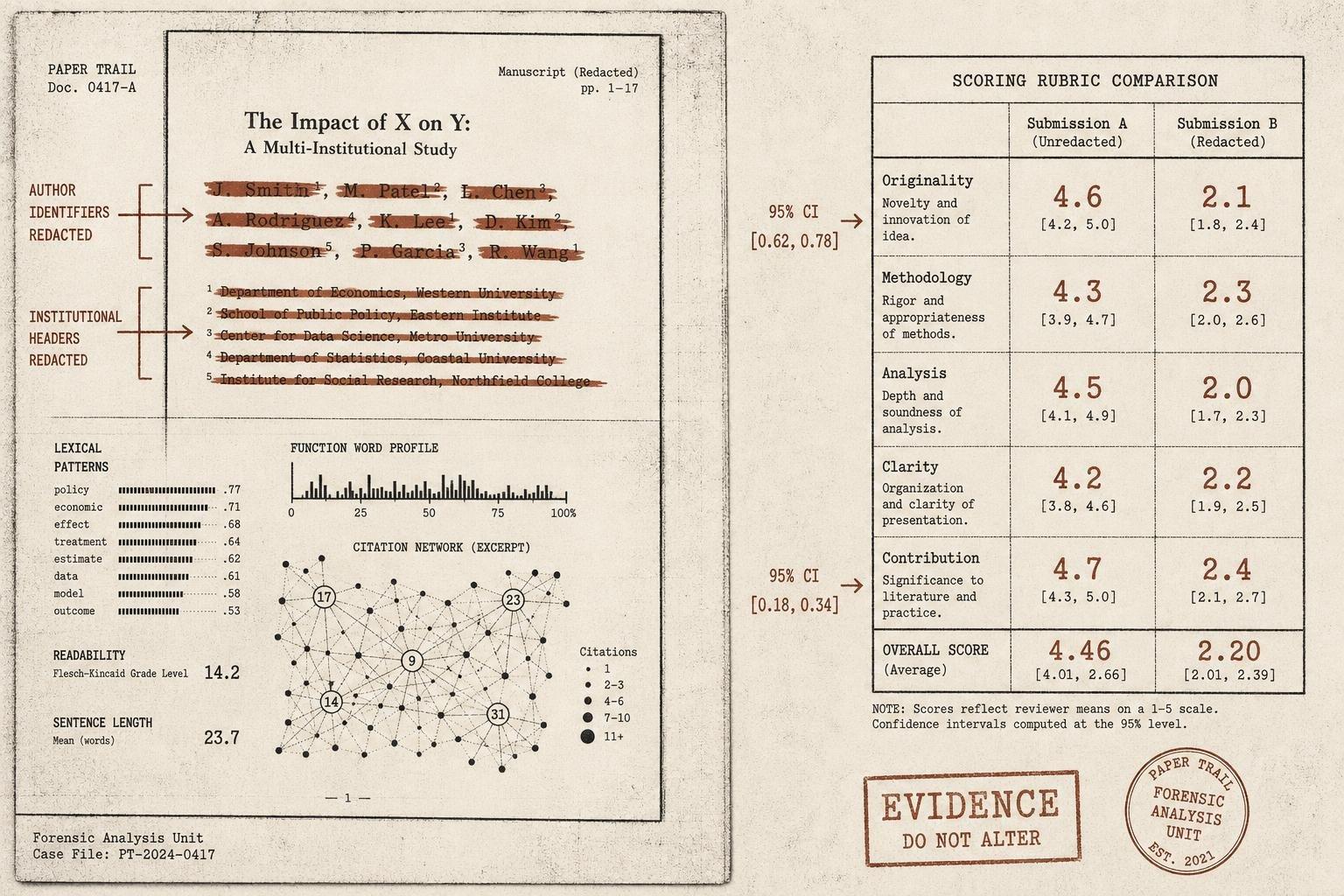

Strip the author names, the institutions, the journal header, and the date from a manuscript, and something strange happens to the score it gets: it drops. Not because the science got worse. Because the reviewer — in this case, an AI system built specifically to test the point — could no longer tell who wrote it.
That's the finding buried inside a new bioRxiv preprint that set out to answer a much broader question: can a blinded AI system audit the biomedical literature at scale? The team built something they call BARS (Blinded AI Review System), which strips every identifying marker from a paper before grading it on methods, evidence, biology, and reproducibility. They ran it across more than 1,700 unique papers and generated 1,874 blind reviews. The headline result that should worry anyone who's ever trusted a peer-reviewed label: 54% of a sample of 320 recent open-access papers from eight fields failed on core scientific rigor when graded blind (bioRxiv).
But the number I keep coming back to isn't the failure rate. It's the +0.35-point prestige boost that disappeared once the system stopped being able to see who wrote the paper (bioRxiv).
The Boost That Vanishes When You Can't See the Name
Here's why that number matters more than it looks like it should. A 0.35-point swing on a 10-point scale sounds small until you realize it was consistent enough to measure across nearly two thousand reviews, and that it vanished entirely under blinding. That's not noise. That's a signal that whatever mechanism was inflating scores — recognizing a famous lab, a familiar journal's house style, a well-known co-author list — was doing real work on the final number.
This is the part the assigned framing of "reviewers guessing who wrote the paper" gets partly right and partly wrong. The sources I have don't document reviewers literally naming authors they weren't supposed to know. What they document is more interesting and more damning: you don't need a reviewer to successfully guess the author's name for identity to leak through and bias the score. You just need enough contextual residue — writing style, dataset choice, citation patterns, institutional fingerprints — to nudge judgment in a direction that has nothing to do with the actual methods section.
Double-blind review was built on the premise that removing names from title pages removes identity from the equation. BARS is a clean demonstration of why that premise is shakier than journals like to admit: identity isn't a label you redact, it's a texture woven through the whole document, and stripping the label doesn't fully strip the texture.
Even the Machines Grading Papers Have Their Own Tells
It's not just identity leaking through the blind spot — it's attention leaking in the wrong direction once AI enters the review pipeline at all. A separate analysis of 2,000 papers from major NLP and ML conferences found that when large language models are used to flag weaknesses in a paper, they draw roughly half their criticisms from the appendix — deep in the supplementary material, far from the paper's actual contribution — while human reviewers draw only about 8% of their critiques from that same section, focusing instead on presentation and the core idea (arXiv). That's a different failure mode than prestige bias, but it rhymes with it: the reviewer, human or machine, isn't actually weighing the thing the paper claims to demonstrate. It's reacting to whatever features are easiest to seize on, whether that's a famous name or a buried technical footnote.
Put side by side, the two findings sketch the shape of the actual problem. Blinding is supposed to force reviewers to engage with the substance. Instead, both human prestige bias and AI's appendix-chasing show that substance is exactly what's easiest to skip.
A System Already Struggling to Keep Up
There's a third thread worth pulling in here. A recent Nature commentary argues that peer review needs to be taught as a core research skill rather than left to informal mentorship, noting that "the rapidly growing volume of academic papers is outpacing the scientific community's ability to critically evaluate them" (Nature). The piece describes grassroots fixes — preprint journal clubs, platforms where early-career researchers practice reviewing outside the formal system — built to give new reviewers structured practice at exactly the kind of judgment calls that prestige bias and appendix-chasing corrupt.
There's also a quieter infrastructure problem sitting underneath all of this: journals still largely rely on manual, ad hoc processes to even find the right reviewers for a given paper, which is part of why researchers have started building retrieval systems meant to match submissions to qualified referees at scale (arXiv). Blinding a paper doesn't help much if the reviewer assigned to it was already a mismatch for the subject.
Put all three pieces together and you get a less comfortable picture than any one alone. The system producing reviewers is stretched thin on training. The matching process that assigns papers to reviewers is still catching up. And the blinding mechanism meant to protect judgment from reputation effects is leakier than the field has been willing to measure.
What to Watch
The real test of this finding isn't whether AI systems can replace human reviewers — it's whether journals start using blinded AI audits as a check on their existing human review process, the way BARS was designed to function. Worth watching whether any journal publicly adopts a tool like this as a second-pass audit, and whether the 54%-fail figure holds up once reviewers outside this research group try to replicate it on a different sample. A single preprint showing a bias effect is a finding. A journal changing its submission process because of it would be a story.


