


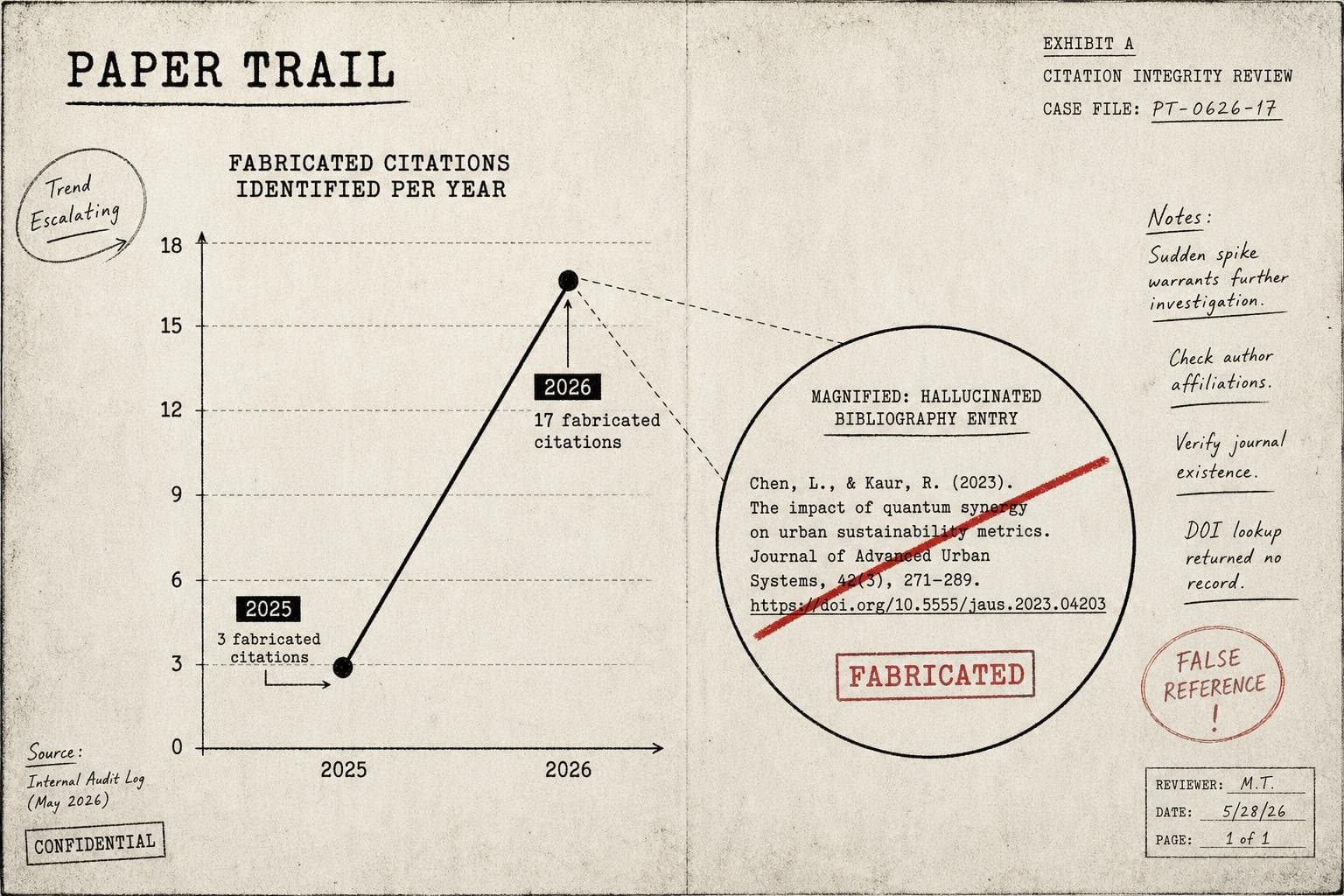

Start with a number: in 2025, three references in papers presented at the ACM's SIGCSE Technical Symposium turned out to be fabrications — citations to studies that don't exist, pointing to invented titles, impossible page ranges, or authors who never wrote the paper attributed to them. A year later, at the same venue, that number was seventeen, showing up in 2.3% of all proceedings papers, according to a new analysis of the computing education literature.
That's not citation-ring fraud in the classic sense — researchers quietly agreeing to cite each other's work to inflate impact metrics. It's something adjacent and, in some ways, more unsettling: the citation record itself starting to fill with references nobody actually checked, because a large language model generated them and a human copied them into a bibliography without verifying they were real.
The Scale Problem Hiding Inside a Small Percentage
The researchers behind this work pulled data on 24,751 computing education papers and set them against the broader ACM Digital Library corpus — more than 723,000 papers and 15 million references — to establish what normal citation behavior looks like before hunting for the abnormal kind, per the paper. That's the right instinct for anyone trying to measure a distortion: you need a baseline before you can call something an outlier. A lot of citation-integrity journalism skips this step and just points at a scary-looking anecdote.
What they found when they went looking at specific SIGCSE-affiliated venues was hallucinated references appearing across five of them in 2025, with the errors falling into recognizable categories — plausible-sounding titles that don't correspond to any real publication, citations misattributed to the wrong authors, page ranges that couldn't possibly exist for the journal in question. These aren't typos. A typo gets a year wrong. A hallucination invents a whole paper.
Two-point-three percent of proceedings papers sounds manageable until you remember what citation counts are used for. They feed into h-index calculations, tenure files, grant applications, and the scientometric rankings that supposedly measure a field's intellectual health. A fabricated reference that slips through peer review doesn't just sit quietly in one bibliography — it can get cited by the next paper, and the one after that, compounding into exactly the kind of untraceable noise that distorts impact rankings over time. The mechanism is different from a coordinated self-citation scheme, but the effect on the integrity of the record is structurally similar: numbers that look rigorous but rest on nothing anyone verified.
Self-Citation Inflation Is a Real Problem — But the Evidence Here Points Somewhere Else
It's worth being precise about what this dataset does and doesn't show. It documents a rise in LLM-generated fabricated citations at a specific set of computer science education venues — not an organized self-citation ring inflating impact metrics through reciprocal citing arrangements, which is a separate and well-documented phenomenon in the scientometrics literature. There's a paper in Quantitative Science Studies examining how self-citation interacts with journal selectivity and reputation, but its substantive findings weren't accessible for this piece, so I'll leave that thread for when the full study can be read properly rather than guess at numbers I can't confirm.
What ties the two problems together is the underlying vulnerability: citation counts are treated as a hard, countable signal of quality, when in practice they're an accounting system that trusts contributors to be careful. Self-citation rings exploit that trust deliberately. Hallucinated references exploit it accidentally, or at least carelessly — a researcher asks a chatbot to help draft a literature review, the tool invents a plausible-sounding source, and nobody closes the loop to check if it's real before submission clears peer review.
Mathematicians are having their own version of this reckoning right now, as AI systems churn out proofs and claimed results faster than the field's verification norms were built to handle, a dynamic Quanta Magazine has been tracking closely this fall. Citation integrity is the quieter cousin of that story — less dramatic than an AI claiming to solve a famous conjecture, but arguably more corrosive, because it erodes the infrastructure every other finding depends on to be trusted.
What to Watch
The SIGCSE paper is slated for the 2027 Technical Symposium, which means there's a natural checkpoint ahead: does the hallucination rate climb again, or does the attention this draws prompt editors to add verification steps before proceedings go to print. If the rate keeps doubling, the conversation needs to shift from "how do we catch these after publication" to "why are editors not catching them before." Impact metrics are only as honest as the references underneath them, and right now, a growing number of those references were never real to begin with.