


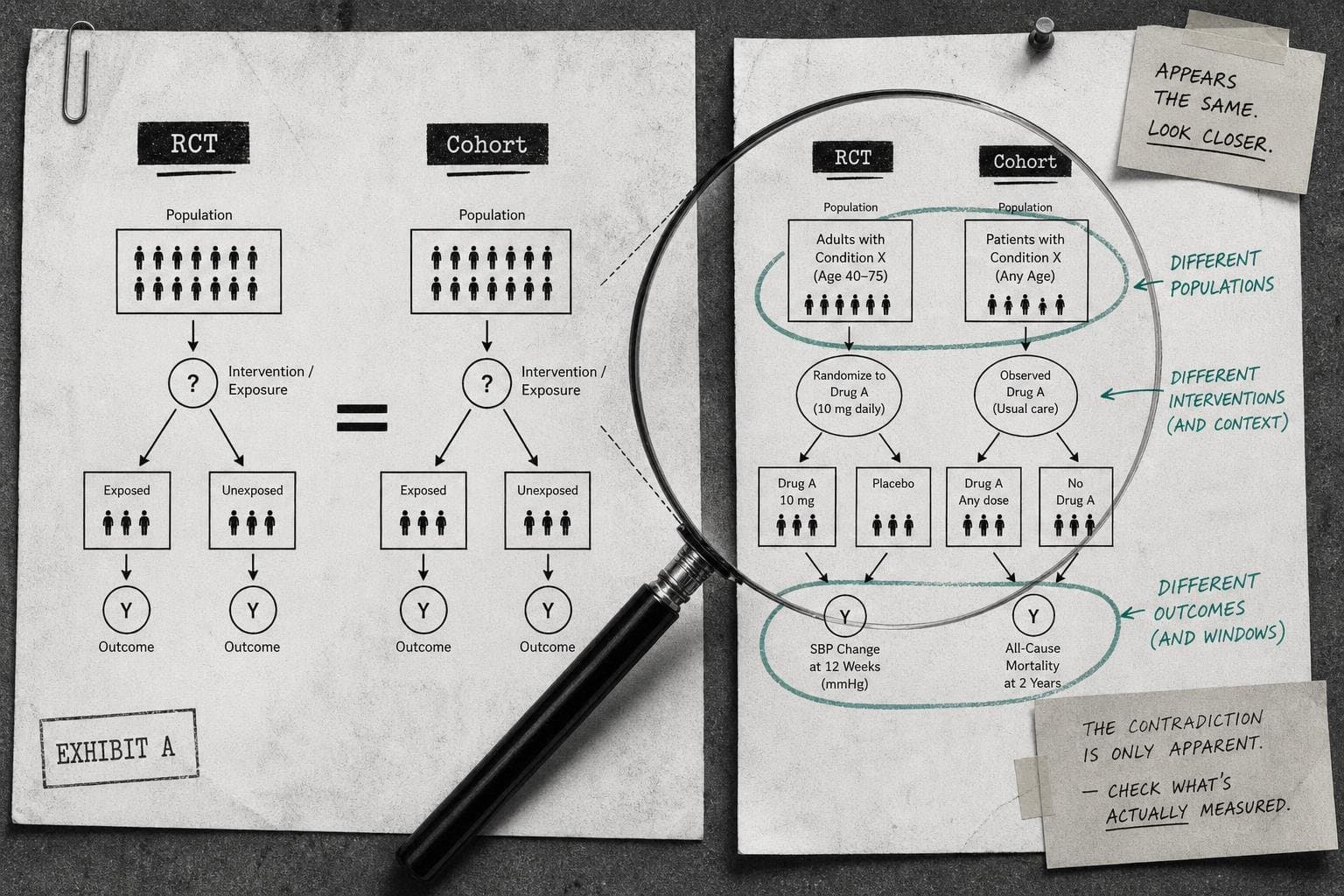

Here's a complaint you've heard a hundred times, maybe from a relative scrolling headlines at Thanksgiving: one study says butter will kill you, the next says seed oils are worse, and nobody in nutrition science can make up their mind. The framing assumes these studies are trying to answer the same question and keep getting different answers. Usually they aren't asking the same question at all.
That distinction is the whole argument of a long-running critique in The BMJ, responding to a 2021 meta-epidemiological review that tried to quantify how often randomized trials and observational cohort studies agree on diet-disease relationships. The commentary's authors looked at 97 paired RCT/cohort analyses the original review had compared and found that none of them were "more or less identical" across population, intervention, comparator, and outcome — the four criteria that would make two studies actually comparable (The BMJ). Their example is almost too clean: one pair of meta-analyses on dietary fiber compared RCTs where people took fiber supplements against cohorts where people simply ate more fiber-rich food. Calling both of those "fiber research" is the nutrition-science equivalent of comparing a pill to a pizza. When the ratios of risk estimates don't match, the natural headline is "fiber study contradicts itself." The more accurate headline is "these were never the same study."
A trial built to actually separate its variables
This is why the methodologically interesting nutrition papers lately aren't the ones chasing a single nutrient's up-or-down verdict — they're the ones trying to model who responds and why. The newest wave of results from the PREDIMED-Plus trial, a long-running Spanish lifestyle intervention, is a good case study. Researchers followed 448 older adults with obesity and metabolic syndrome for three years, randomizing them to either an intensive energy-reduced Mediterranean diet program with behavioral support or a looser, ad-libitum Mediterranean diet control (BMC Medicine). The headline-friendly finding is that food-addiction symptoms dropped more and stayed down in the intensive group. But the number that actually matters methodologically is the split by baseline food-addiction status: participants without food addiction at baseline were roughly three times as likely to hit clinically meaningful weight loss (OR 2.87, 95% CI 1.99–4.14) and waist-circumference reduction (OR 3.01, 95% CI 2.20–4.11) compared with controls, and adherence gains were stronger still in that subgroup (OR 5.82). That's a trial designed to find out for whom an intervention works, not just whether it works on average — which is exactly the kind of stratification that a simple population-wide cohort comparison would flatten into a single, less interesting number.
The missing layer is cellular, not statistical
Even a well-designed trial like PREDIMED-Plus can't fully explain why some people respond and others don't, because most nutrition research still treats the body as a black box between "nutrient in" and "outcome out." A newly funded research program at UCLA is aimed squarely at that gap. Molecular pharmacologist Tara TeSlaa, backed by an NIH Director's New Innovator Award, is building methods to track how individual cell types actually use specific nutrients in their native tissue environment, rather than inferring it from blood markers or outcomes studies (Newswise). Her framing of the problem is blunt: "This is how we end up with one study saying dietary fat is good and another study saying it's bad for you. What's good for one cell type may not necessarily be good for another." It's a hypothesis more than a finding so far — the funding is for a five-year research program, not a completed result — but it names the actual mechanism gap that correlation-chasing nutrition headlines paper over.
A smaller but concrete example of what filling that gap looks like: a secondary analysis of vitamin B12 absorption and supplementation data from a long-running Indian cohort study found that how a person's blood biomarkers responded during a short B12 absorption test predicted how they'd respond to a full year of oral supplementation — with response scaling positively with dose and negatively with body weight (European Journal of Clinical Nutrition). That's the kind of mechanistic, individual-level marker that could eventually explain why "B12 supplementation works" is true for some people and false for others, instead of leaving two contradictory headlines sitting next to each other.
The contradictions are the data, not the noise
None of this means nutrition science is broken. It means most nutrition headlines are summarizing mismatched questions as if they were competing answers to the same one. The next useful study on your feed won't resolve whether a food group is "good" or "bad" — it'll tell you which subgroup, at what dose, measured which way. That's a less satisfying headline. It's also the only kind that's actually true.