
The scandal everyone expects — an editor discovers a referee report was obviously churned out by ChatGPT, complete with a stray "as an AI language model" — hasn't shown up in my source pool this week, and I'd be suspicious of anyone who claims it's already a documented epidemic. What has shown up is something more interesting and, honestly, more useful: researchers building actual instruments to measure whether AI peer reviewers can do the job at all. That's a different question than "are people cheating," and it's the one worth answering first, because you can't catch a bad AI review if you don't know what a good one looks like. As one Nature Machine Intelligence commentary puts it, AI changes not just how criticism gets produced but the economics of producing it in the first place (Nature Machine Intelligence).
The Benchmark That Plants Errors on Purpose
A new arXiv paper does something refreshingly concrete: it takes real preprints, surgically inserts errors — bad math, wrong numbers, fabricated or misattributed citations, general logical issues — at three severity levels, and then checks whether various AI reviewer systems actually catch them (arXiv:2611.17052). This is the kind of design I want more of in this space: a ground truth you can verify, rather than a vague vibe check of whether the AI's feedback "sounds smart."
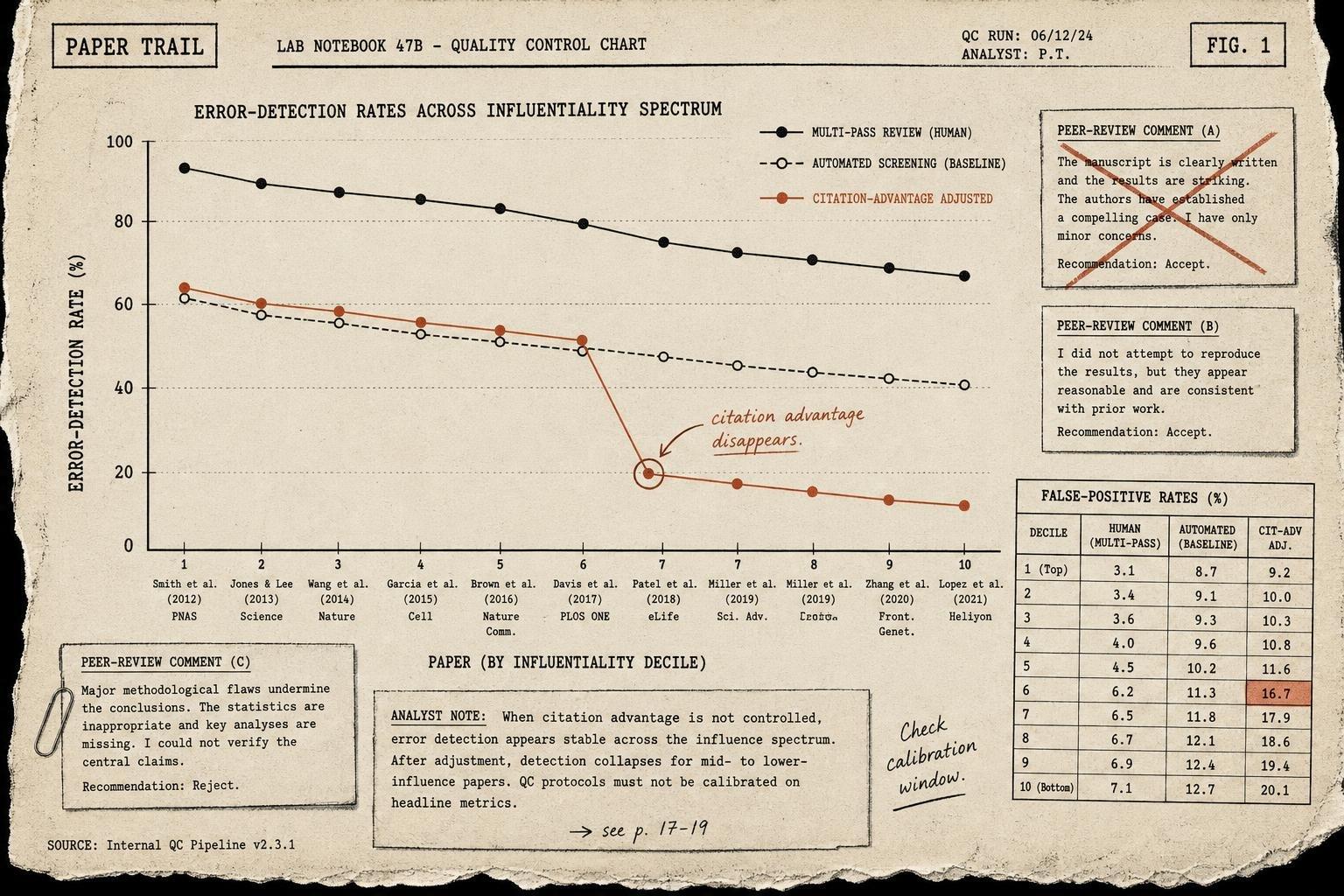
The results are genuinely uneven. Across 357 injected errors in 30 papers spanning astrophysics and machine learning, the choice of underlying model mattered more than any scaffolding trick — three frontier LLMs differed by roughly 50 percentage points in total detection rate on the identical prompt and identical papers (arXiv:2611.17052). That's not a rounding error. That's the difference between a reviewer who catches half the planted problems and one who catches almost none, with no way for an editor to know in advance which one they got.
The paper's "Skepthical" system — which verifies citations by actually retrieving the cited paper, checks math with computer algebra, and runs numerical claims through code — did best at catching citation errors overall, but only in astrophysics. On the machine-learning corpus, its citation-detection advantage disappeared entirely, indistinguishable from a plain single-model reviewer (arXiv:2611.17052). The authors' explanation is that ML papers cite work the models already "know" well from training data, so retrieval adds nothing. That's a useful methodological lesson on its own: a tool's apparent rigor can be an artifact of how familiar the literature already is to the model, not a property of the tool itself.
False-positive rates stayed under 10% for most systems — reassuring, until you notice that math flags were the dominant source of the false alarms that did occur (arXiv:2611.17052). A second, smaller workshop paper built around 100 planted errors points in a similar direction, though it's a non-archival workshop submission rather than a peer-reviewed benchmark, so I'd treat its specific numbers as a corroborating data point rather than a load-bearing one (arXiv:2611.12820).
The Real Bottleneck Isn't Generating Criticism. It's Judging It.
Here's where the methodology connects to the policy question everyone actually cares about. A commentary in Nature Machine Intelligence makes an argument I keep coming back to: AI doesn't just change how fast criticism gets produced, it changes the economics of criticism entirely. Producing a plausible-sounding concern about a manuscript used to take real time and expertise, which naturally rationed how many objections a referee could raise. AI collapses that cost to near zero. What it doesn't collapse is the cost of figuring out which of those AI-generated concerns actually threatens the paper's central claim, since authors are typically expected to answer every concern a referee raises, regardless of its merit (Nature Machine Intelligence).
That asymmetry is the quieter, more important version of the "AI wrote my peer review" story. It doesn't require fraud. It just requires reviewers leaning on AI to draft their reports, which produces reports that look thorough and read fluently but may not reflect calibrated judgment about what matters — the same fluency problem one bioethics journal editor has already flagged on the submission side, describing AI-assisted manuscripts that arrive with "fluent prose, plausible-sounding arguments, neatly organized sections" that fall apart only on a second, closer read, complete with citations to only open-access papers because that's what the model could actually see (The Atlantic). It's the mirror image of a pattern that keeps showing up whenever large language models get tested systematically: they perform respectably on familiar benchmarks and degrade in ways that are hard to predict in advance, a pattern one recent climate-information study also found when it pushed 33 different models on harder, more adversarial questions rather than simple factual recall (Ars Technica). Peer review is getting squeezed from both directions at once: AI-polished submissions on one side, and potentially AI-assisted reviews on the other, with human editorial attention as the only remaining filter.
What Actually Helps, and It Isn't a Detector
It's worth noting what Nature Portfolio's own data suggests works, even though it has nothing to do with AI: bringing early-career researchers into co-review arrangements measurably sped up turnaround and raised reviewer satisfaction, according to an analysis of nearly 80,000 reviewers across two journals (Nature). That's a reminder that the fix for an overloaded, under-resourced review system isn't necessarily a better error-detection algorithm — it might just be more trained human judgment distributed more widely. The benchmarks matter because they tell editors which AI tools can be trusted to flag a problem. They don't yet tell anyone how to make sure a flagged problem gets the kind of expert attention that decides whether it's real. Watch for whether journals start requiring disclosure of AI assistance in referee reports the way some now require it for manuscripts — that's the policy move that would turn this measurement problem into an enforceable standard.