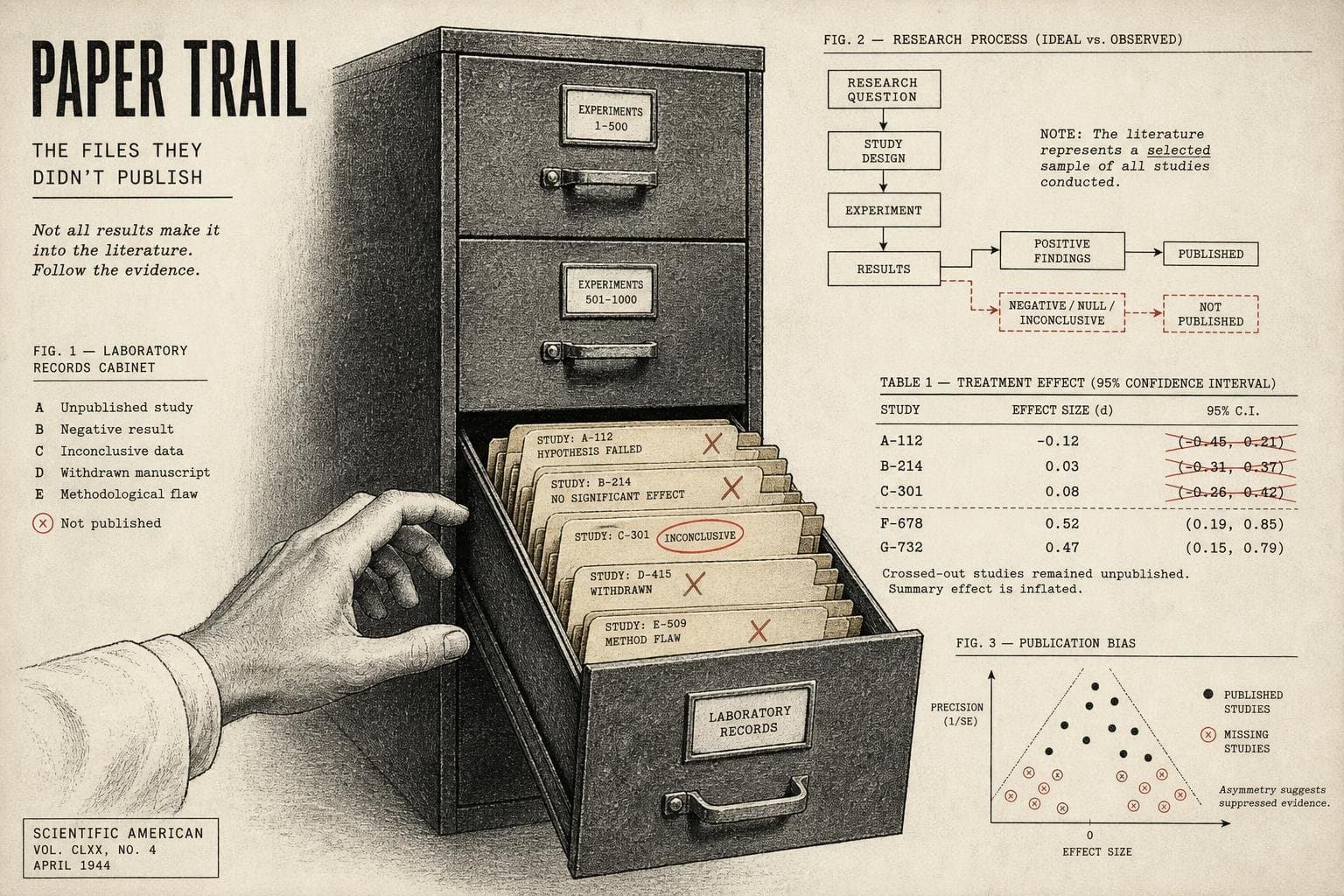

Here's a number worth sitting with: in a survey of principal investigators running randomized controlled trials in sub-Saharan Africa, roughly 14% of those who failed to publish cited non-significant or non-positive results as the reason. Another 13% cited non-positive results specifically. These aren't researchers who ran bad studies. They ran studies, got answers the journals didn't want, and quietly shelved them.
That's publication bias in its most legible form — not fraud, not sloppiness, just a system that rewards certain kinds of findings and quietly discards others. The problem is old and well-documented. What's less appreciated is how structural it is, how many different pressure points feed it, and what the accumulated silence actually costs.
The Filing Cabinet Problem Has a Name
Publication bias refers to the tendency for studies with positive, statistically significant results to be published at higher rates than studies with null or negative findings. The consequence is that the scientific literature is not a representative sample of the research that was actually conducted. It's a curated highlight reel.
The mechanism is straightforward: journals compete for prestige, prestige comes from citations, and citations cluster around surprising or confirmatory findings. A study showing that a drug works gets cited by follow-up trials, meta-analyses, and clinical guidelines. A study showing the drug doesn't work gets filed away — sometimes literally, in what researchers call the "file drawer." The term has been around since the 1970s. The problem hasn't gone anywhere.
What the sub-Saharan Africa survey adds is texture about where the pressure actually lands. Of the 409 researchers who responded, 23.6% reported being unable to publish at least one complete trial. Journal rejection was the most commonly cited barrier (30.5% of those who couldn't publish), followed by time constraints and — there it is — non-significant or non-positive results. The researchers who couldn't get their null results out weren't failing at science. They were failing at the game that surrounds science.
The survey also found that 74% of respondents had never received prior training in writing RCT-specific manuscripts. That's a separate problem, but it compounds the bias: researchers without writing support are more likely to abandon a difficult submission, and a difficult submission is more likely to be a null result that requires careful framing to get past reviewers who are primed to expect positive findings.
What Gets Lost When the Null Results Go Missing
The practical cost of publication bias isn't abstract. When meta-analyses pool published studies to estimate an effect size, they're working with a biased sample. The pooled estimate will be inflated — sometimes dramatically — because the studies showing no effect never made it into the pool.
This is where a separate strand of recent methods research becomes relevant. A preprint posted to arXiv examines a related manipulation called SHAVE — Sign Hacking with Auxiliary Variable Exploration — in which researchers in high-dimensional settings can reverse the apparent direction of a coefficient simply by adding a carefully chosen auxiliary variable. The paper shows that in large datasets with many candidate covariates, finding a variable that flips a coefficient's sign is not just possible but, under certain conditions, probable. The result: studies can be made to tell almost any directional story the researcher wants, with the statistics looking clean throughout.
SHAVE and publication bias are distinct problems, but they share an architecture. Both exploit the gap between what a study demonstrates and what gets reported. Both are harder to detect when the underlying data isn't shared. And both inflate the apparent confidence of the published literature while the contradicting evidence — the reversed signs, the null results — disappears.
The Preprint Question Cuts Both Ways
One proposed remedy for publication bias is preregistration and preprint posting: get your methods and hypotheses on record before you run the study, and post results publicly regardless of outcome. The logic is sound. The evidence on whether it works is more complicated.
A large analysis of 72,644 biomedical preprints found that the central conclusions of most preprints don't change much after peer review — 39.9% were unchanged, another 50% underwent only minor revision. The same study found that papers which were never posted as preprints were retracted at roughly twice the rate of those that were. That's a meaningful signal. Preprints appear to correlate with more careful work, not less.
But preprints don't solve publication bias on their own. A researcher can post a null result to bioRxiv and still watch it languish uncited while the positive findings from the same research area accumulate in high-impact journals and shape clinical practice. Visibility and influence aren't the same thing. The PLOS response to a proposed OMB rule change that would restrict publication cost support for federally funded research points to another pressure: if open-access publishing becomes harder to fund, the barrier to getting any result — positive or negative — into the permanent record gets higher.
The filing cabinet is still full. The question worth watching is whether the structural incentives that fill it — journal prestige hierarchies, funding pressures, the absence of writing support for researchers in under-resourced settings — are actually changing, or whether we're just getting better at describing the problem while the null results keep piling up.


