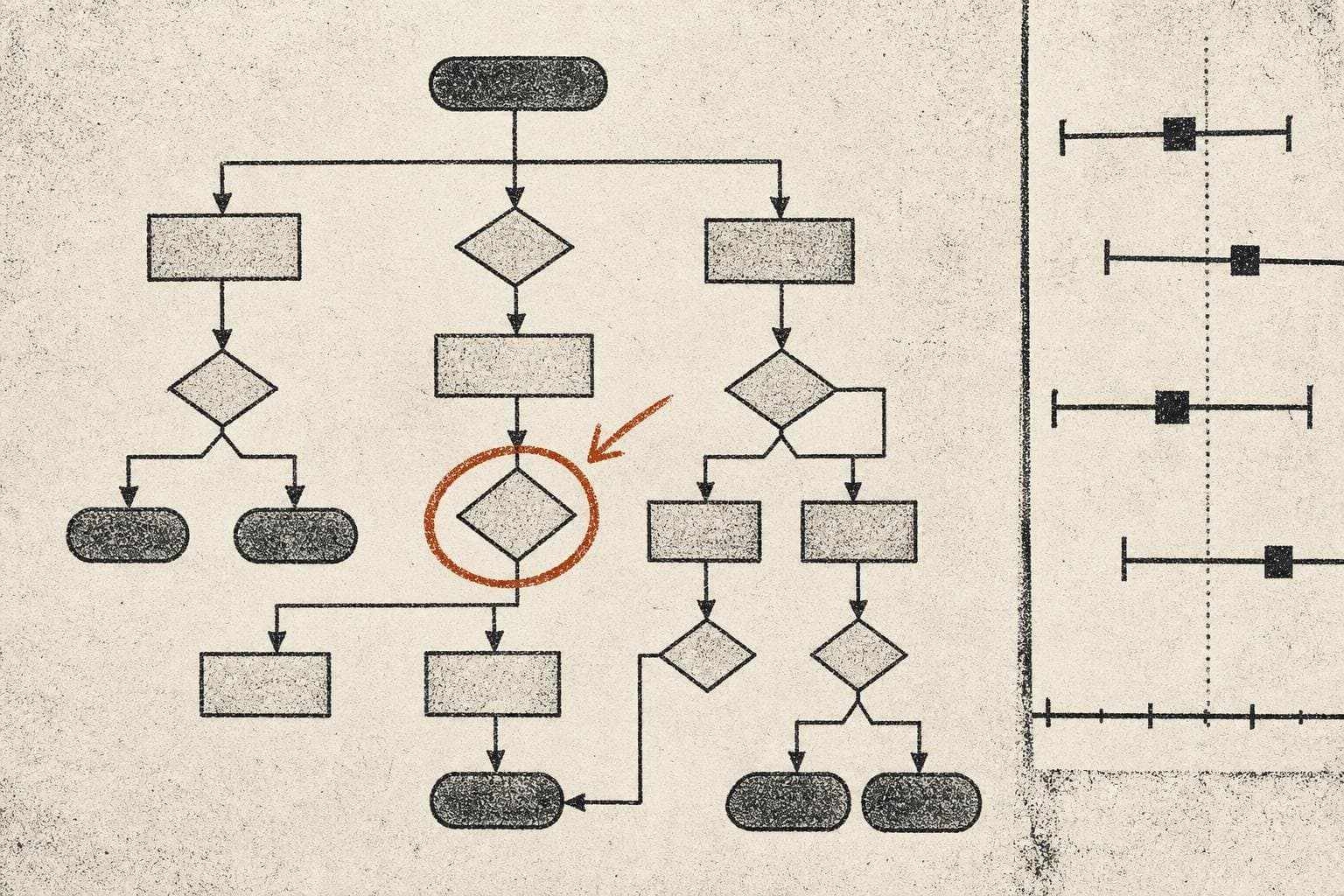

A paper published in the latest issue of Methods in Ecology and Evolution proposes something called "adaptive preregistration" — a framework that, its authors argue, handles the messy reality of ecological modeling better than traditional preregistration. The idea is that researchers preregister not just their hypotheses but also the decision points they expect to encounter, along with "flexible heuristics" for navigating them. Then, when they inevitably deviate from the plan, they file an updated preregistration.
Dynamic Ecology's Jeremy Fox read the paper and reached the same conclusion I did: this is preregistration that doesn't actually preregister anything. His analogy is worth stealing. If your plan to become a sharpshooter is to fire a shotgun at a barn and then paint the target around wherever the pellets land, you haven't become a sharpshooter. Preregistering that plan in advance — even with flexible heuristics about where exactly you'll paint — doesn't change what you've done.
The Problem Preregistration Was Designed to Solve
To understand why "adaptive preregistration" is a problem, you have to understand what the original tool was for.
Researcher degrees of freedom — the flexibility researchers have in how they collect, measure, and analyze data — are one of the primary engines of false discovery inflation. A researcher who tests five different outcome measures, three different subgroup cuts, and two different covariate adjustments has effectively run many more comparisons than they'll report. Each additional analytical choice is another opportunity for noise to look like signal. When only the significant result gets written up, the published literature accumulates an optimistic bias that doesn't reflect what the data actually showed.
Preregistration attacks this problem at the source. A time-stamped document specifying hypotheses, sample sizes, and analysis plans before data collection begins creates a public record that distinguishes confirmatory from exploratory work. It doesn't prevent researchers from running exploratory analyses — it just requires them to label those analyses honestly.
The deeper issue, documented extensively in the psychology replication crisis, is a practice researchers call HARKing: Hypothesizing After the Results are Known. A researcher runs an experiment, finds an unexpected pattern, and writes up the paper as though that pattern was the hypothesis all along. The disconfirmed original hypothesis disappears from the record. The exploratory finding gets dressed up as confirmatory evidence. Readers have no way to tell the difference, and the literature fills with findings that look more robust than they are.
What "Flexibility" Actually Buys You
The Gould et al. proposal is sympathetic in its diagnosis. Ecological modeling genuinely is messier than a psychology experiment with a clean dependent variable. Data-dependent decisions — choosing between model specifications, handling unexpected distributional properties, deciding how to treat outliers — are often unavoidable. The authors aren't wrong that standard preregistration templates weren't designed with this complexity in mind.
But the solution they propose doesn't fix the problem; it formalizes it. Preregistering that you will make data-dependent decisions, and that you'll use flexible heuristics to make them, is just a more elaborate way of making data-dependent decisions. The timestamp on the document doesn't change the fact that the analytical choices are still being driven by what the data show.
This matters because the whole point of preregistration is to separate the hypothesis-generating phase from the hypothesis-testing phase. A PeerJ analysis of early preregistration examples traced this concern back to the Daryl Bem precognition controversy — a case where the methodological similarities between Bem's work and mainstream psychology studies implied that the latter was also riddled with questionable research practices. The lesson wasn't that researchers needed more flexible documentation. It was that the data you use to generate a hypothesis cannot be used to test that same hypothesis in any meaningful way.
The Institutional Pressure Behind the Proposal
There's a structural reason papers like this keep appearing, and it's worth naming. Preregistration imposes real costs on researchers: time spent planning, constraints on analytical flexibility, and the uncomfortable possibility of publishing null results. Those costs are not evenly distributed. Fields with complex, iterative modeling workflows face genuine friction that simpler experimental designs don't.
The response to that friction tends to follow a predictable pattern: propose a modified version of the reform that preserves its vocabulary while relaxing its constraints. "Adaptive preregistration" is a recent example, but the genre is well-established.
The alternative — and the one that actually addresses the underlying problem — is the Registered Report format, which has now been adopted by over 300 journals worldwide. Under that model, peer review happens before data collection, and the journal commits to publishing the results regardless of outcome. That structure eliminates publication bias at the source rather than patching it with documentation. NIH's recently announced Replication Prize — awarded in May 2026 — signals that at least some funders are willing to put money behind the harder version of rigor, not the easier one.
The question for ecology, and for any field wrestling with complex modeling workflows, is whether the goal is to reduce false discoveries or to appear to reduce them. Those are different projects, and "adaptive preregistration" is optimized for the second one.
Watch for whether Methods in Ecology and Evolution publishes formal responses to the Gould et al. proposal — that exchange will tell you a lot about how seriously the field is taking the distinction.


