


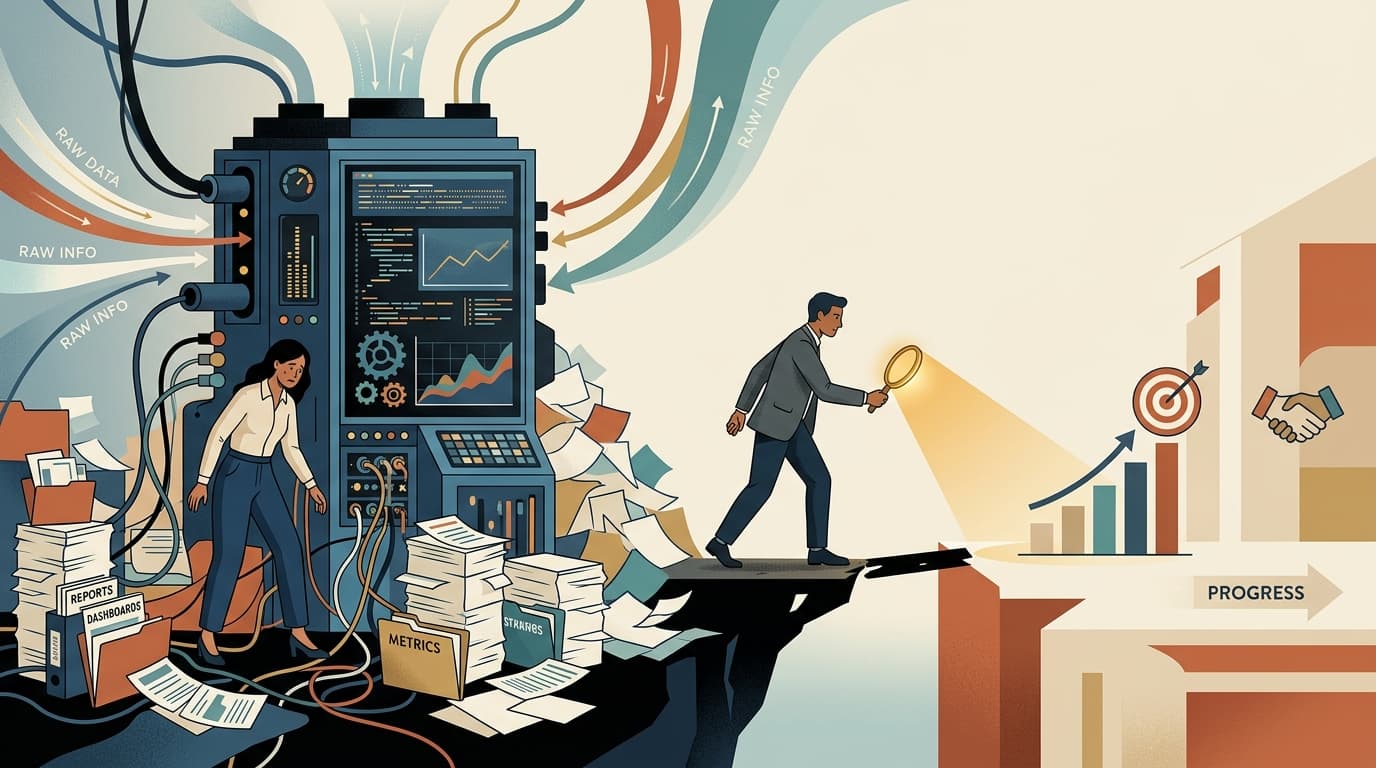

There's a particular kind of organizational dysfunction that doesn't show up in dashboards. No metric flags it. No post-mortem names it. It's the slow drift between what a team knows and what it actually acts on — the gap between intelligence and operation.
Most organizations have more information than they can use. The problem was never access. It was translation.
When More Data Produces Less Clarity
The pattern is familiar enough to be almost invisible: a team invests in better reporting, better tooling, better visibility into what's happening across the business. The dashboards multiply. The weekly updates get longer. And somewhere in that expansion, the signal-to-noise ratio quietly inverts.
I'd argue this happens because most information systems are designed around capture rather than decision. They're optimized to record what happened, not to surface what it means for what you should do next. The result is a kind of operational paralysis dressed up as diligence — teams that are extremely well-informed about the past and genuinely uncertain about the present.
The distinction matters. Operational intelligence, in the truest sense, isn't about having more data. It's about having the right interpretation, at the right moment, in the hands of the person who can act on it.
The Translation Problem
Between raw information and useful action, there's a step most organizations handle poorly: translation. Not translation in the linguistic sense, but the harder work of converting observations into judgments, and judgments into directives.
This is where expertise actually lives. Not in the ability to gather information — that's increasingly automated and cheap — but in the ability to read a situation, apply context, and produce a recommendation that a decision-maker can actually use. The analyst who can say "this number is moving for this reason, and here's what it implies for the next 90 days" is doing something categorically different from the analyst who can build a beautiful chart showing the number moving.
The organizations that handle this well tend to share a few structural habits. They separate the reporting function from the interpretation function, so the people responsible for producing analysis aren't also responsible for defending the data collection process. They create explicit space for uncertainty — "here's what we know, here's what we're inferring, here's what we don't know yet" — rather than presenting all conclusions at the same confidence level. And they close the loop: when a recommendation is acted on, the outcome feeds back into how future recommendations are framed.
None of this is complicated in principle. In practice, it requires a kind of institutional discipline that's easy to let slip when the pressure is on.
The Urgency Trap
Operational pressure is the enemy of operational intelligence. When things are moving fast, the instinct is to compress the translation step — to go directly from observation to action, skipping the interpretation layer because there isn't time. This feels like decisiveness. It often isn't.
The decisions made under that kind of pressure tend to be locally rational and globally incoherent. Each one makes sense given the immediate information available; together, they pull in conflicting directions because no one had time to hold the full picture. The cost shows up later, in rework, in misalignment, in the slow accumulation of small decisions that each seemed reasonable and collectively created a mess.
The countermeasure isn't to slow down. It's to build interpretation capacity that can operate at speed — people and processes that are practiced enough at the translation step that they can do it quickly without skipping it. That's a training and structural problem, not a technology problem.
What This Requires Going Forward
The organizations that will operate well over the next several years aren't necessarily the ones with the most sophisticated data infrastructure. They're the ones that have figured out how to make the human judgment layer work reliably under pressure.
That means investing in the people who do interpretation, not just the systems that do collection. It means treating analytical judgment as a skill to be developed, not a commodity to be hired. And it means building feedback loops tight enough that the organization actually learns from what it does — not just what it measures.
The gap between knowing and acting is where most operational failure actually lives. Closing it is less a technology problem than a discipline problem. And discipline, unlike software, doesn't deprecate.