


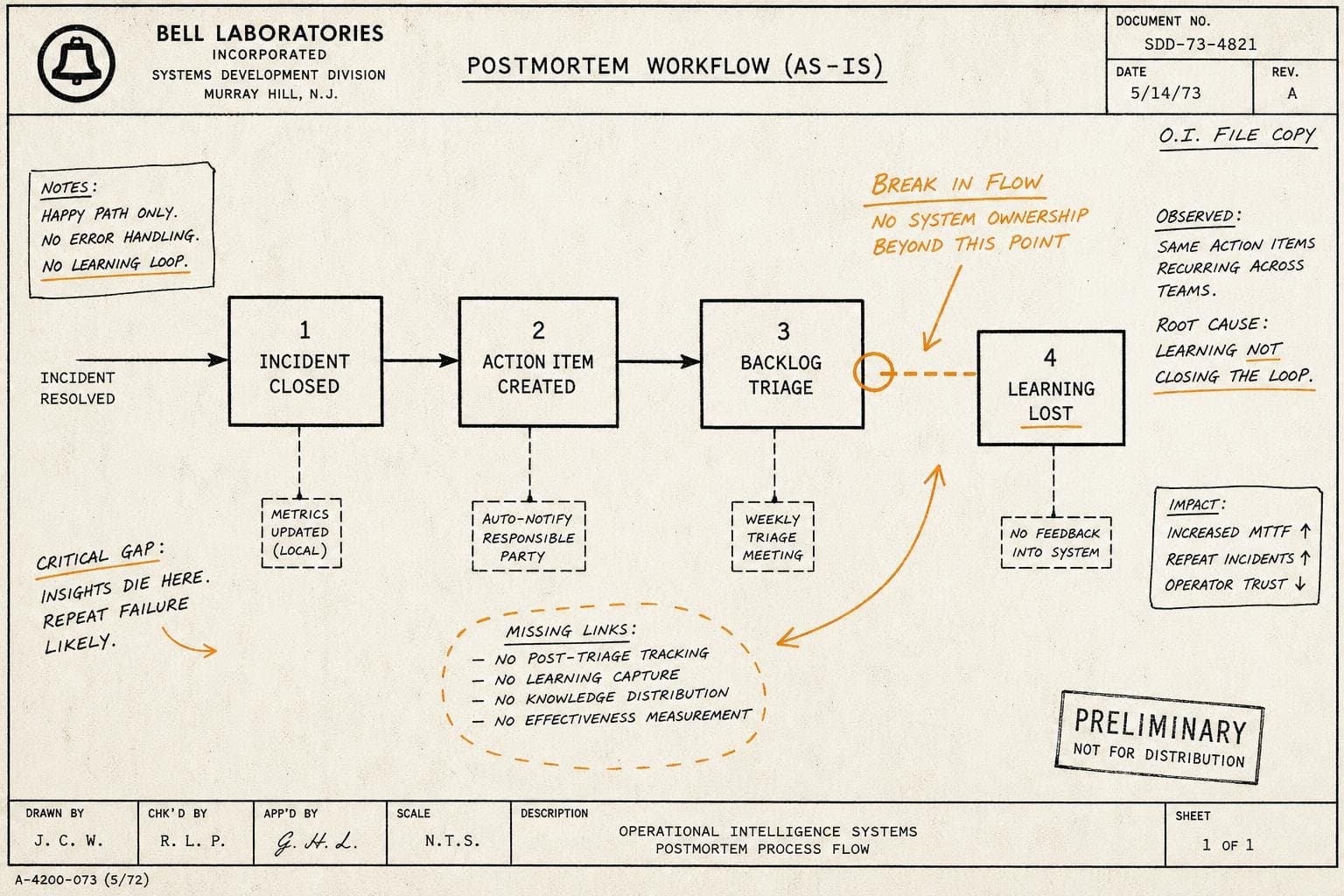

The postmortem is filed. The action items are in Jira. Someone marked the incident resolved at 4:17am and went back to sleep. By Monday morning, the ticket has a due date three sprints out, the engineer who wrote the root cause analysis has moved on to the next fire, and the organizational learning that was supposed to happen has quietly evaporated.
This is the default. Not the exception.
We've covered the mechanics of postmortems before — the difference between asking "what broke" and asking "why were we surprised." But there's a layer underneath that most teams never reach: the gap between capturing an incident and actually metabolizing it. Writing the postmortem is the easy part. Changing how the system behaves — and how the team thinks — is where the work actually lives.
The Action Item Graveyard
Every team has one. It's usually a Jira board or a GitHub project with labels like "reliability" and "tech-debt" and a filter nobody has opened since Q1. The action items from last November's database incident are in there, right next to the ones from the load balancer failure in March. Some of them have been re-estimated twice. None of them are done.
The problem isn't prioritization, exactly. It's that action items from incidents compete against feature work on the same backlog, and feature work has a product manager attached to it. Reliability improvements from a postmortem have an engineer who was awake at 3am attached to them — and that engineer is now exhausted and has a sprint full of other commitments.
The teams that actually close this loop do something structurally different: they treat postmortem action items as a separate class of work with protected capacity, not as suggestions that get triaged alongside everything else. Not a separate team. Not a separate process. Just a standing agreement that some percentage of engineering time belongs to the incidents that already happened, not the features that haven't shipped yet.
The exact percentage matters less than the commitment being real. "We do 20% reliability work" means nothing if that 20% evaporates the moment a deadline moves.
What the Incident Is Actually Telling You
Here's the thing about production failures that most postmortems miss: the specific failure is almost never the point. The database went down because of a misconfigured connection pool. Fine. But why did it take forty minutes to identify the connection pool as the issue? Why did three engineers spend the first twenty minutes looking at the wrong service? Why did the runbook point to a dashboard that hadn't been updated since the migration?
The incident is a symptom. The system that produced it — the monitoring gaps, the knowledge silos, the runbook rot, the alert that everyone ignores — that's the disease. A postmortem that fixes the connection pool configuration and calls it done has treated the symptom. The next incident will be different in its specifics and identical in its structure.
The better question to ask in every postmortem isn't "what caused this?" It's "what made this hard to see, hard to diagnose, and hard to fix?" Those three questions will surface the actual systemic problems. The first question just tells you what to patch.
Teams that get good at this start to notice patterns across incidents that they never would have seen looking at each one in isolation. The same three services show up in every blast radius. The same two engineers are always the ones who actually know what's happening. The same monitoring gap gets rediscovered every six months. That's not bad luck. That's architecture.
The Metric You're Probably Not Tracking
Mean time to detect. Mean time to resolve. These are the standard operational metrics, and they're useful as far as they go. But there's a third number that tells you more about your operational maturity than either of them: mean time to learn.
How long does it take from the moment an incident closes to the moment the team's behavior actually changes? Not the moment the action item is created. Not the moment the runbook is updated. The moment the next engineer on call would handle a similar situation differently because of what the team learned.
For most teams, that number is either infinite (the learning never actually propagates) or unmeasured (nobody's tracking it). The teams that run reliable systems tend to be obsessive about the propagation problem — they do incident reviews in public, they write up near-misses, they build the postmortem findings into onboarding and runbooks and alert documentation. They treat the incident as a curriculum, not a report.
The incident you survived last month is still trying to teach you something. The question is whether your team has built the conditions to actually learn it — or whether the lesson is sitting in a Jira ticket, due date TBD, waiting for a sprint that never comes.
Build the sprint. Do it before the next incident makes the lesson more expensive.