



You've been in this meeting. Fifteen people on a call, someone sharing their screen, a timeline of what broke and when. The incident commander walks through the sequence. A few engineers nod. Someone asks a clarifying question about the database failover. The on-call engineer explains what they did. The incident commander says "good catch" and moves on. Forty-five minutes later, everyone logs off.
Nothing changed. Nothing will change. The same failure mode is sitting in your system right now, patient as ever.
The incident review — the postmortem, the retrospective, whatever your organization calls it — is the highest-leverage learning opportunity in operational work. It's also the one most reliably converted into theater. Not maliciously. Nobody schedules a postmortem hoping to waste everyone's time. But the structural pressures that turn incident reviews into status meetings are strong, and most teams don't fight them deliberately enough.
The Blameless Postmortem Solved the Wrong Problem
The blameless postmortem was a genuine advance. Getting engineers to write honestly about what happened — without fear that the document would be used against them — unlocked a level of operational candor that punitive cultures couldn't reach. That's real. The Google SRE tradition built something important there.
But "blameless" got misread as "comfortable." Teams learned to write postmortems that were honest about the technical sequence and carefully vague about the organizational conditions that made the sequence possible. The database query that took down production gets documented in detail. The fact that the team had flagged that query pattern three sprints ago and the fix got deprioritized — that part tends to stay in the hallway conversation.
Blameless was supposed to mean: we're not looking for a person to punish, we're looking for a system to fix. It got operationalized as: we're not going to say anything that makes anyone uncomfortable. Those are not the same thing.
What a Real Review Is Actually Trying to Produce
A postmortem that doesn't change anything is documentation, not learning. The distinction matters because documentation has a different purpose — it's a record, useful for future reference, valuable for compliance. Learning produces a different output: a team that behaves differently next time.
The test for whether your incident review is producing learning is simple and uncomfortable: what did this team decide to do differently, and how will you know if they did it?
Not action items. Action items are easy to generate and easy to close without impact. "Add monitoring for X" gets closed when the alert is created, regardless of whether the alert is useful. "Improve documentation for Y" gets closed when someone edits the runbook, regardless of whether the runbook is now accurate. The question is whether the underlying condition that made this incident possible has actually changed.
This requires the review to go somewhere most teams avoid: the organizational decisions that shaped the technical conditions. Why was that service running without a circuit breaker? Because the team that owned it was understaffed and the reliability work kept getting pushed. Why was the on-call engineer the only person who understood the failover procedure? Because knowledge transfer is hard to prioritize when the roadmap is full. These aren't comfortable questions. They're also the only questions that produce durable change.
The Structural Fix Most Teams Skip
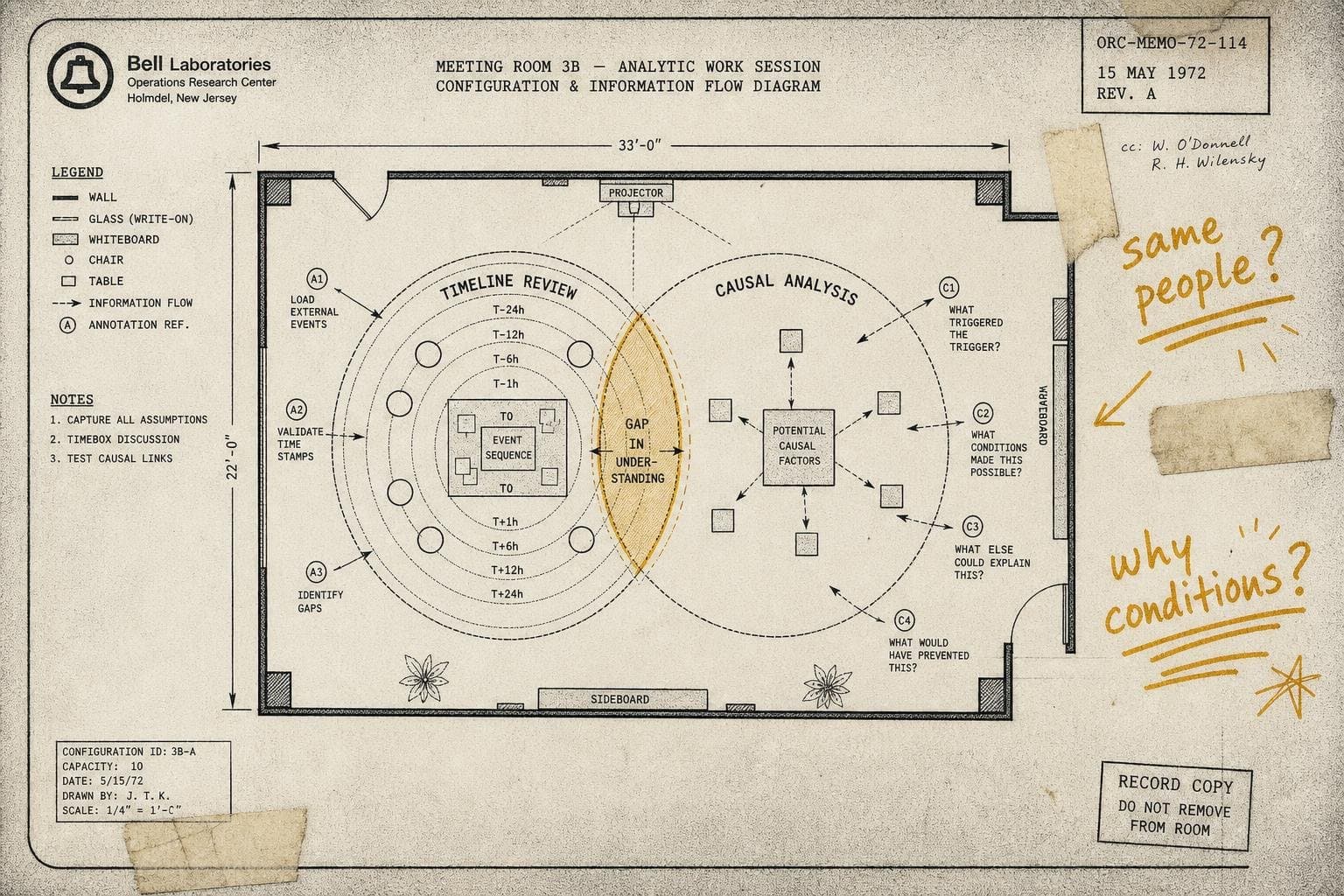
The most reliable way to make incident reviews produce learning rather than documentation is to separate the timeline review from the causal analysis — and run them with different people in the room.
The timeline review needs the people who were in the incident: the engineers who were paged, the incident commander, anyone who made a significant decision during the response. Get the sequence right. Understand what information was available at each decision point. This part should be relatively fast.
The causal analysis needs a different composition. It should include people who weren't in the incident — engineering managers, platform leads, whoever owns the systems and processes that created the conditions. The engineers who were paged are witnesses to what happened; the people who weren't paged are often better positioned to ask why the conditions existed in the first place.
Most teams run these as one meeting, which means the causal analysis gets crowded out by timeline reconstruction, and the people with organizational authority to change conditions spend the meeting learning what happened rather than interrogating why.
Split the meeting. Run the timeline review within 48 hours while memory is fresh. Schedule the causal analysis separately, with explicit agenda time for the organizational questions. Assign someone — not the incident commander, who is usually exhausted — to prepare the "why did these conditions exist" framing before the second meeting.
The incident review is the moment where operational learning either happens or doesn't. Everything else — the monitoring, the runbooks, the escalation paths — is downstream of whether your team actually changes behavior after things break. A postmortem that produces a comfortable document and a list of action items that will be closed without impact is worse than no postmortem at all, because it creates the illusion of learning while the underlying conditions sit unchanged, waiting.
The 3am page that's coming for you in six months is probably already in your last postmortem. The question is whether anyone read it that way.