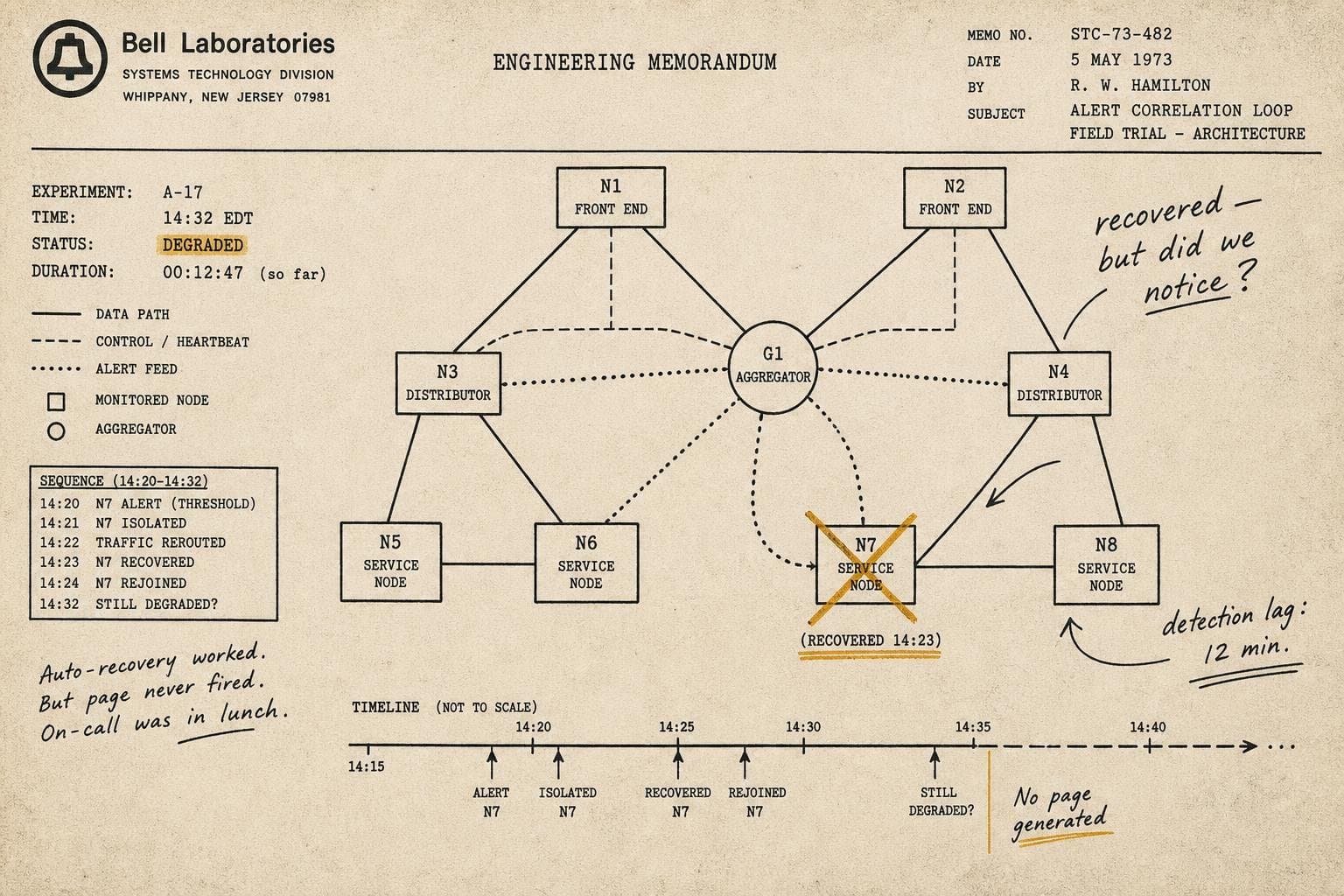

You schedule the chaos experiment for Tuesday at 2pm. You kill a pod. The system recovers. You write "resilience validated" in the ticket and close it. Three weeks later, a real failure takes down the service for forty minutes.
What went wrong? The experiment worked. The system recovered. The runbook was followed. And yet.
The gap between controlled failure injection and actual production incidents is one of the most underappreciated problems in reliability engineering. Teams invest heavily in chaos engineering — and they should — but the practice has developed a theater problem. The experiment becomes the goal rather than the question.
Controlled Conditions Are the Problem, Not the Solution
Chaos engineering's core promise is sound: inject failure deliberately, observe behavior, fix weaknesses before they find you at 3am. The practice has genuine value. But there's a structural flaw in how most teams run these experiments that limits what they actually learn.
Real failures don't arrive alone. They arrive in combinations, at inconvenient times, against systems already under load, operated by engineers who are context-switching from three other things. A pod killed on a Tuesday afternoon by an engineer watching the dashboards is a fundamentally different event than a pod dying at 11pm during a traffic spike when the on-call engineer is mid-handoff and the monitoring dashboard — as I wrote about a few weeks ago — is the one nobody actually looks at during an incident.
The controlled experiment validates the happy path of your resilience design. It does not validate your team's ability to detect, diagnose, and respond to failure under realistic conditions. Those are different things, and conflating them is where the theater starts.
The tell is in what teams measure after a chaos experiment. Most measure recovery time and system behavior. Fewer measure detection time — how long before anyone noticed something was wrong. Almost none measure the quality of the diagnostic process: did the responding engineer understand what was happening, or did they get lucky?
What the Experiment Doesn't Inject
Consider what a real incident contains that a chaos experiment typically omits:
Ambiguity. Real failures often don't announce themselves cleanly. Symptoms appear in one service while the root cause lives somewhere else. The chaos experiment usually has a known blast radius; the real incident does not. Engineers in chaos experiments know they're in an experiment. Engineers in real incidents are deciding, in real time, whether this is a real incident.
Compounding state. Production systems accumulate state — queues backing up, caches warming or cooling, retry storms building. A chaos experiment run against a freshly deployed, lightly loaded system misses the failure modes that emerge from accumulated operational state. The most dangerous failures tend to happen when a system is already stressed.
Organizational friction. Who's actually on call? Are they familiar with this service? Is the runbook current? (It probably isn't — I've written about this before.) Is the escalation path clear? Chaos experiments rarely stress the human coordination layer, which is frequently where real incidents actually break down.
None of this means chaos engineering is wrong. It means the experiment is answering a narrower question than teams often assume it is.
What to Inject Instead
The most useful shift is treating chaos experiments as hypothesis tests rather than validation exercises. Before you run the experiment, write down your specific prediction: "When we kill this pod, the load balancer will redistribute within 30 seconds and error rates will spike to X% before recovering." Then run it. If the prediction was wrong — even if the system recovered — that's a finding worth investigating.
This reframes the experiment from "does the system survive?" to "do we understand the system well enough to predict its behavior?" The second question is harder and more honest.
Beyond that: vary the conditions deliberately. Run experiments during high-traffic periods when you can afford to (with appropriate safeguards). Run them against systems that have been running for weeks, not freshly deployed ones. Occasionally, don't tell the on-call engineer it's an experiment — run a gameday where the scenario is realistic enough that the team has to treat it as real. The discomfort of that exercise is the point.
And measure detection, not just recovery. If your chaos experiment killed a service and it took twelve minutes before anyone noticed, that's the finding. The recovery time is almost irrelevant if detection is that slow.
The Honest Version of Resilience Testing
The teams I've seen do this well share a common trait: they're more interested in what they don't know than in confirming what they do. They run chaos experiments expecting to find gaps, not to validate that gaps don't exist. When the system recovers cleanly, they ask why — and whether that recovery would hold under conditions they haven't tested yet.
That posture is harder to maintain than it sounds. There's organizational pressure to show that the system is resilient, that the investment in reliability engineering is paying off. A chaos experiment that produces a clean recovery is a satisfying artifact. One that exposes a detection gap or a runbook failure is uncomfortable.
But uncomfortable findings are the only ones that make the system more reliable. The experiment that tells you everything is fine is the one you should trust least.


