


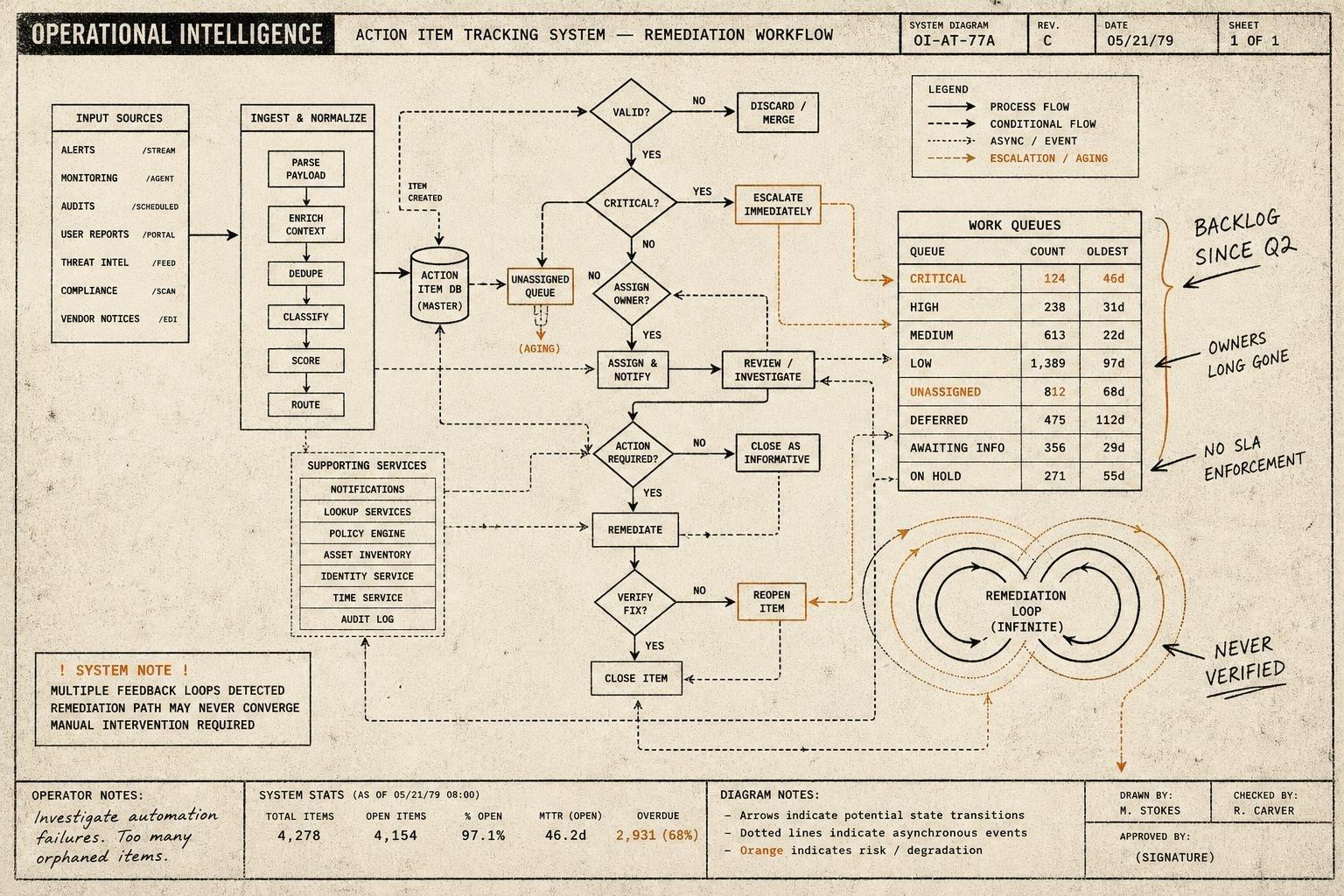

Every postmortem ends the same way: a list of action items, each one assigned an owner, each one meant to make sure this particular failure never happens again. Six months later, most of that list is still open. Nobody re-reads it until the next outage looks suspiciously familiar, and then someone pulls up the old doc and says some version of "wait, didn't we already write this down?"
That's not a failure of discipline. It's what happens when you treat remediation work as a side project instead of a workload.
The List Grows Faster Than the Team Can Clear It
Postmortem culture, as it's practiced across most SRE organizations, optimizes for the writing of the document, not the execution of its recommendations. The retro happens, the root cause gets documented, the action items get filed into a tracker, and the team moves on to the next sprint's feature work. Each individual incident produces two or three remediation tasks that feel reasonable in isolation — add a circuit breaker here, tighten an alert threshold there, write a runbook for that edge case. But incidents don't arrive one at a time with space between them for cleanup. They arrive in clusters, usually right when the team is already underwater, and the backlog compounds.
The honest version of this problem is that action items compete with feature work for the same engineering hours, and feature work has a product manager attached to it who shows up in planning meetings. Reliability debt doesn't have a champion unless someone on the team deliberately assigns it one. So the fixes that would prevent the next page sit in a backlog column labeled "reliability" that nobody triages with the same rigor as the product roadmap.
Closing a Ticket Is Not the Same as Fixing the Problem
There's a second, quieter failure mode once teams do start taking the backlog seriously: closing the ticket becomes the goal instead of closing the gap. An action item that says "add monitoring for queue depth" gets satisfied by a dashboard panel nobody watches. An item that says "document the failover procedure" gets satisfied by a wiki page that's never been run live. The box gets checked. The system is no safer than it was before the incident that generated the ticket.
This is the same pattern I've written about before when it comes to runbooks that lie and dashboards nobody opens during an incident — the artifact exists, but the artifact was never tested against the condition it's supposed to protect against. Action items inherit that same risk, because the pressure to clear the backlog rewards the appearance of remediation over the verification of it. A team under review pressure will produce evidence of closed tickets faster than it will produce evidence of actual resilience, because the first is easy to measure and the second requires someone to go break the thing again on purpose.
What Actually Clears the Backlog
The teams that keep their remediation backlog from calcifying tend to do a few unglamorous things consistently. They cap the number of open action items per incident and force prioritization at the time of the retro, instead of letting every idea generated in the heat of a postmortem discussion become its own ticket. They route the highest-severity remediation items into the same sprint planning process as customer-facing work, with an owner who has to defend not doing it, rather than a backlog that only gets attention when someone's bored. And they periodically audit old closed tickets against the incidents that follow — if the same root cause shows up twice, that's a signal the first fix wasn't real, not that the team got unlucky twice.
None of this is clever. It's closer to maintenance than to engineering, which is probably why it gets deprioritized. Nobody gets promoted for clearing a two-year-old monitoring ticket. But the alternative is a reliability program that looks thorough on paper — full of postmortems, full of documented root causes, full of action items with due dates — and still produces the same page at 3am that it produced last year, because the fix that would have stopped it is sitting in a column nobody's opened since the day it was filed.
The question worth asking at your next retro isn't whether you wrote down what to fix. It's whether anyone's checking, a quarter later, whether the fix actually works.