


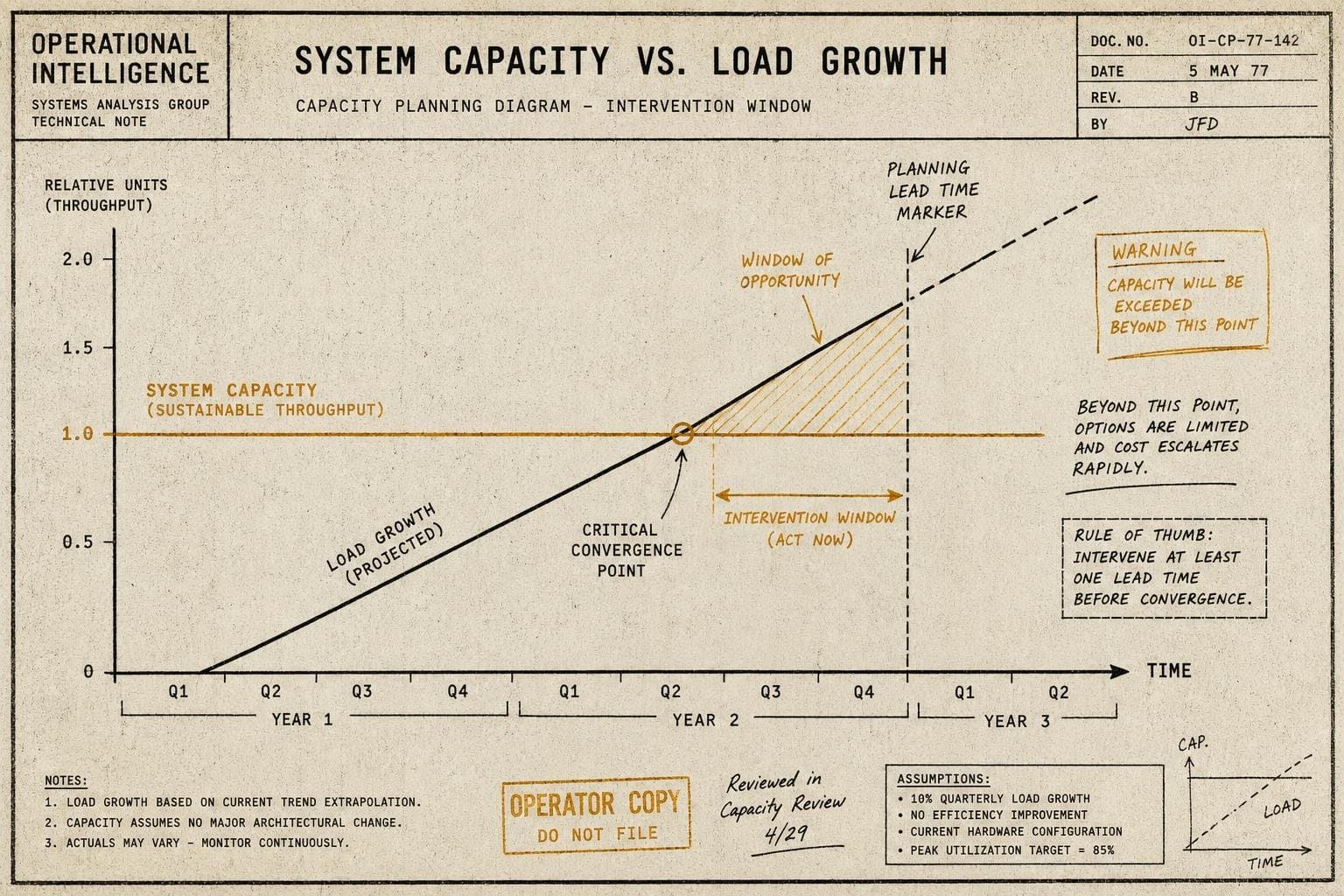

Nobody gets paged because capacity planning didn't happen. That's the problem. The pager goes off because a queue backed up, a database ran out of connections, or a service started shedding load — and by the time anyone's staring at a dashboard at 3am, the actual failure happened weeks earlier, in a planning meeting that never took place.
I've watched this pattern repeat across more teams than I can count: capacity work gets done reactively, in the panic before a known traffic spike, or not at all until the spike arrives uninvited. It's one of the few disciplines in operations where the cost of neglect is deferred so far into the future that it stops looking like a cost at all — until the quarter it isn't.
The Incentive Problem Is Structural, Not Personal
Capacity planning loses the prioritization fight for a boring reason: it competes against features, and features have a date attached while capacity risk doesn't. A product launch has a deadline. A migration has a deadline. "We might run out of headroom in six months if growth continues at the current rate" doesn't have a deadline — it has a probability distribution, and probability distributions lose to roadmaps every time.
This isn't a failure of individual engineers being lazy about math. It's what happens when an organization's planning cycle (quarterly, usually) is shorter than the lead time on the thing that actually fails (database resharding, hardware procurement, architectural changes to a bottlenecked service). By the time the warning signs are unambiguous enough to justify the work, the lead time to fix it is often longer than the time remaining before the problem bites.
The teams that handle this well tend to treat capacity headroom the way they treat error budgets: as a number someone owns and reports on continuously, not as a special project that gets spun up when someone notices CPU trending up on a graph. The ones that handle it badly treat it as a fire drill — something you do the week before Black Friday or the week before a marketing team announces a traffic-driving campaign nobody told infrastructure about.
Graceful Degradation Is the Admission That Planning Will Fail Sometimes
Here's the uncomfortable truth under all of this: even good capacity planning doesn't guarantee you won't get overwhelmed. Growth forecasts are wrong. Marketing campaigns outperform expectations. A dependency you don't control has its own bad day at the worst possible moment. The systems that survive these moments aren't the ones that predicted the load perfectly — they're the ones built to degrade in a way a human chose, rather than a way the system discovered on its own at the worst possible time.
That distinction matters more than it sounds. A system that falls over because a queue fills up and workers start timing out is failing randomly — whichever requests happen to be in flight when the collapse starts are the ones that get dropped, including the ones that matter most. A system that's been designed to shed load deliberately — turning off non-critical features, serving cached or degraded responses, prioritizing the actions that matter — fails in a way someone decided on in advance, calmly, without a pager going off.
This is the part that gets skipped most often, because it requires work that has no visible payoff until the one day it does. Nobody gets promoted for building a load-shedding path that activates once every eighteen months. But that's exactly the kind of boring, invisible reliability engineering that separates teams who have a bad afternoon from teams who have a bad quarter.
Ownership Is the Real Gap
The organizational failure mode I see most often isn't a lack of monitoring or a lack of technical sophistication. It's a lack of clear ownership. Capacity sits at the intersection of infrastructure, individual service teams, and whoever owns the business forecast that's driving growth — and when a risk sits at an intersection like that, it's nobody's job until it's everybody's emergency. The teams that get this right usually have one group explicitly accountable for tracking headroom against growth trends and escalating early, with enough organizational authority to make that escalation land before the roadmap is already locked.
The next time your team heads into a known high-traffic period — a launch, a seasonal peak, an event you can see coming on the calendar — pay attention to whether the capacity conversation happens as its own agenda item or gets squeezed in as a caveat at the end of a planning meeting. That's usually the tell for whether you're planning for growth or just hoping it stays polite.