
Blythe Carey checked that her gynecologist was in-network before her appointment. She showed her insurance card. Nobody flagged a problem. Weeks later she got a bill for $963 because the doctor had actually left the network, per The New York Times. That story is about Medicare Advantage, not medical debt negotiation specifically, but it's a clean illustration of the real problem underneath most medical bills: the number on the page was never a fixed, verified fact. It's a output of a system with gaps, stale records, and coding errors, and it's often wrong in the provider's favor.
That's the premise worth sitting with before you negotiate anything. You're not asking for a favor. You're correcting a number that was probably never right to begin with.
Why Medical Debt Behaves Differently Than Every Other Bill You Owe
With a car loan or a credit card, you agreed to a number up front — you know the balance, the schedule, what happens if you miss a payment. Medical debt skips that whole negotiation. You get treated, then you find out what it costs, and the billed amount frequently has little relationship to what the provider will actually accept, per Yahoo Finance.
That gap is exactly why medical debt is more negotiable than other consumer debt. Providers would often rather collect something now than chase the full balance through collections for months, per Yahoo Finance. The incentive isn't generosity — it's that pursuing the full amount is expensive and uncertain for them too.
What Actually Moves the Number
Two things work consistently, and neither requires a debt settlement company taking a cut.
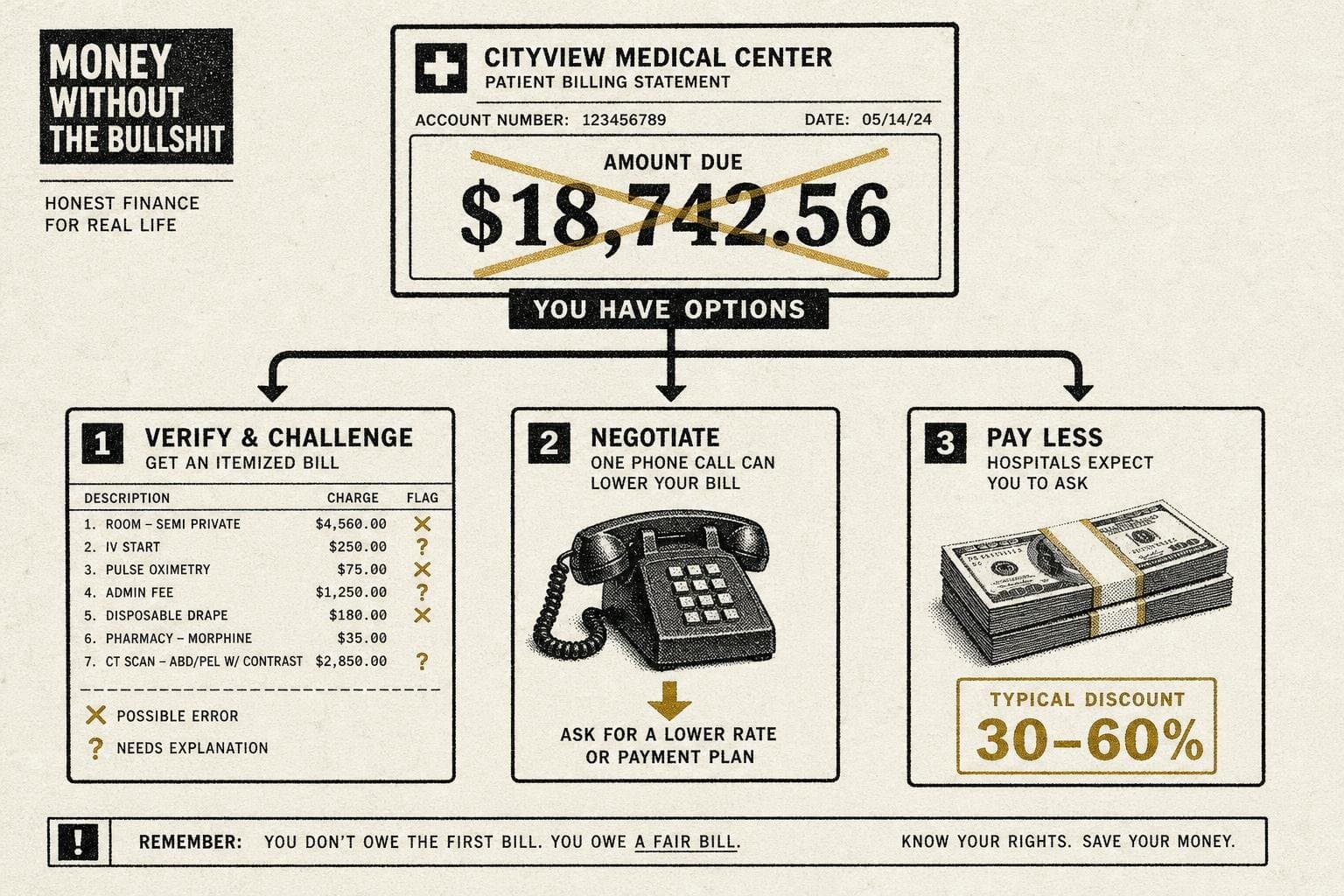
Ask for the itemized bill before you pay anything. Hospital billing systems generate errors constantly — duplicate charges, services never rendered, wrong codes. You can't negotiate from a summary statement; you need the line items to find what's actually wrong or inflated.
Call and ask for a reduction or a payment plan, explicitly. NerdWallet lists negotiating costs directly with the provider and setting up a payment plan among the standard options for dealing with medical debt, alongside using credit as a last resort. The mechanism is simple: you tell billing you can't pay the full amount, you ask what they can do, and you let silence sit instead of filling it. Hospitals and practices have financial assistance policies that aren't advertised on the bill itself — you often have to ask specifically.
Lump-sum settlement is a real lever, with a real tradeoff. If you have some cash available — savings, a tax refund, whatever — offering a smaller amount paid immediately in full can get a discount that a payment plan won't, because the provider is trading a smaller guaranteed amount now for the uncertainty of collecting the full balance over months, per Yahoo Finance. That only makes sense if the cash you'd use isn't your emergency fund, and if you get the settlement terms in writing before you send money — verbal agreements about debt forgiveness have a way of evaporating once the check clears.
The closest cousin to this logic shows up in how the government itself handles debt it can't fully collect. The IRS's own offer-in-compromise program lets taxpayers settle a tax debt for less than the full amount owed when paying it in full would mean real hardship, and the agency decides case by case what it can realistically expect to collect, per the IRS. Same principle, different collector: an institution weighing a smaller guaranteed payment against the cost and uncertainty of chasing the full balance.
The Thing People Skip: Confirming It in Writing
None of this works if you negotiate by phone and never get the result documented. Ask for written confirmation of any reduced balance, payment plan terms, or settlement agreement before you pay a dollar. A biller telling you "we'll take care of it" is not a contract. This matters more with medical debt than most other categories, and the surprise-billing pattern in the Times's Medicare Advantage reporting is a reminder of how easily a verbal assurance — "yes, that doctor's in network," "yes, we'll adjust that" — turns out not to hold up once the bill actually arrives. Get the paper trail. A dispute later is only as strong as what you can prove you agreed to.
What doesn't work, or at least isn't guaranteed to: assuming every provider has the same policy, assuming a payment plan is automatically better than a lump sum, or assuming your situation looks like your neighbor's. NerdWallet frames these as parallel options precisely because the right one depends on your own cash position, not on which strategy sounds most aggressive. A single parent on a tight income has a different calculus than someone with six months of expenses in savings — the first should prioritize protecting liquidity and may do better with a structured plan even at a smaller discount; the second may come out ahead paying a lump sum fast.
The bill you got isn't the final answer. It's the opening bid in a conversation most people never start.


