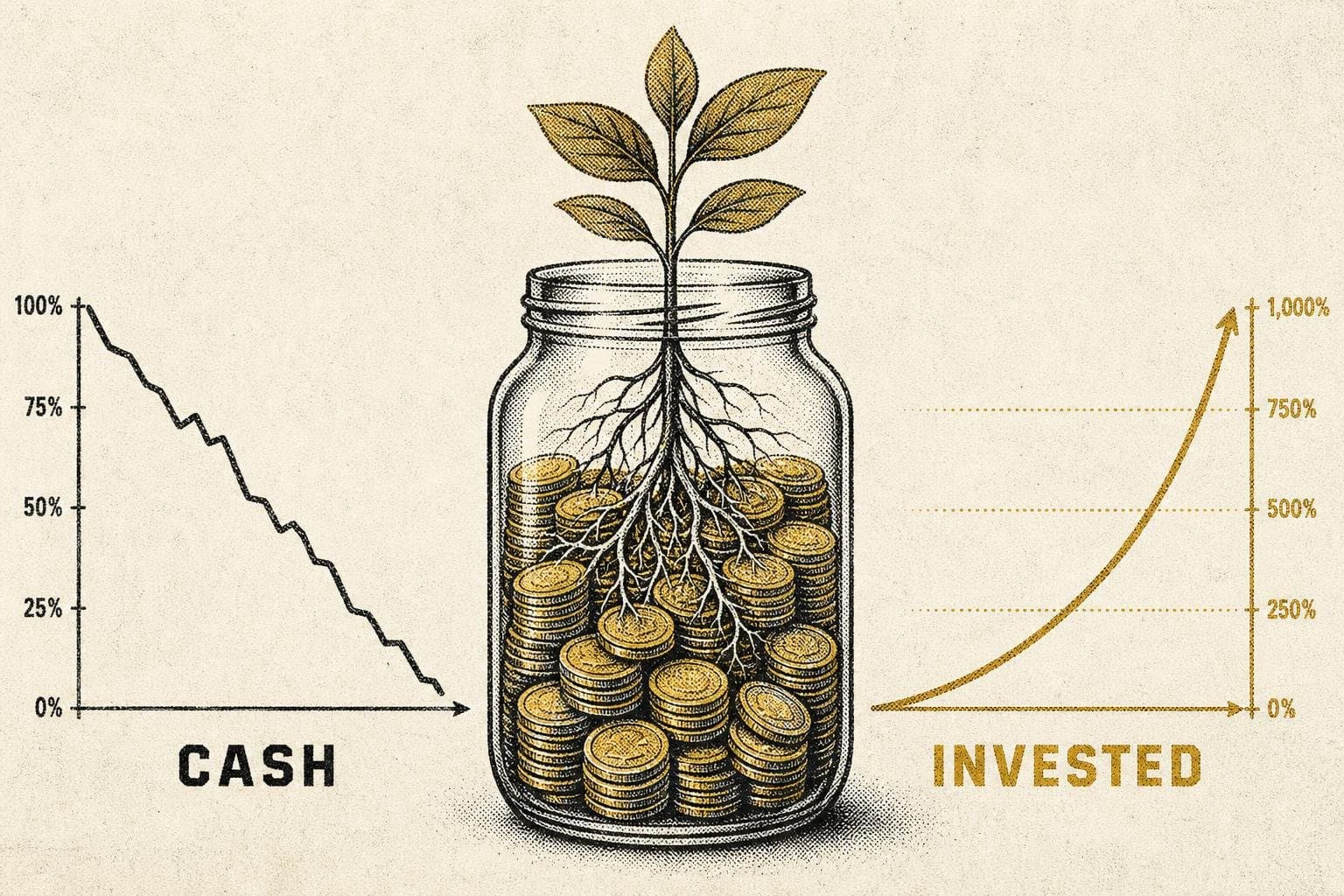

Most people with an HSA treat it like a medical checking account: money goes in, money comes out when something hurts. That's not wrong, exactly — it's just leaving the most tax-efficient account in the American system doing the least possible work.
The HSA's reputation as a "retirement tool" has become a personal finance cliché at this point. But the cliché skips the part that actually matters: the strategy only works if you invest the balance, and most people don't.
The Triple Tax Thing Is Real, But It Has a Catch
The pitch is accurate. An HSA is the only U.S. account that gives you a tax deduction going in, tax-free growth, and tax-free withdrawals for qualified medical expenses — all three, simultaneously. A traditional 401(k) gives you the deduction. A Roth gives you the tax-free growth and withdrawal. The HSA does both, plus the middle.
For 2026, the contribution limits are $4,400 for self-only coverage and $8,750 for family coverage, per IRS Revenue Procedure 2025-19. If you're 55 or older, you can add another $1,000 per person. After age 65, you can withdraw for any reason — not just medical — and it's taxed as ordinary income, the same as a traditional IRA. Qualified medical withdrawals stay tax-free at any age.
One state caveat that matters: California and New Jersey do not conform to federal HSA rules and may tax contributions or earnings at the state level. If you live in either state, you still get the federal benefits, but your state tax picture is different. Check your state's current treatment before assuming the full advantage applies.
The catch embedded in all of this: none of it compounds unless you actually invest the money.
The Default Setting Is Killing Your Returns
Here's the failure mode that's more common than it should be: your HSA contributions land in a cash account earning somewhere between nothing and almost nothing. Most HSA custodians pay roughly 0.05% to 0.50% APR on cash balances — functionally zero. And most default new contributions to cash, even if you've previously set up an investment allocation.
A custodian change can silently reset your auto-invest settings. A widely-shared Reddit thread described a user who lost over two years of compound growth because their balance defaulted back to cash after their employer switched providers — and they didn't notice.
The math on this is stark. Contributing the 2026 self-only maximum and investing at a 7% annual return over 35 years compounds to roughly $650,000. The same dollars sitting in cash at 0.5% APR over the same period produces roughly $167,000. That gap — around $483,000 — is the cost of the default setting. (Note: these projections assume consistent contributions and a steady 7% real return, which is a simplification; actual returns vary.)
The action item is boring but necessary: log into your HSA provider, find the investment section, and confirm your balance is actually invested. Don't assume. Check.
What to Actually Invest In (Without Overthinking It)
The investment menu varies by provider, which is one of the genuinely annoying things about HSAs. But the strategy doesn't require a sophisticated portfolio. Broad-market index funds — the same ones you'd hold in a Roth IRA — are the standard approach, ranked by expense ratio and diversification.
If your provider is Fidelity, you have access to their ZERO-fee index funds. If you want a single-decision option, a target-date fund handles allocation automatically and adjusts as you age. If you want more control, a two-fund combination of a U.S. total market fund and an international fund covers the basics. The specific fund matters less than the decision to invest at all.
One practical note: the HSA contribution limit counts all sources combined — your contributions, your employer's contributions, everything. If your employer puts $1,000 into your family HSA, your personal maximum for 2026 drops to $7,750. Factor that in before you set your contribution rate.
The Actual Strategy, Stated Plainly
The HSA-as-retirement-account strategy has two moving parts. First, invest the balance — don't let it sit in cash. Second, if your cash flow allows it, pay current medical expenses out of pocket and let the HSA balance compound. The IRS doesn't require you to reimburse yourself immediately; you can pay a medical bill today, keep the receipt, and reimburse yourself from the HSA years later — tax-free — after the balance has grown.
That second part requires you to have enough cash flow to cover medical costs without touching the HSA, which isn't realistic for everyone. If you need the HSA to cover actual healthcare costs, use it for that — the tax-free medical withdrawal is still a better deal than most accounts offer. The strategy scales to your situation; it doesn't require you to be wealthy to start.
The constraint to identify first: can you afford to leave the HSA invested, or do you need it as a medical expense buffer? Answer that honestly, then build from there.


