
Most people treat their emergency fund as a parking problem — get the money somewhere safe, stop thinking about it. The "somewhere safe" they pick is usually the same bank that handles their paycheck, because that's the path of least resistance.
That decision is costing them hundreds of dollars a year.
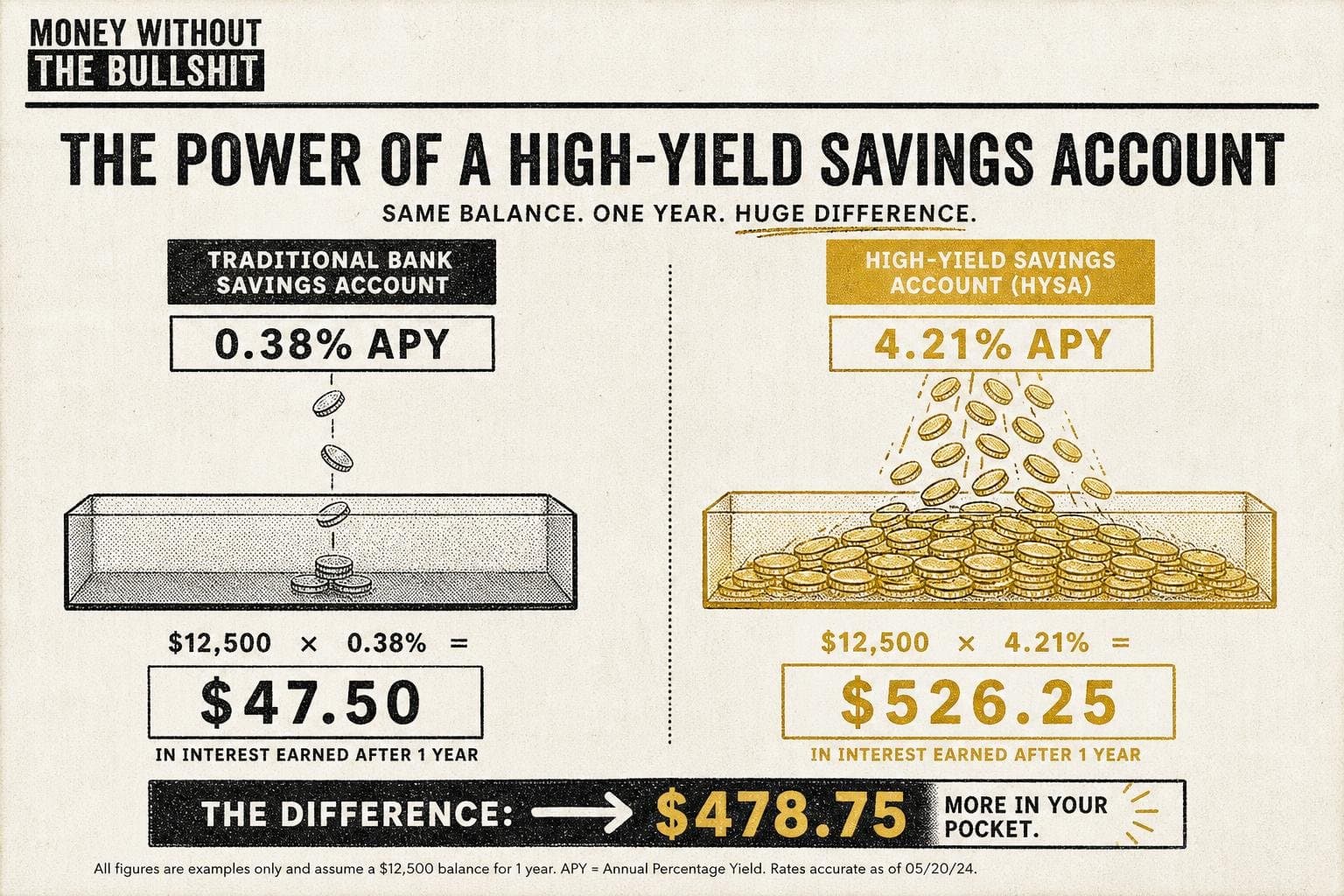
The FDIC national average savings rate sits around 0.38% APY. Top high-yield savings accounts — the online-only kind — are currently running around 4%, with some accounts reaching 4.21% as of August 2026. On a $12,500 balance (roughly three months of expenses for a lot of households), that gap works out to about $450 a year. Not life-changing. Not trivial either. And the fix requires no change to your spending habits, no new financial strategy, and no spreadsheet.
Before we get to where to park it, though, there's a prior question most people skip: how much do you actually need?
The "3-6 Months" Rule Is a Starting Point, Not a Target
I've written before about how the standard emergency fund guidance answers the wrong question. The 3-to-6-month rule tells you a range; it doesn't tell you where in that range you belong, or whether the range even fits your situation.
Here's the faster version of the sizing logic: your emergency fund is insurance against income disruption. So the right question is how long your income could plausibly be disrupted, and what your non-negotiable monthly costs are during that period.
A few variables that actually move the number:
Job replaceability. If you work in a field where comparable jobs take two weeks to find, you need less cushion than someone in a specialized role where searches run three to six months. The Bureau of Labor Statistics tracks median unemployment duration by occupation and industry — as of recent data, median unemployment duration has been running around 9-10 weeks nationally, though this varies significantly by sector and local labor market conditions.
Income structure. One income, two incomes, freelance, seasonal — these change your exposure dramatically. A dual-income household where both jobs are stable has a built-in partial hedge. A single-income household with variable pay has almost none.
Fixed obligations. Mortgage or rent, car payment, insurance premiums, minimum debt payments — these are the costs you can't defer. Your emergency fund needs to cover these, not your full lifestyle spending. If your fixed monthly obligations are $2,800 and your total spending is $4,200, you're sizing to $2,800, not $4,200.
Run that math and you'll often find the "right" number is either lower than you thought (if you have stable dual income and low fixed costs) or higher (if you're the sole earner with a mortgage and a specialized job). The 3-to-6-month rule is a reasonable first approximation — it's just not a substitute for five minutes of actual arithmetic.
Where to Park It: The Rate Gap Is Real and Fixable
Once you have a target, the parking question has a pretty clear answer right now, with one important caveat.
High-yield savings accounts at online banks are currently offering rates up to 4.15-4.21%, are FDIC-insured, and keep your money fully liquid. That last part matters — an emergency fund locked in a CD does you no good when the furnace dies in January. The liquidity-plus-yield combination makes HYSAs the obvious home for most emergency funds at current rate levels.
The caveat: these rates are variable. They move with the federal funds rate, which Federal Reserve Governor Lisa Cook noted in an August 2026 speech remains subject to ongoing assessment as inflation stays stubborn. If the Fed cuts rates, HYSA yields will follow. That's not a reason to avoid them — it's a reason to check your rate annually rather than set it and forget it for five years.
A few practical notes on the switch:
- Opening a HYSA at a separate online bank takes about 10 minutes and a routing number. You don't need to close your existing account or change your direct deposit.
- Keep one to two months of expenses in your regular checking account as a buffer. The HYSA is for the deeper reserve — the money you'd need if you lost your job, not the money you need because your car registration is due.
- Some online banks impose limits on monthly transfers out of savings accounts. Check this before you open one — you want to confirm you can actually access the money when you need it.
The Real Cost of Doing Nothing
At a $10,000 balance, the difference between the average bank rate and a competitive HYSA works out to roughly $362 a year. Over a decade at those rates, the compounding gap is substantial — though rates will obviously move over that period, so treat the long-run projection as directional rather than precise.
The point is simpler than the math: your emergency fund is money you're holding in reserve specifically because you might need it. It should be safe, liquid, and earning something reasonable. Right now, "something reasonable" is available and easy to access. The only thing standing between most people and $300-500 a year is a form they haven't filled out yet.


