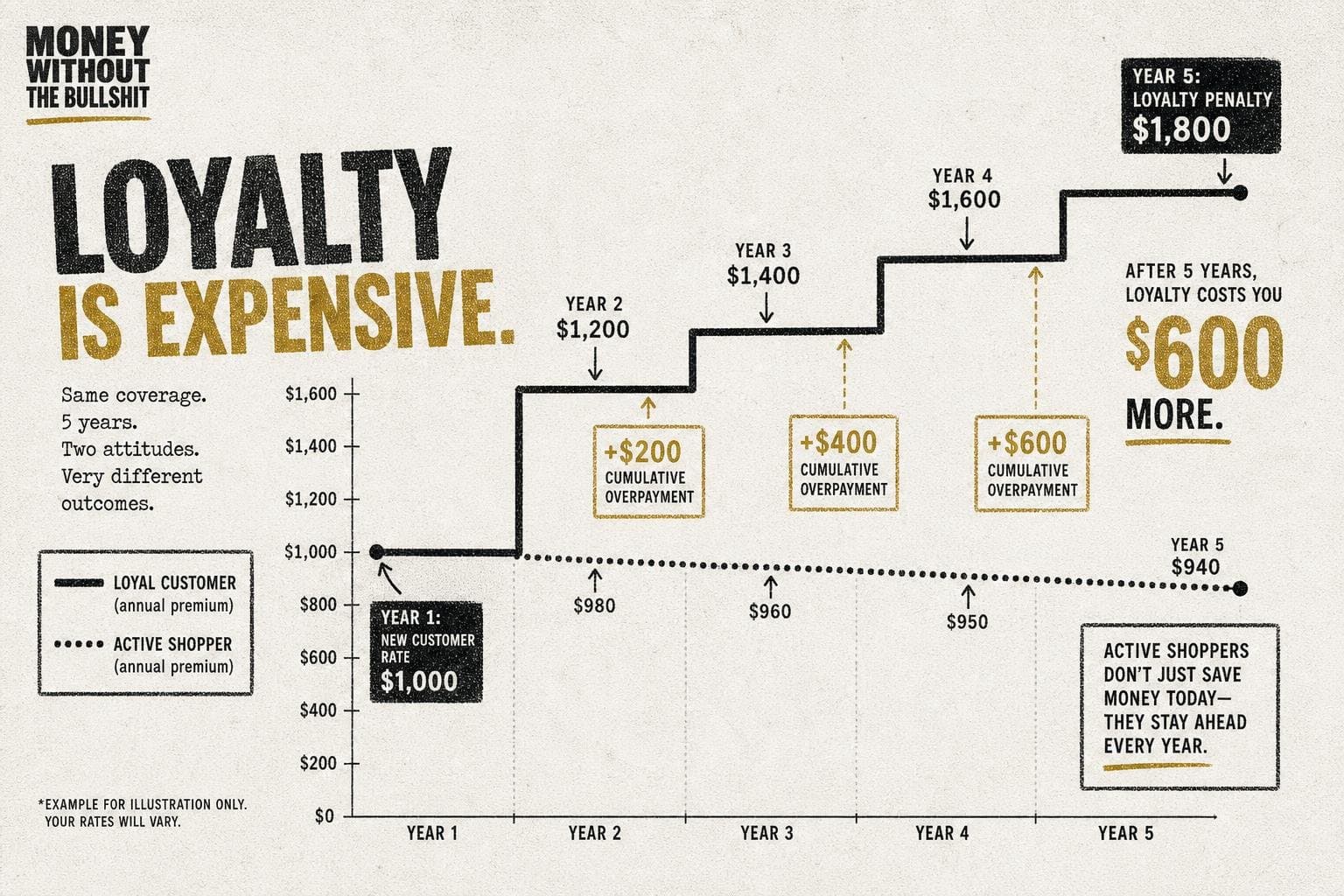

The auto insurance industry has a business model that depends on inertia. You sign up, set up autopay, and forget about it — and every year your premium quietly climbs while your insurer quietly profits from the fact that you haven't noticed. This is not a conspiracy theory. It's a documented pricing strategy called "price optimization," and it's exactly why shopping your car insurance on a regular cycle is one of the few personal finance moves that actually pays off without requiring a spreadsheet addiction.
Here's the current setup: the wave of aggressive premium hikes that defined 2023 and 2024 is starting to cool. According to JD Power's 2026 U.S. Insurance Shopping Study, released in June 2026, the share of customers actively shopping for auto insurance has declined as prices ease — which means most people are easing off the gas precisely when the competitive environment is most in their favor. Insurers are hungry for new customers right now. That's leverage you're leaving on the table.
The Loyalty Penalty Is Real, and It Compounds
The core problem with staying with one insurer indefinitely is that your premium gets adjusted based on your renewal behavior, not just your risk profile. GOBankingRates reported in June 2026 that loyalty to your insurance company can cost you hundreds of dollars annually — not because you're a worse driver, but because insurers have learned that long-tenured customers are less price-sensitive and less likely to leave.
This is the constraint worth identifying: the price you're paying today is partly a function of how long you've been paying it. The longer you stay, the more your insurer knows you'll stay, and the less competitive your rate needs to be. New customers, by contrast, get acquisition pricing — the insurer's best offer, because they're trying to win business.
The math compounds over time. A $200 annual overpayment in year one becomes a $200 overpayment in year two, year three, and so on — while a competitor would have offered you a better rate at each renewal. The "cost of doing nothing" here is not a one-time hit; it's a recurring drag.
What the Market Looks Like Right Now
The JD Power 2026 Shopping Study found that customers are getting more quotes than ever — 3.5 on average — and that competitive pricing is the primary factor keeping shoppers engaged through the process. States in the South are showing particularly high shop-and-switch rates, which suggests regional pricing variation is significant enough to make geography a relevant variable in your own calculation. Insurance rules and rate-setting practices also vary by state, so what's driving prices in one market may not apply in another — a point worth keeping in mind before you treat any single quote as a national benchmark.
Separately, JD Power's 2026 U.S. Auto Insurance Study found that only 58% of customers fully understand their auto policy coverage. That's a compounding problem: you can't evaluate whether you're getting a fair deal on coverage you don't understand. And it tracks with a broader pattern — NerdWallet's auto insurance comparison tools exist precisely because decoding what you're actually buying, across carriers, is genuinely confusing for most people.
One other data point from the JD Power Auto Insurance Study worth flagging: roughly one-third of auto insurance shoppers are now using AI tools to compare coverage, and those who do are significantly more likely to switch. The friction of shopping — getting quotes, comparing apples to apples, understanding what you're actually buying — has been the main reason people don't do it. That friction is decreasing.
When to Shop, and What to Actually Compare
The "every 2-3 years" framing is reasonable as a default cadence, but the more useful triggers are event-based:
- Your premium increased at renewal — even a modest increase is a signal to get competing quotes before you accept it.
- Your life circumstances changed — moved to a new ZIP code, added or removed a vehicle, changed your commute, hit a birthday that moves you into a lower-risk age bracket.
- Three years have passed with no changes — at that point, the loyalty penalty has had time to accumulate and the market has likely shifted enough that your rate is no longer competitive.
Context matters here too. The Federal Reserve's July 2026 Beige Book noted that prices rose at a robust pace across the Eighth District, with elevated costs weighing on consumer sentiment broadly — a reminder that insurance premiums don't move in isolation from the wider price environment. When everything costs more, the savings from a competitive insurance quote hit harder in relative terms.
When you do shop, compare the same coverage limits and deductibles across quotes — not just the premium. A lower premium on a policy with a higher deductible or lower liability limits is a different product, not a better deal. And note that insurance pricing varies significantly by state; any specific rate you see cited somewhere else should be treated as illustrative, not predictive of your situation.
The actual work here is about 45 minutes every few years. Get three or four quotes, compare them on identical terms, and make the call. Your current insurer may even match a competitor's offer if you ask, which takes the friction of switching off the table entirely.
The market is soft right now. Your insurer is hoping you don't notice.


