


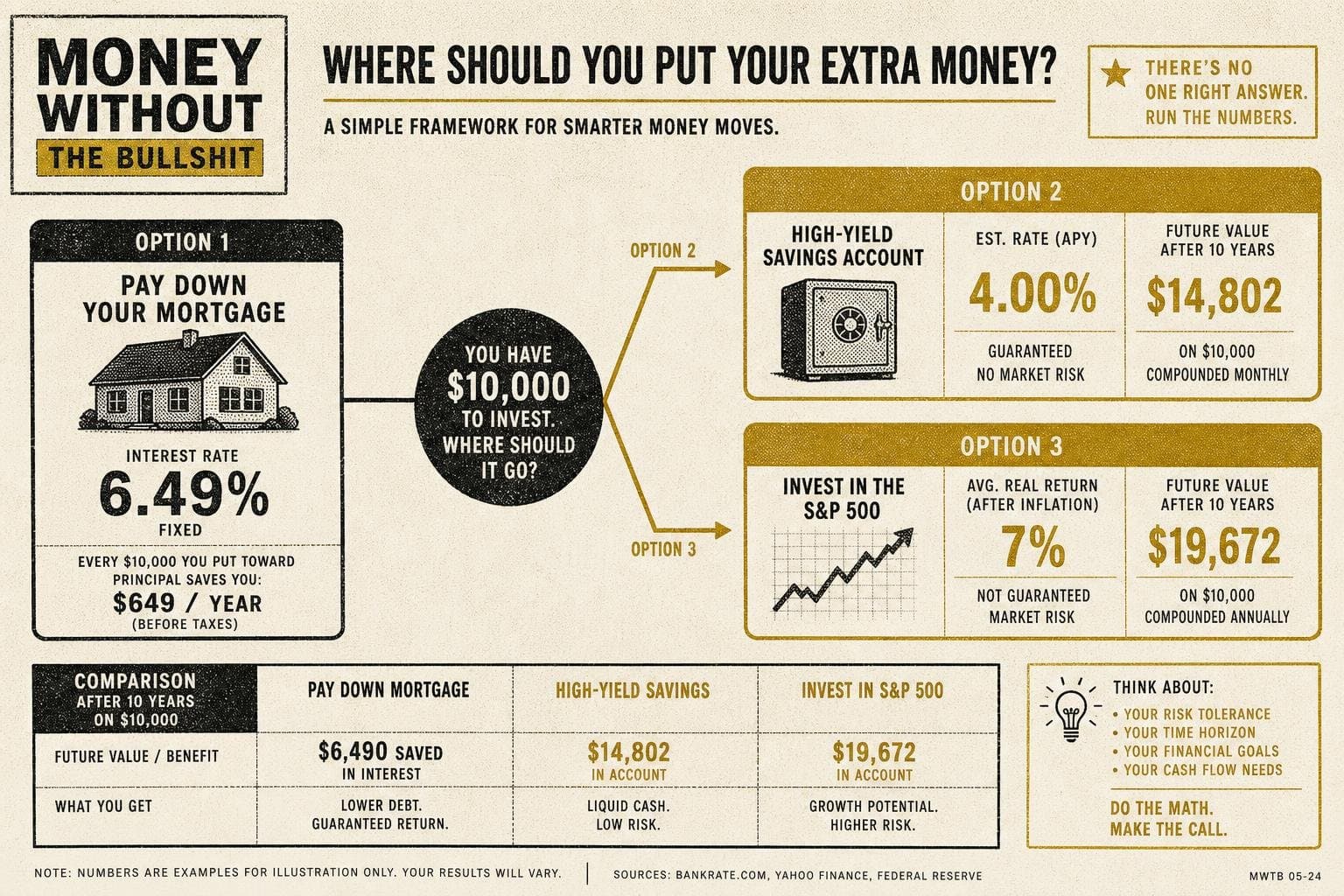

For a decade, the answer to "should I pay off my mortgage early?" was basically: no, obviously not, go invest. When 30-year mortgages were sitting at 3%, paying one down early to "save 3%" while a savings account paid more than that was a bad trade. The math was embarrassingly one-sided.
That math has flipped. And most of the advice floating around hasn't caught up.
The Rate You Have Is the Only Rate That Matters
Here's the cleanest way to think about this: every extra dollar you put toward your mortgage principal earns you a guaranteed return equal to your interest rate. No volatility, no sequence risk, no behavioral tax when markets drop 30%. Just a locked-in return for the life of that dollar.
So the question becomes: what else can you earn, reliably, on that dollar?
According to Edgen's July 2026 analysis, 30-year fixed rates averaged around 6.49% in early July 2026, while top high-yield savings accounts were paying roughly 4%. That gap matters. At a 3% mortgage, prepaying was a bad trade — you were giving up 4% savings yields to "earn" 3%. At 6.5%, prepaying is a guaranteed 6.5% return in a world where guaranteed 6.5% is genuinely hard to find.
The S&P 500's long-run nominal return is often cited around 10%, which still beats a 6.5% mortgage on paper. But PayOff Pro's July 2026 breakdown makes the honest adjustment: after inflation, that long-run real return drops to roughly 7%, and that's before accounting for sequence-of-returns risk, your own behavior in a crash, and the fact that current valuations are historically elevated. The margin between "invest" and "prepay" has narrowed to the point where it's a genuine call, not an obvious one.
One more variable that changes the answer: whether you itemize deductions. If you're in the 24% federal bracket and itemizing, your effective after-tax mortgage cost is closer to 4.9% than 6.5%, per the same PayOff Pro analysis. That shifts the math back toward investing. If you're taking the standard deduction — which most households do — your mortgage rate is your mortgage rate, full stop. Tax bracket and deduction status are not details; they're the whole ballgame. (These are federal rules; state tax treatment varies.)
The Hidden Leverage Problem Nobody Names
There's a framing that clarifies this decision faster than any spreadsheet: if you could pay off your mortgage but choose to invest instead, you are borrowing at your mortgage rate to buy stocks.
Edgen's analysis calls this what it is — margin, with a friendlier name. Leverage works when your investment returns exceed your borrowing cost, and over 20+ years, stocks have usually cleared that bar. But it only works if you actually hold through crashes, don't panic-sell when your portfolio drops while your mortgage payment stays fixed, and have enough income stability to keep making payments regardless of what markets do.
If your job is secure, your emergency fund is solid, and you've got the temperament to watch a portfolio drop 40% without touching it, the math probably favors investing. If any of those conditions are shaky, the "invest instead" strategy is leveraged speculation dressed up as conventional wisdom.
Do These Things First, Then Decide
Before this debate is even worth having, three things come first — and this is the one part of the conventional advice that's actually right.
PayOff Pro's framework puts it plainly: capture your full 401(k) employer match, build an emergency fund, and eliminate high-interest debt before directing a dollar toward either early mortgage payoff or taxable investing. The employer match is an immediate guaranteed return that almost nothing beats. High-interest debt at 20%+ makes a 6.5% mortgage look cheap. These aren't philosophical preferences — they're the actual order of operations.
Once those boxes are checked, the mortgage-vs-invest question becomes real. And the honest answer, given where rates sit right now, is that it depends on three things you need to look up: your actual mortgage rate, your tax situation, and your income stability. The neighbor who locked in at 2.75% in 2021 should invest every spare dollar. The person who bought in 2023 at 6.8% is in a different calculation entirely.
The NYT reported in July that the number of homeowners under 35 living without a mortgage increased 56% — a trend concentrated among wealthier buyers who could pay cash or pay down aggressively. That's not a model to copy blindly, but it does suggest that the psychological and financial case for owning your home outright is landing differently than it did when rates were near zero.
Check your rate. Check your tax situation. Then decide. The spreadsheet answer and the right answer are finally close enough that the details are what separate them.