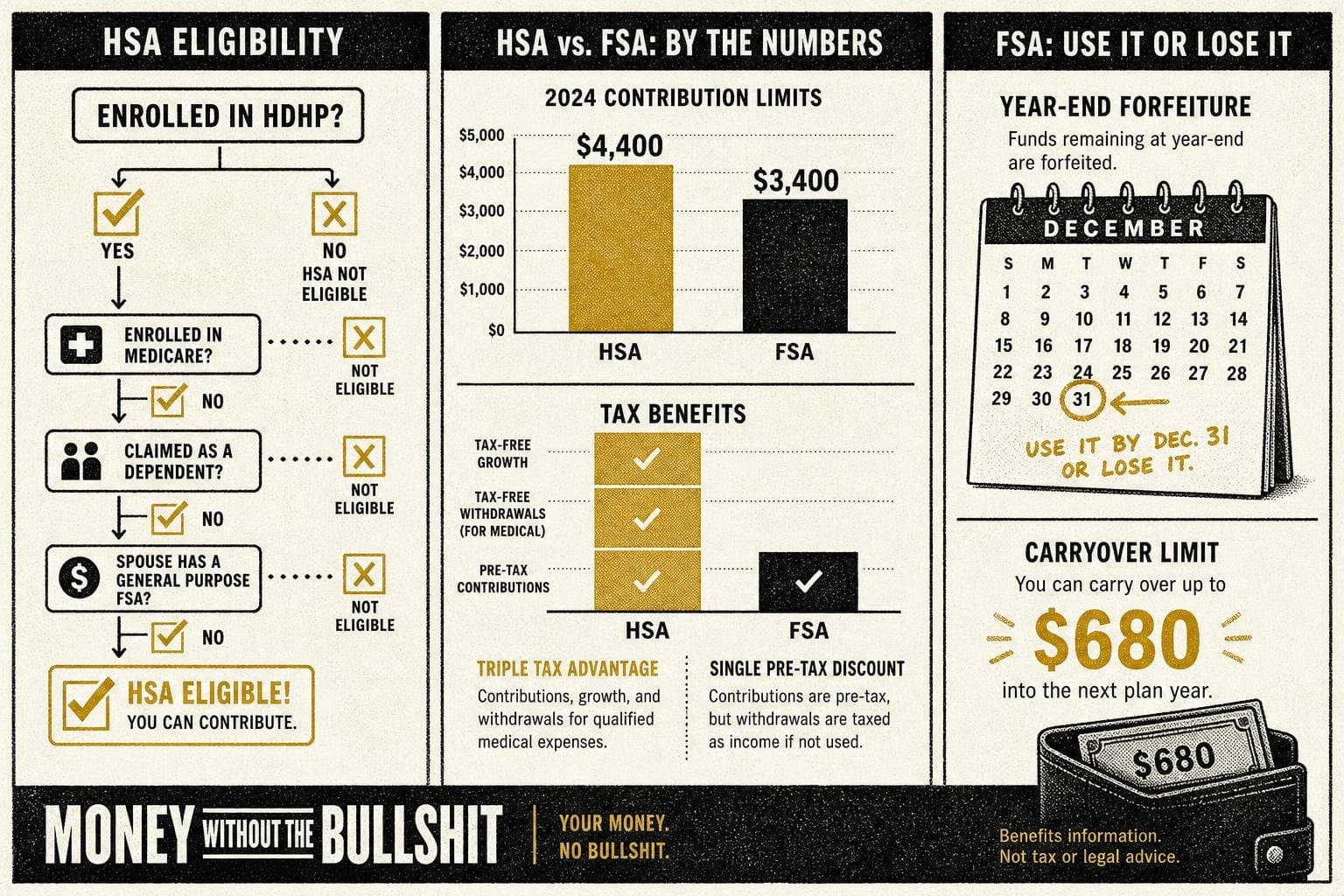

Most people treat this as a comparison between two similar accounts. It isn't. An HSA and an FSA are solving different problems for different people, and the "which one saves more money" framing skips the only question that actually matters: which one are you even eligible for?
Start there, because the eligibility rules are where most people get tripped up.
The Gate You Have to Pass First
To contribute to an HSA, you must be enrolled in a qualifying High Deductible Health Plan — and your current plan has to actually meet the IRS's specific thresholds. Per IRS Publication 969 (via taxguidance.org), you're also disqualified if you're enrolled in Medicare, can be claimed as a dependent on someone else's return, or are covered by a general-purpose FSA or HRA that pays for broad medical expenses. That last one catches people: if your spouse has a standard health FSA through their employer and you're on their plan, you may be locked out of HSA contributions entirely.
An FSA has no such eligibility gate. Your employer offers it, you elect an amount during open enrollment, done. That accessibility is the FSA's main advantage — and almost its only one.
Why the HSA Wins on Paper (and Usually in Practice)
T. Rowe Price describes the HSA as the only "triple tax-advantaged" account available to individual investors: contributions reduce taxable income, growth is tax-deferred, and withdrawals for qualified medical expenses are tax-free. That combination — pre-tax in, tax-free growth, tax-free out — doesn't exist anywhere else in the tax code. A 401(k) gives you the first two. A Roth IRA gives you the last two. The HSA gives you all three, for healthcare spending.
The FSA gives you only the first benefit: pre-tax contributions. Your money doesn't grow, it doesn't invest, and it doesn't roll over (with limited exceptions). You're essentially getting a discount on medical expenses equal to your marginal tax rate — useful, but structurally simpler.
For 2026, the HSA contribution limit is $4,400 for self-only coverage and $8,750 for family coverage, per IRS Rev. Proc. 2025-19. The health FSA salary-reduction limit for 2026 is $3,400, per IRS Rev. Proc. 2025-32. So the HSA also has higher contribution ceilings — another structural advantage, assuming you can max it.
The Use-It-or-Lose-It Problem Is Real, But Manageable
The FSA's notorious downside is forfeiture. By default, unspent FSA funds are forfeited at year-end. Two IRS-created exceptions exist — a grace period (extra time to spend) or a carryover (up to $680 in 2026) — but your employer can only offer one of them, not both, and it's their choice, not yours. Check your Summary Plan Description before assuming you have either.
This is where the FSA becomes a planning problem rather than a savings vehicle. If you elect $2,000 and spend $1,400, you've lost $600. The tax savings on $2,000 don't compensate for forfeiting $600 in cash. The FSA rewards accurate forecasting, which is hard to do with healthcare.
The HSA has no forfeiture. Unused funds roll over indefinitely. T. Rowe Price's research found that median annual healthcare costs in retirement range from roughly $4,300 to $6,400 depending on insurance coverage — which means an HSA you don't touch for 20 years isn't a mistake, it's a strategy. Pay current medical expenses out of pocket if you can afford to, let the HSA compound, and withdraw tax-free in retirement for healthcare costs you'll definitely have.
The Decision Tree Is Short
If you're not on an HDHP: you get an FSA if your employer offers one. That's your only option. Elect conservatively — only what you're confident you'll spend — and treat it as a discount on predictable expenses, not a savings account.
If you're on an HDHP and HSA-eligible: the HSA is almost always the better vehicle, assuming you can handle the higher out-of-pocket exposure that comes with the HDHP itself. T. Rowe Price recommends estimating your expected medical costs first — if you anticipate heavy healthcare use, the HDHP/HSA combination may cost you more in total than a lower-deductible plan, even with the tax advantages. The math depends on your specific plan's premiums, deductibles, and your employer's HSA contribution, if any.
One wrinkle worth knowing: you can hold an HSA alongside a limited-purpose FSA — one restricted to dental, vision, and preventive care — without losing HSA eligibility. If your employer offers this combination, it's worth taking seriously. You get the FSA's immediate pre-tax discount on predictable dental and vision costs while keeping the HSA's long-term compounding intact.
The accounts aren't really competitors. One is a discount mechanism with an expiration date. The other is a retirement account that happens to be optimized for healthcare. Which one you get depends on your health plan — and that decision, made during open enrollment, is the one that actually matters.


