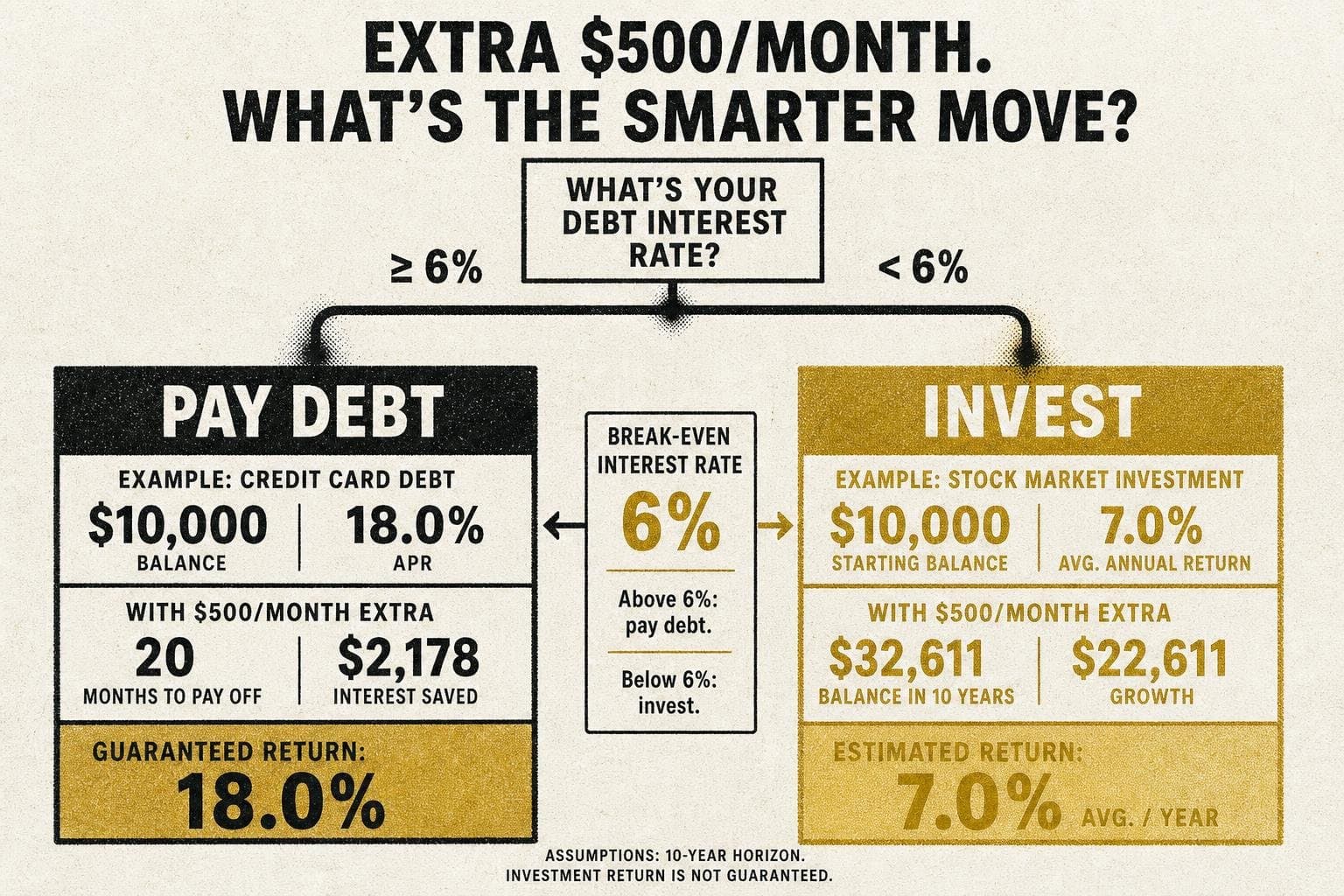

You have $500 extra this month. Your student loan is sitting there. So is your 401(k) enrollment form. The conventional wisdom says: kill the debt first, sleep better, then invest. That advice is sometimes right. It's also sometimes the most expensive financial decision you'll make in a decade.
The problem isn't that people choose wrong — it's that they're solving the wrong problem. The question isn't "debt or investing?" It's "what does each dollar cost me if I put it here instead of there?" Once you frame it that way, the answer usually becomes obvious. But it requires looking at a few specific numbers, not just vibes about financial responsibility.
The Rate Comparison Is the Whole Game
The core logic is simple: if your debt costs more than your investments earn, pay the debt. If your investments earn more than your debt costs, invest. The hard part is that most people don't actually know either number with any precision.
On the debt side, LendingTree's 2026 credit card data puts total U.S. credit card balances at $1.252 trillion as of Q1 2026, up $482 billion since Q1 2021. That's not just a macroeconomic statistic — it's a signal that a lot of households are carrying high-rate balances while also trying to figure out whether to invest. Credit card debt at rates in the high teens to low twenties percent APR almost always wins the comparison: no diversified investment portfolio reliably clears that hurdle. Pay the card.
Mortgage debt is a different calculation entirely. According to Money&Planet, the 30-year fixed-rate mortgage averaged 6.48% per Freddie Mac's Primary Mortgage Market Survey in early June 2026. That's meaningfully higher than the 3% rates that made early payoff nearly pointless a few years ago — but it's still well below the long-run nominal S&P 500 return of roughly 10% that the same source cites. The gap has narrowed, but it hasn't closed. For most homeowners with mortgages in the 6% range, the math still favors investing in tax-advantaged accounts over accelerating principal payments — assuming you have the risk tolerance for equity exposure and a long enough time horizon.
Student loans and auto loans sit somewhere in the middle, and the right answer genuinely depends on the specific rate. This is why "pay off all debt before investing" is a platitude, not a strategy.
The One Exception That Changes Everything
There's a scenario where the rate comparison doesn't even matter: your employer's 401(k) match. Debt Discipline's analysis makes the point clearly — skipping an employer match to pay off debt slightly faster is walking away from free money you'll never recover. A 50% match on your contributions is a guaranteed 50% return before your money touches a single investment. No debt payoff strategy competes with that.
This is the one place where nearly every financial planner agrees, regardless of their general philosophy on debt. Capture the full match first. Then run the rate comparison on everything else.
The Hidden Cost Nobody Talks About
The St. Louis Fed's work on opportunity cost frames this well: every dollar has an alternative use, and the cost of a decision includes what you gave up. Most people calculate the cost of investing (the debt interest that keeps accruing) but not the cost of paying off debt early (the compound growth that never starts).
That asymmetry matters more the longer your time horizon. A 35-year-old who redirects $500/month from a 6% mortgage to a tax-advantaged investment account for 30 years is making a very different bet than a 58-year-old doing the same thing. The math that favors investing assumes time for compounding to do its work. Shorter horizons, lower risk tolerance, or proximity to retirement shift the calculus toward debt payoff — not because the rate comparison changes, but because the assumptions underlying it do.
The CFPB's consumer credit data tracks originations and balances across mortgage, credit card, auto, and student loan markets — useful if you want to benchmark your own debt load against current market conditions, though the real work is still running your own numbers.
The Decision Framework in Three Steps
- Capture any employer match first. Always. The return is unbeatable.
- Compare your debt rate to a realistic investment return. High-rate consumer debt (credit cards, high-APR personal loans) almost always wins. Low-to-mid-rate debt (mortgages, federal student loans) often doesn't — especially in tax-advantaged accounts.
- State your assumptions explicitly. The "right" answer depends on your tax situation, time horizon, and risk tolerance. A strategy that's optimal for a 40-year-old in a high tax bracket with a 6.5% mortgage is not optimal for a 55-year-old with the same mortgage and a shorter runway.
The gut feeling that paying off debt is always the responsible choice is understandable. Debt feels bad. But financial decisions aren't moral judgments — they're optimization problems. Run the numbers, state the assumptions, and pick the least-bad option for your specific situation. That's the whole job.


