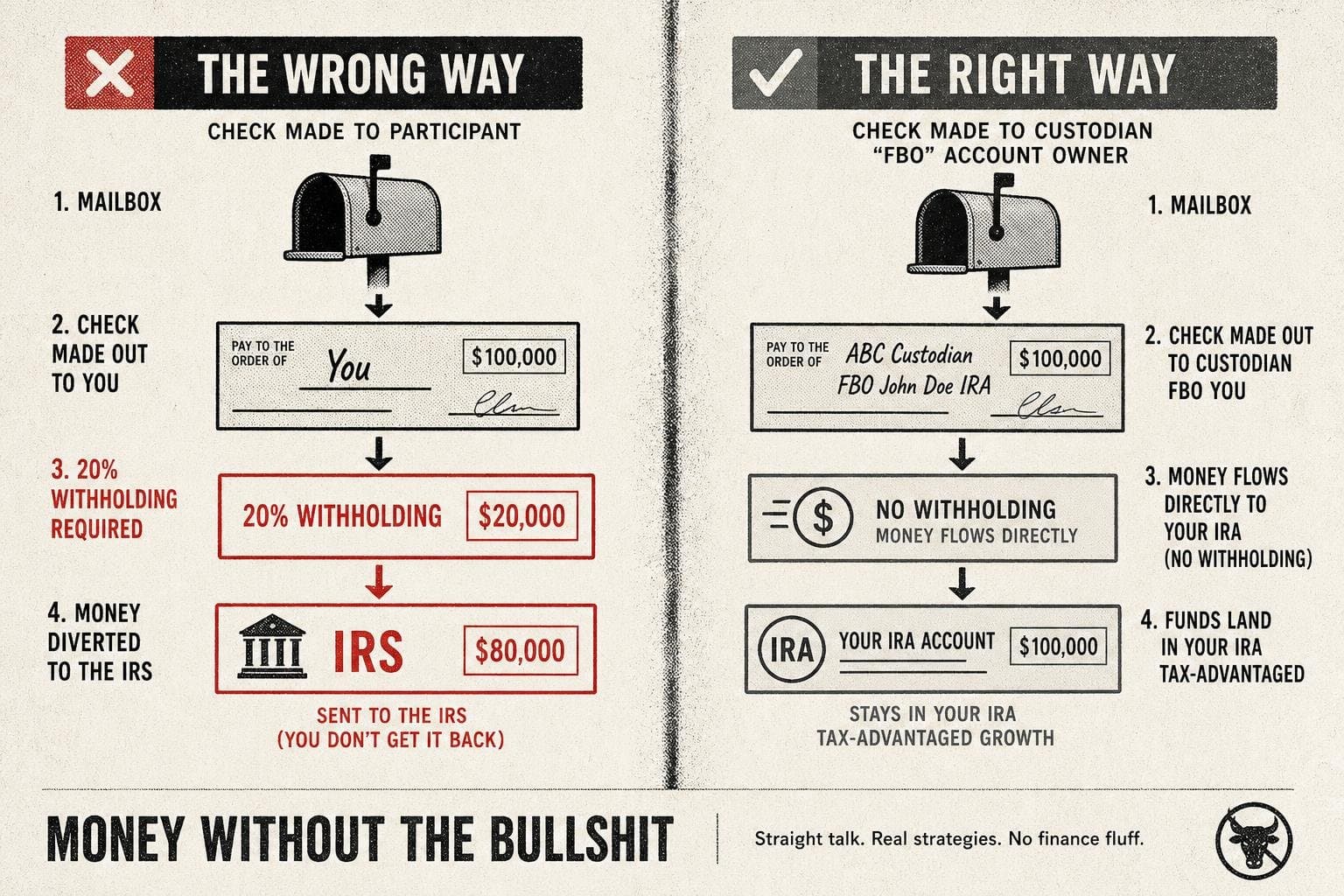

A retiree moves $400,000 out of his old 401(k) into a new IRA. He calls the plan, picks "payment to me" instead of a direct transfer, and two weeks later a check for $320,000 shows up in the mail. He deposits it, feels like he handled his own retirement competently, and closes the folder. Two years later, Medicare flags his income and the IRS treats the missing $80,000 as a taxable distribution — because that's exactly what it was, per 24/7 Wall St..
That $80,000 wasn't lost or stolen. It was mandatory 20% federal withholding on an eligible rollover distribution paid directly to a participant, which the plan sent straight to the IRS as a tax prepayment, as 24/7 Wall St. reported. To keep the full $400,000 out of taxable income, he had 60 days to come up with the missing $80,000 from other savings and deposit the full original amount into the IRA. He didn't, so the withheld money became ordinary income for the year, and because he's 65, it also showed up on Medicare's two-year income lookback.
This kind of error keeps happening in part because rollovers aren't a rare event tucked into a few people's lives — they're a routine byproduct of an economy where people change jobs constantly. Payroll employment was still growing, if modestly, as of the September 2026 report, with job switching remaining a normal feature of a labor market that the New York Times described as steady but uneven across sectors. Every one of those job changes is a potential rollover decision, made once, by someone who's done it maybe three or four times in their life.
The Checkbox Nobody Reads Carefully
This isn't an exotic edge case. It's what happens whenever someone selects "payment to me" instead of a direct trustee-to-trustee transfer on a rollover form. The fix is almost boring in how simple it is: when a check is made payable to the receiving IRA custodian for the benefit of the account owner, rather than to the individual, the 20% withholding never gets triggered in the first place, per 24/7 Wall St.. The money moves from one institution to another without ever touching the participant's hands, and the withholding rule simply doesn't apply.
So the actual decision point in a rollover isn't "traditional or Roth" or "same custodian or different one." It's a single line on a distribution form that determines whether a chunk of your own retirement savings gets routed to the IRS as a prepayment you then have to backfill out of pocket within two months. Most people don't know that line exists until they're staring at a check that's smaller than they expected.
The System Is Built to Put the Error on You
The deeper problem, as Morningstar lays out, is that the handoff between a 401(k) plan administrator and an IRA custodian used to involve actual coordination — the receiving custodian would confirm the account existed and what type it was before the sending plan released funds. That practice has largely disappeared. Now the plan cuts a check, mails it to the participant, and expects the participant to deliver it to the right account, of the right type, within the right window.
Morningstar's example involves a different flavor of the same structural gap: a participant asked for her 401(k) to roll into a traditional IRA, but the custodian deposited the funds into a Roth IRA instead, which the IRS treats as a taxable conversion. When she asked for extra time to fix it, the IRS denied the request because she couldn't prove the error was the financial institution's fault rather than her own, according to the ruling Morningstar describes. The account owner is expected to catch an error made by people who do this professionally, in a process most people navigate only a handful of times in their entire working life.
Part of why nobody's closing this gap is jurisdictional. The Consumer Financial Protection Bureau supervises banks, thrifts, and credit unions above a certain asset threshold, along with nonbank mortgage servicers, payday lenders, and student loan servicers — but IRA custodians and 401(k) plan administrators handling rollover mechanics don't sit squarely inside that mandate. The two institutions passing your money back and forth aren't being watched by the same referee, which is a tidy explanation for why nobody's incentivized to fix the coordination problem Morningstar describes.
What Actually Protects You
None of this requires a financial advisor or a spreadsheet. It requires one decision, made correctly, at the moment you fill out the rollover paperwork: always choose a direct trustee-to-trustee transfer, where the check or electronic transfer is made payable to the new custodian for your benefit, never to you personally. If a plan or custodian only offers to mail you a check, confirm in writing — before the money moves — exactly which account type it's landing in, and get something from the receiving custodian confirming the account is open and ready.
The 20% withholding rule and the 60-day deadline aren't obscure tax trivia. They're the default outcome if you let the process run on autopilot. The job change is the easy part. The rollover form is where the money actually gets decided.


