


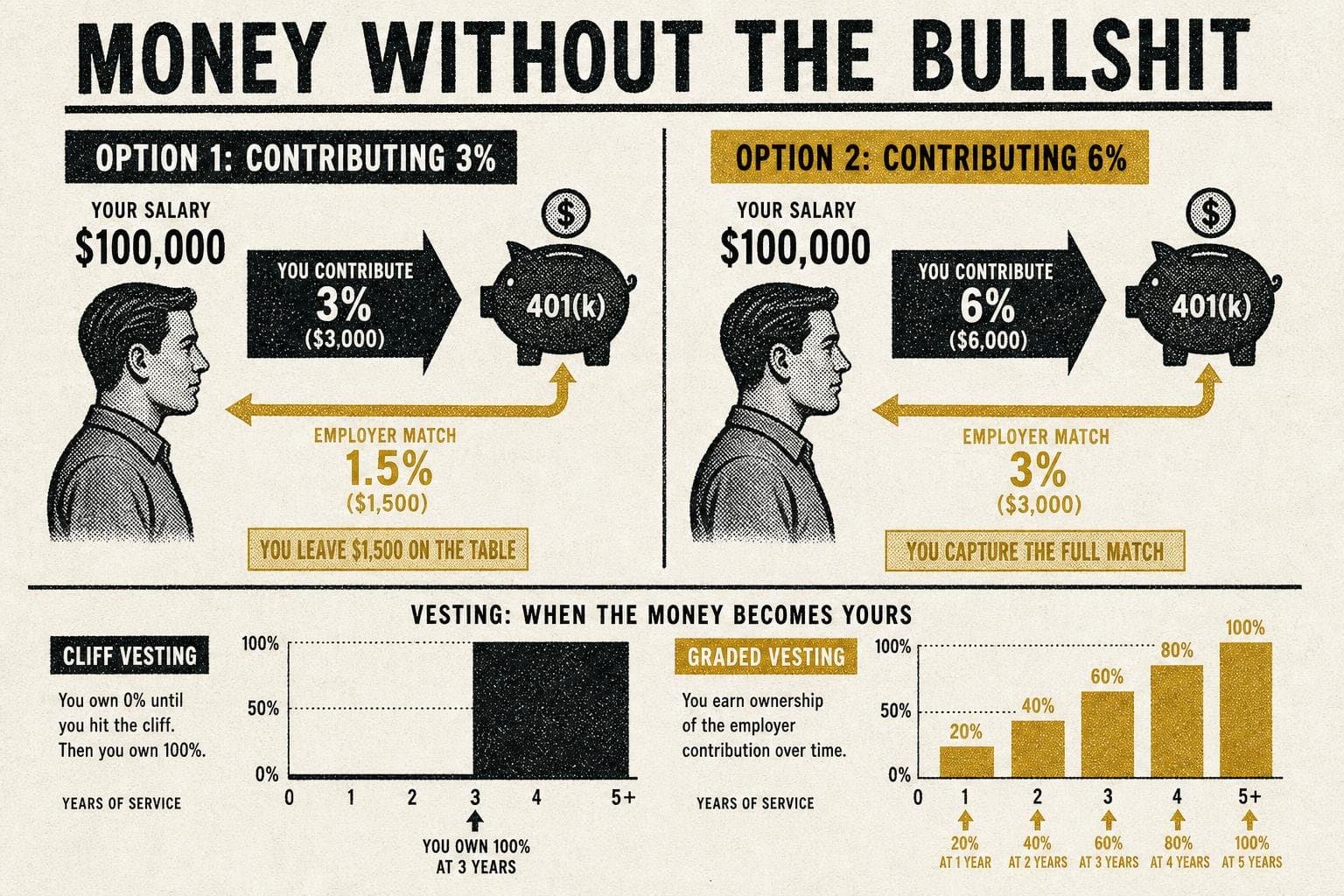

You get a new job. HR walks you through benefits. Someone says "we match 50% of your contributions up to 6% of your salary" and your brain files it under "good, I should do that" — and then you set your contribution to 3% and move on with your life.
That's the trap. You captured the match. You did not capture the money.
The Match Formula Is Designed to Confuse You (Not Maliciously, But Still)
Employer match formulas come in two main flavors: full matching (dollar-for-dollar up to a salary cap) and partial matching (a fraction — often 50 cents — per dollar you contribute, up to a cap). The partial match is where most people leave money on the table.
Here's the math on a common structure: your employer matches 50% of your contributions up to 6% of your salary. To get the full match, you need to contribute 6%. If you contribute 3%, you get a 50% match on 3% — which is 1.5% of your salary from your employer. Contribute 6%, and you get 3% from your employer. That's double the employer money for double your own contribution.
Most people intuitively understand this. What they miss is the second number — the cap. If you're contributing 10% of your salary because you're trying to save aggressively, you're still only getting the match on the first 6%. The extra 4% you're putting in is entirely your own money, which is fine, but you're not getting "more match" for it.
The formula tells you exactly what to do: contribute at least up to the cap. Everything above that is a separate decision.
Vesting Is the Fine Print That Can Cost You Thousands
Here's where "free money" gets complicated. Your own contributions to a 401(k) are always 100% yours. The employer match is a different story — it's frequently subject to a vesting schedule, meaning you don't actually own those matched dollars until you've stayed at the company long enough.
Vesting schedules vary by employer. Some vest immediately (you own the match the moment it lands). Others use cliff vesting — you own nothing until a specific date, then suddenly own everything. Others use graded vesting, where you earn ownership incrementally over several years.
The practical implication: if you leave a job before you're fully vested, you walk away from some or all of the employer contributions. That's not a penalty — it's just how the contract works. But it's a number worth knowing before you take a new job offer, negotiate a raise, or decide whether to stick around another year.
The question to ask HR is simple: "What's the vesting schedule for employer contributions?" If they can't answer it clearly, ask for the plan documents. You're entitled to them.
The Access Problem Nobody Talks About
Nearly half of private-sector workers don't have access to a workplace retirement plan at all, which means the match conversation is moot for a significant chunk of the workforce. If you have access to a match, that context matters — you're already in a better position than many people, and not using the full match is a real cost.
For those who do have access, the behavioral failure is usually one of two things: either the contribution rate was set at enrollment and never revisited, or the employee is contributing to a Roth option and isn't sure whether the match goes into the same bucket (it doesn't — employer matches are almost always deposited as pre-tax, traditional contributions regardless of your own election, which has tax implications when you eventually withdraw).
Neither of these is a moral failing. They're just system defaults that don't work in your favor.
The Actual Checklist
This is the whole thing, reduced to four questions:
-
What's the match formula? Get the exact numbers — percentage matched, and the salary cap it applies to. Calculate the minimum contribution you need to make to receive the full employer match.
-
What's the vesting schedule? Cliff or graded, and over how many years? If you're close to a vesting milestone, that's a real financial consideration when evaluating a job change.
-
When does the match actually hit your account? Some employers match per paycheck; others do a lump sum at year-end. If you front-load contributions early in the year and hit the IRS annual contribution limit before December, you might miss out on matches for the rest of the year — depending on how your plan is structured. Ask.
-
Where is the match being invested? Many plans default employer contributions into a money market or stable value fund. If you haven't directed it, it may be sitting in cash — a problem I wrote about in more detail last month in the context of HSAs, but the same logic applies here.
The match is real money. The formula is the instruction manual for how to get it. Most people just don't read it.