


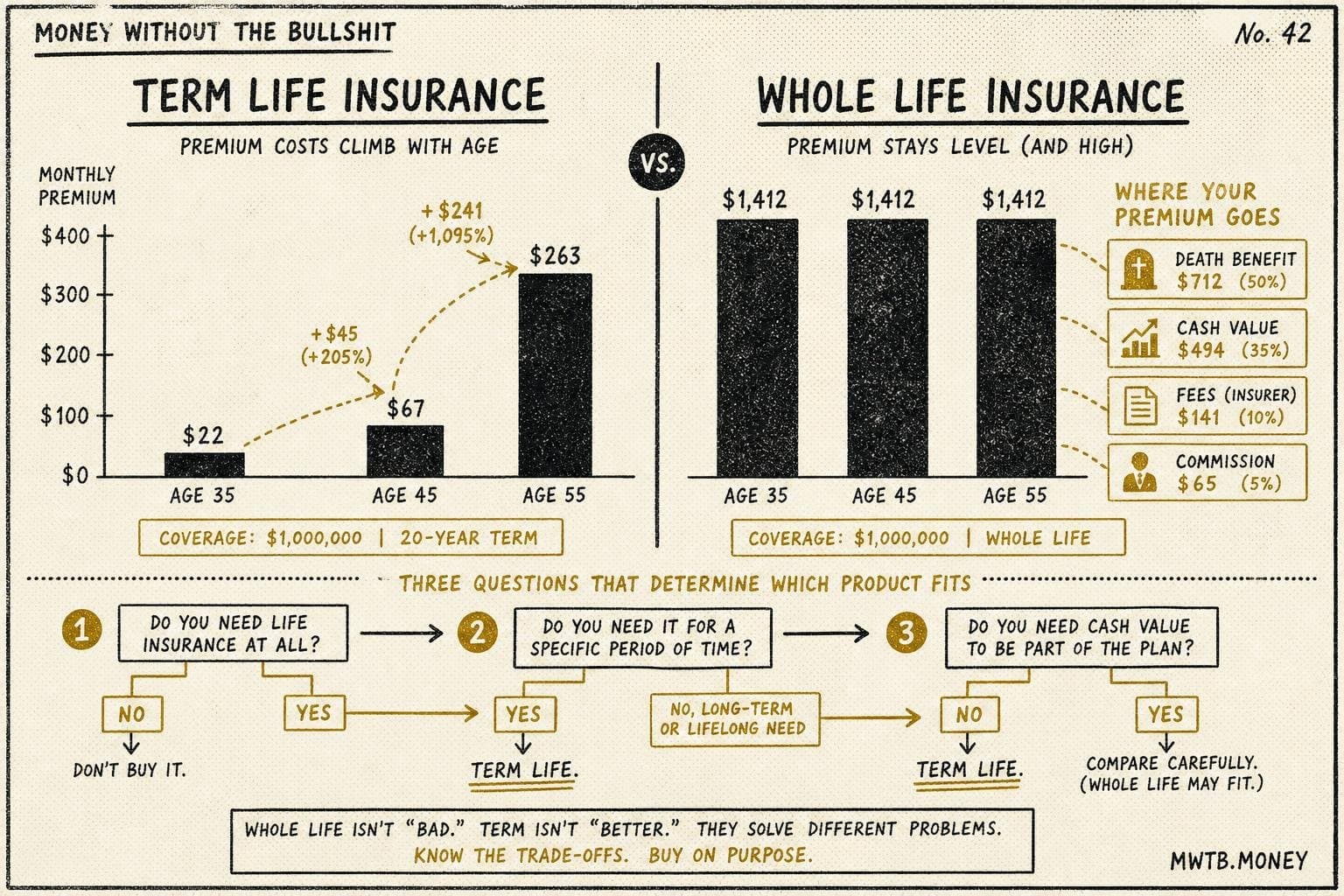

A healthy 40-year-old can buy $500,000 of 20-year term life coverage for somewhere around $26 a month, according to a comparison published by The Economist on September 25, 2026. A whole life policy with the same death benefit routinely costs many multiples of that for the same person, because it's bundling a permanent premium with a cash-value savings component. Insurance agents will tell you this difference is the price of "permanence." It's mostly the price of commission.
That's not a moral judgment on anyone who owns whole life insurance. It's a description of how the product is priced and sold. The question for your budget isn't which policy sounds more responsible — it's which one actually matches the risk you're trying to cover and the years you need it covered for.
Term Pricing Is a Function of Age and Health, Not Virtue
Term premiums are set almost entirely by underwriting: your age at application, your health classification, the policy length, and the death benefit you want. According to industry rate data cited by Paycheck Note, a healthy 35-year-old male can typically find a 20-year, $500,000 term policy for roughly $25 to $40 a month at a preferred health classification — and premiums roughly double or more by age 45 at the same coverage level. Women generally see somewhat lower rates, reflecting longer average life expectancy, per the same reporting.
The number that matters more than the quote is the term length relative to your actual exposure. If you've got a 30-year mortgage and a kid who's a decade from being financially independent, a cheap 10-year policy that expires in year 11 isn't a bargain — it's a gap you'll have to re-underwrite into later, at a worse age and possibly a worse health class, per Paycheck Note. Buy the term length that matches the liability, not the one with the lowest monthly number on the quote page.
Whole Life's Cash Value Isn't Free Money — It's a Forced Savings Account With Fees Baked In
The pitch for whole life centers on cash value: part of your premium builds up inside the policy and grows over time, tax-advantaged, and you can borrow against it. That's real. It's also expensive to access through this vehicle, because a chunk of early premiums goes to the insurer's costs before cash value builds meaningfully. For most people with decades of earning years left, the same monthly difference — term premium versus whole life premium — invested in a regular tax-advantaged account will outperform a policy's cash value growth over a 20- or 30-year horizon, which is the entire logic behind "buy term and invest the difference." The slogan gets mocked because people repeat it without doing the investing part, not because the math behind it is wrong.
Where whole life actually earns its premium: permanent liabilities that term can't solve. A special-needs dependent who will need support for life. An estate tax exposure that persists past your working years (and estate tax rules vary significantly by state and by federal exemption level, so this is not a one-size assumption). A business succession plan that needs a death benefit no matter when a partner dies, not just within a fixed window. If none of those describe your situation, you're very likely paying permanent-policy prices to solve a temporary problem.
The Actual Decision Framework
Before shopping, answer three questions: How many years does the risk you're insuring against actually last — until the mortgage is paid, until the kids are grown, until retirement savings cover the gap? What's your health classification likely to be right now versus if you wait five years? And is there a genuinely permanent liability in your life, not a vague feeling that "whole life is more serious"?
If you answered a defined number of years to the first question and nothing to the third, term is very likely your answer, sized to match that number — a point echoed across affordability-focused comparisons like CNBC Select's roundup of cheap life insurance carriers, which treats term as the default budget option and lists companies including State Farm and Ladder among its affordable picks. The premium difference between term and whole life, compounded over the years you'd otherwise be overpaying, is not a rounding error. It's the difference between insurance that does its one job cheaply and a savings product wearing an insurance costume.
The next move isn't picking a carrier. It's writing down the actual year your coverage need expires, then buying a policy that expires the same year — nothing more, nothing less.