
The standard pitch for refinancing student loans goes like this: you're paying a high rate, private lenders will give you a lower one, you save money. Simple arbitrage. Run the numbers, sign the paperwork, done.
That pitch was always incomplete. Right now, it's actively dangerous for a specific group of borrowers — and the window for everyone else is narrower than the ads suggest.
The Federal Loan Trap That Refinancing Can't Fix (and Might Make Worse)
Here's the context that changes everything: the New York Times reported this week that the One Big Beautiful Bill Act — passed last summer — rewrote the rules for existing federal student loan borrowers, not just new ones. The Pay as You Earn plan (PAYE), which let borrowers pay 10% of discretionary income for 20 years before discharge, is being eliminated in summer 2028. Borrowers who enrolled in PAYE years ago — some as far back as 2012 — will be forced onto plans with worse terms.
Matthew Hansen, a pharmacist who borrowed $166,000 for graduate school and enrolled in PAYE in 2013, described it to the Times as his mortgage lender calling to add five years and $100,000 to his loan.
For borrowers in Hansen's position, the instinct to refinance into a private loan to escape the chaos is understandable. It's also almost certainly wrong. When you refinance federal loans with a private lender, the CFPB is explicit: you permanently lose income-driven repayment, Public Service Loan Forgiveness, federal forbearance and deferment, and death-and-disability discharge. The word "permanently" is doing real work there — Experian's refinancing guide confirms you cannot reverse the process once it's done.
So if you're on PAYE and facing worse terms in 2028, refinancing into a private loan doesn't solve your problem. It trades a bad federal situation for a private loan with no safety net at all. That's a worse deal, not a better one.
Who the Math Actually Works For
Strip away the borrowers with federal protections worth keeping, and the population where refinancing makes sense gets specific fast.
The clearest candidate: someone with private student loans already — no federal protections to lose, so the only question is whether a new rate beats the old one. Experian notes that most lenders require a credit score in the mid-600s or higher just to get approved, and the best rates go to borrowers with strong credit and stable income. If your credit has improved significantly since you took out the original loans, you're a better candidate than you were.
The second candidate: someone with federal loans who is certain — not pretty sure, certain — they won't need income-driven repayment, won't qualify for PSLF, and has stable enough employment that federal forbearance is a theoretical rather than practical backstop. High earners with large balances and no public service employment sometimes fit this profile. But "certain" is a high bar. The borrower who was certain in 2019 that they'd never need forbearance learned something in 2020.
A USA Today account of one borrower's refinancing decision captures the tradeoff honestly: she cut her monthly payment from $800 to under $400 by refinancing with SoFi — but she also extended her repayment term by 20 years and had to weigh replacing some 2% loans with a blended rate that was higher. Her conclusion was that the cash flow relief was worth it given her family's situation. That's a legitimate call. It's also a call that required actually running the numbers on her specific loan mix, not just comparing headline rates.
The Calculation Nobody Does Before Signing
The break-even math on refinancing (which I covered in the context of mortgages earlier this year) applies here too, with an added wrinkle: student loan refinancing has no closing costs in the traditional sense, but it has opportunity costs that are harder to quantify.
What's the value of PSLF eligibility to you? If you work in public service and have eight years of qualifying payments, that's not an abstraction — it's a specific dollar amount attached to a specific timeline. What's the value of income-driven repayment if your income drops? That depends on your job stability, your field, your savings cushion.
As Steve Rhode at GetOutOfDebt.org puts it, the refinancing ads sell you on the rate. They don't sell you on what you're giving up to get it, because they don't profit from that part of the conversation.
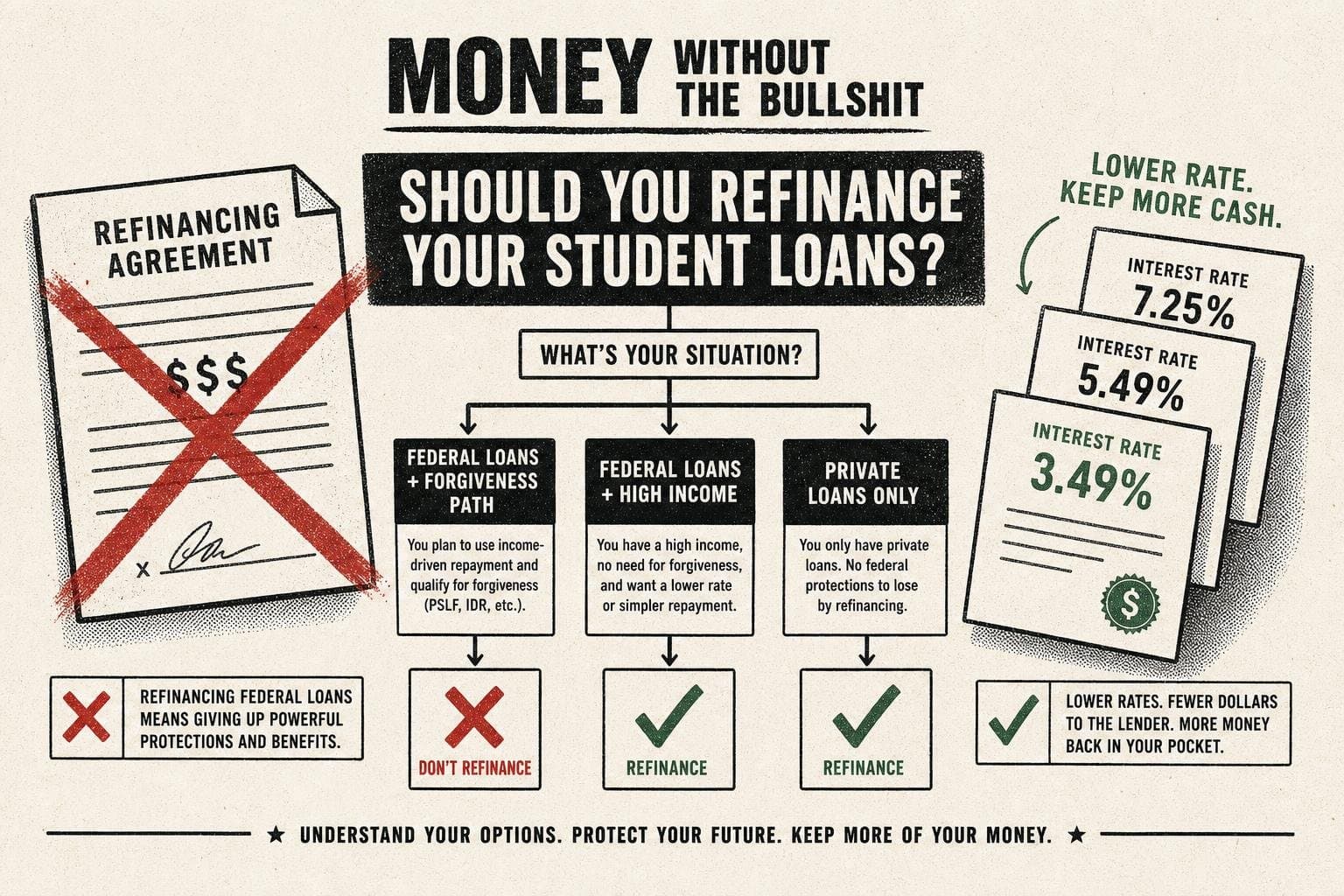
The decision tree is actually pretty clean once you accept that federal and private loans are different products, not the same product at different prices:
- Federal loans + any realistic path to forgiveness or IDR need: Don't refinance. Full stop.
- Federal loans + high income + no forgiveness path + strong job security: Model the break-even carefully, including the value of protections you're surrendering.
- Private loans only: Compare rates, check prepayment penalties, run the total cost over the actual payoff timeline — not just the monthly payment.
The current policy environment makes the first category larger than it was two years ago. More borrowers have reason to hold onto federal protections, not fewer. That's the context the refinancing ads aren't going to give you.


