
A Long Island landlord named Craig Marlow found out the hard way what happens when you insure for the wrong number. A tenant's cigarette started a fire in his three-family rental, the building burned down, and his insurer cut him a check for about $130,000 — roughly what the house was worth at the time, not what it would cost to rebuild it, according to his account on the Real Estate Pros Show relayed by Investor Fuel. He'd bought actual cash value coverage instead of replacement cost to save maybe $40 a month, and he didn't fully register the difference until an adjuster explained it to him on the worst day of his career.
That's a landlord's story, but the same mechanism sits underneath renters insurance, at a much smaller dollar scale. Most people treat the policy as a box to check, buy whatever coverage number the app defaults to, and never think about it again. The actual decision has two parts that matter — how much coverage you buy, and what kind — and getting either one wrong turns a cheap policy into a useless one.
The Price Tag Depends on Whose Number You Trust
Ask "how much does renters insurance cost" and you'll get a different answer depending on who's counting. NerdWallet puts the national average at $165 a year, with state ranges running from $120 to $315. Insure.com puts the national average closer to $313 a year, with Vermont as low as $164 and Louisiana as high as $656. CNBC Select, citing the Insurance Information Institute, lands around $14.25 a month — call it $171 a year.
None of these are wrong, exactly. They're built from different samples, different coverage assumptions, and different years of rate data, which is the actual lesson here: there is no single "average renters insurance cost," only a cluster of estimates that agree on the order of magnitude — somewhere in the low hundreds annually — and disagree sharply once you factor in your state. Louisiana and Mississippi run four times what Vermont does, per Insure.com, largely because severe weather and theft rates vary that much by geography. If you're budgeting, use your state's number, not the national headline — and treat any single quote as a starting point, not a verdict, since Insure.com found Progressive and Farmers quoting the same Louisiana coverage $683 apart.
The Coverage Type Matters More Than the Price
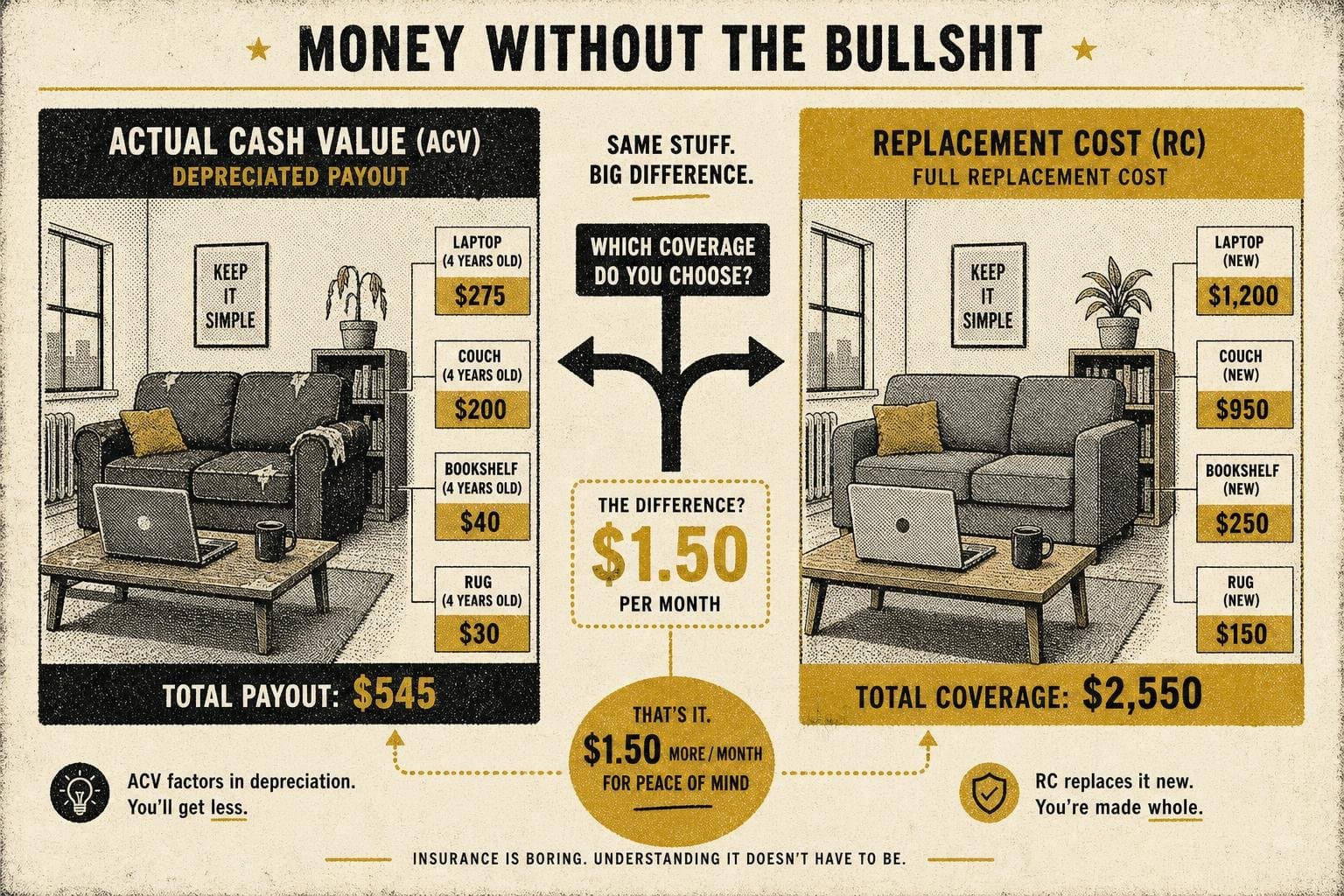
Here's where Marlow's fire story becomes directly relevant to renters, scaled down. Every renters policy offers a choice between actual cash value and replacement cost coverage for your belongings. Actual cash value pays what your stuff was worth, depreciated, at the moment it was destroyed — a four-year-old laptop gets a four-year-old laptop's payout, not a new one. Replacement cost pays what it actually takes to buy the item again, up to your policy limit, according to Moneycrashers, which cites the Insurance Information Institute's estimate that replacement cost coverage runs about 10% more than actual cash value — roughly $1.50 a month on a $15 policy.
That's the cheapest insurance decision you'll make all year, because the downside of getting it wrong only shows up when you file a claim and discover your payout doesn't cover a replacement. CNBC Select notes that at least one major insurer, Lemonade, now includes replacement cost coverage standard rather than as an upsell — worth checking for before you assume you need to add it as a rider.
The other number worth getting right is your personal property limit. The generic advice is to "estimate what you own," which is exactly the kind of vague instruction that gets ignored. The better version: walk your apartment room by room once a year, total replacement cost (not resale value) for electronics, furniture, and clothes, and set your limit there — not at whatever number the quote tool suggests by default.
Where the Actual Savings Are
If you already carry auto insurance, get your renters quote from the same carrier first. Moneycrashers cites an Insure.com analysis finding that bundling renters and auto coverage saves about $114 a year on average, though the range varies a lot by company. CNBC Select also points out that about half of U.S. landlords now require tenants to carry a policy — so if yours doesn't, the cost of skipping it isn't a rule violation, it's just a bet that nothing happens to your stuff before you get around to it.
The honest framing: renters insurance is one of the few financial products in this newsletter where the gap between "cheap and right" and "cheap and wrong" is a single checkbox, not a complicated tradeoff. Check the box for replacement cost. Set the property limit from an actual inventory, not a guess. Everything else is rounding error.


