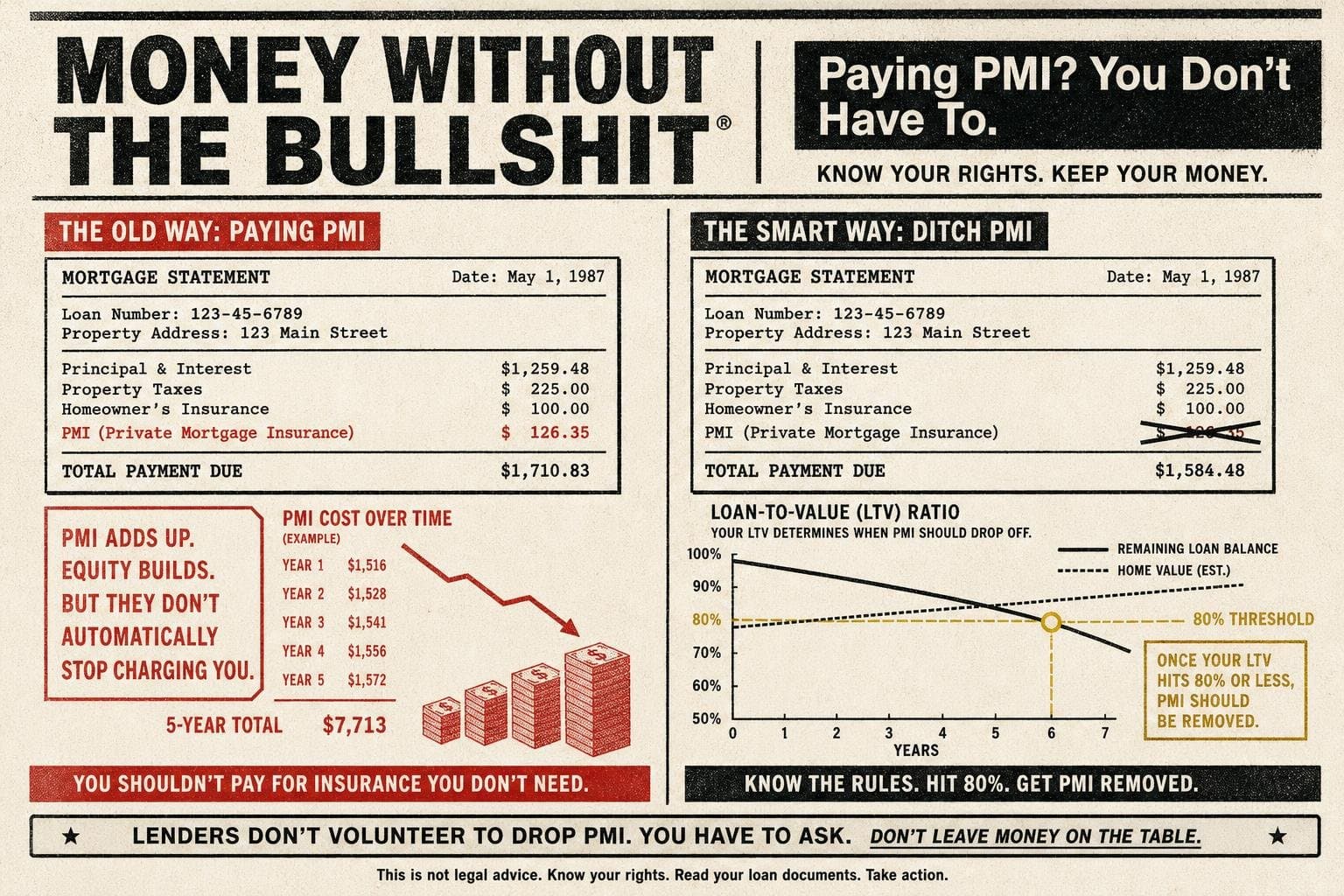

Private mortgage insurance is one of the only recurring costs in homeownership that exists purely to protect someone else. It doesn't cover your house, your belongings, or you. It covers the lender in case you default — and once you've built enough equity, federal rules give you the ability to stop paying for it. Most homeowners who still carry PMI simply haven't asked.
Why You're Probably Still Paying It
If you bought with less than 20% down on a conventional loan, PMI got added automatically — it's standard underwriting, not a penalty, and it's what let you buy before you had a full down payment saved (HomeLight). That's a bigger share of buyers than you'd think: among first-time buyers, the typical down payment hit 10% in 2025, the highest share since 1989, according to the National Association of Realtors' Profile of Home Buyers and Sellers, cited via HomeLight (HomeLight). A few years earlier, that same survey put the first-time buyer down payment at 8% — the highest in over 25 years at the time — which gives you a sense of how much the typical equity cushion has shifted in a short window (InvestGuiding).
The part that gets lost in translation is that PMI removal eligibility depends on two separate things: your loan-to-value ratio (how much you owe relative to what the home is worth) and your payment history (HomeLight). PMI itself typically runs somewhere between roughly 0.2% and 2% of your annual loan amount, depending on that same loan-to-value ratio (InvestGuiding). Home values have been climbing in a lot of markets because inventory has stayed tight, which means plenty of homeowners who assumed they were years away from the 20% equity mark are already past it on paper — they just haven't checked (HomeLight).
The Math on Doing Nothing
PMI isn't a rounding error. Over the life of a loan it can add up to tens of thousands of dollars in extra housing cost if you let it ride instead of actively tracking your equity position (HomeLight). That's the real cost of treating PMI as a "set it and forget it" line item on your mortgage statement. Nobody's servicer is going to call you up and say "hey, your home value went up, you can drop this now." The appreciation has to be verified — often through an appraisal — and the request has to come from you (HomeLight).
This is where I'd push back on the passive framing a lot of homeowners default to. People will refinance to shave a fraction of a point off their rate but won't spend an afternoon figuring out whether they can cancel a monthly insurance premium that benefits exactly nobody in their household. The friction isn't the math — it's that nobody tells you the clock has already started.
What Actually Moves the Needle
The practical move is to stop waiting for your lender to flag eligibility and instead track your own loan-to-value ratio as home values shift in your market. A rough estimate — comparing your remaining loan balance against a current home value estimate — isn't a substitute for a formal appraisal, but it tells you whether it's worth paying for one (HomeLight). The underlying loan-to-value math is the same whether you're pulling the number from HomeLight's calculator or any other estimate tool — what matters is getting a current figure, not a two-year-old one (InvestGuiding).
If the math looks favorable, the next step is a conversation with your servicer about what documentation they require, because PMI cancellation processes and the specific equity thresholds that trigger eligibility vary by lender and by whether your loan is conventional versus government-backed. That variation is exactly why a blanket "just wait until you hit X%" rule from a finance influencer is useless to you personally — your servicer's requirements are the only ones that matter for your loan.
None of this applies if your loan isn't conventional. FHA loans have entirely different mortgage insurance rules that don't automatically phase out the same way, so the strategy here is specifically for people who bought with a conventional mortgage and a down payment under 20%.
The One Afternoon That Pays for Itself
If you haven't checked your loan-to-value ratio in the last year, that's the actual task — not "pay down debt faster" or "save more," but one specific phone call to your servicer asking what their PMI removal process requires and whether a current appraisal would put you over the line. In a market where home values have kept climbing in a lot of regions, the gap between "I think I still have PMI" and "I definitely don't need to anymore" might already be closed. You just haven't asked the question that closes it on paper.


