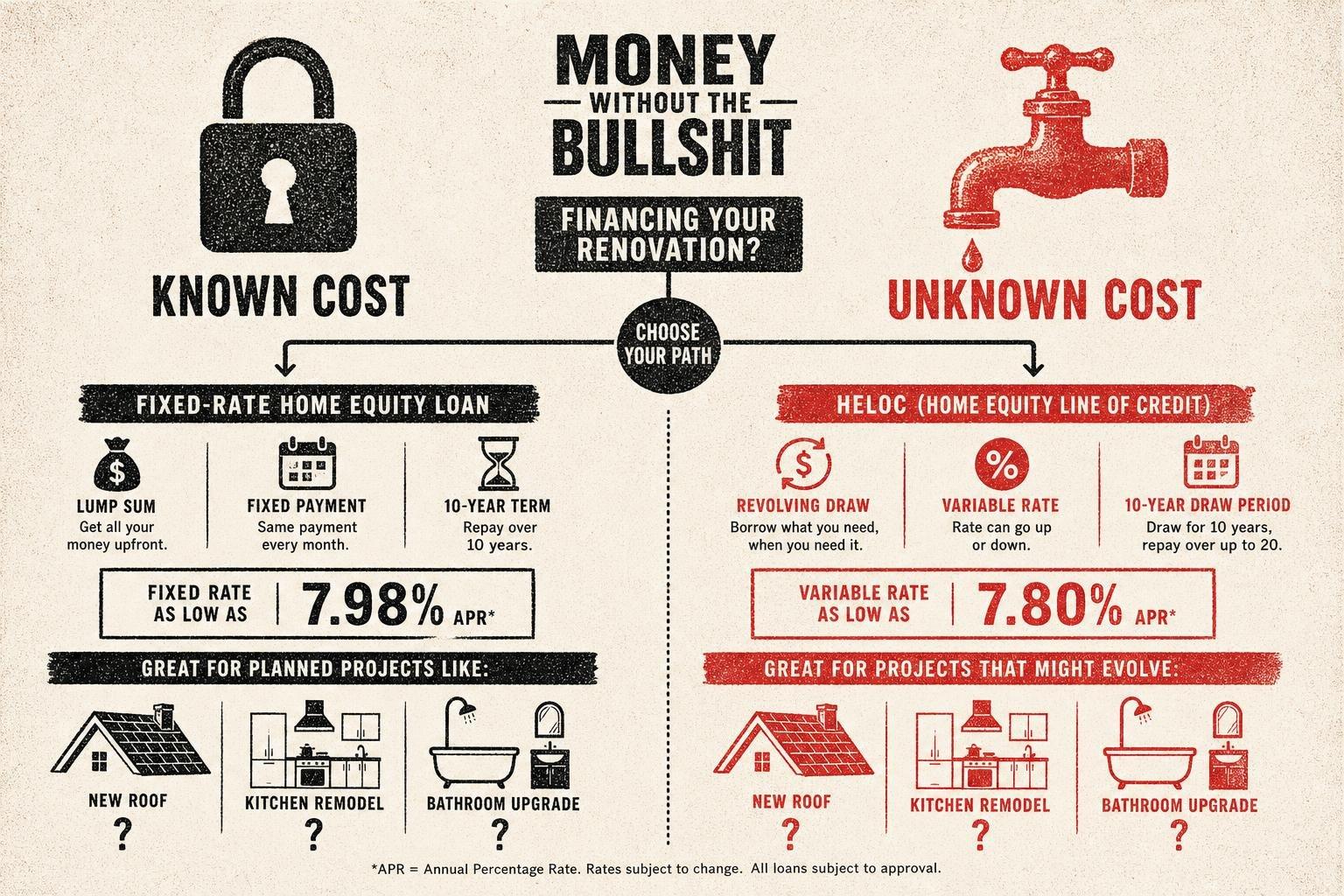

Here's the thing nobody tells you when you start Googling "home equity loan vs HELOC": the rates are close enough right now that rate-chasing is the wrong place to spend your mental energy. As of November 2026, the average home equity loan rate is 7.98% and the average HELOC rate is 7.80%, according to Experian. That's an 18-basis-point gap. If you're picking a product based on that spread alone, you're optimizing the wrong variable.
The variable that actually matters is whether you know the total cost of your renovation before you start.
Known Cost vs. Unknown Cost Is the Real Fork in the Road
A home equity loan hands you a lump sum at a fixed rate, with payments that don't move for the life of the loan — typically structured as 120 monthly payments over 10 years, per Experian. A HELOC gives you a revolving line you draw against as needed, usually with a 10-year draw period, but the rate floats with benchmarks tied to the Fed, so your payment can move too, according to Experian.
That structural difference maps directly onto renovation types. If you're replacing a roof or redoing a kitchen with a signed contractor bid in hand, you know the number. A home equity loan locks in a payment against that known number and you're done thinking about it. If you're doing a multi-phase renovation — gut a bathroom, see what's behind the walls, decide whether to also redo the plumbing — you don't know the number yet, and a HELOC lets you draw only what you need, when you need it, instead of borrowing against a guess.
As USA Today reported, this is exactly how financial planners frame it in practice. "A home equity loan provides a lump sum for a known cost, while a HELOC offers a flexible line of credit for uncertain expenses," the outlet noted, citing CFP Greg Black and WSFS Home Lending president Jeffrey Ruben, who suggests testing urgency with a simple question: will delaying this repair cost more than financing it now?
The Variable Rate Isn't a Footnote — It's the Whole Risk Profile
CNBC's reporting on the latest New York Fed data makes a point that's easy to skip past: HELOC balances jumped $23 billion in the third quarter of 2026, the largest increase since 2005 and the 18th straight quarterly gain, per the New York Fed data reported by CNBC. Fed researchers attribute this to strength, not stress — serious delinquency on these lines is around 1%, according to the New York Times. People are tapping equity because they have a lot of it (homeowners collectively hold about $17.5 trillion in home equity, per ICE data cited by CNBC), not because they're underwater.
But "currently healthy" and "structurally safe" aren't the same claim. CFP Douglas Boneparth put it bluntly to CNBC: "If your budget only works at today's rate, then your budget doesn't really work" — because HELOC rates move with the prime rate, which the Fed influences even though it doesn't set it directly. If your renovation budget assumes a 7.80% HELOC rate holds steady for three years while you draw and repay, you're making a bet on Fed policy you probably haven't priced in. A home equity loan removes that bet entirely — your payment on month 1 is your payment on month 120.
This is where income and risk tolerance actually belong in the decision, and where a lot of renovation advice goes generic. If your monthly budget has slack — room to absorb a rate move without reshuffling other payments — a HELOC's flexibility is worth the variable-rate exposure. If your budget is tight enough that a payment increase would force tradeoffs elsewhere, the home equity loan's fixed payment is the safer structural choice even if it costs you slightly more in average APR today.
Skip the "Equity Sharing" Pitch Entirely
One more thing worth flagging while you're in this research: some fintech firms are now marketing "home equity investments" or "equity sharing agreements" as a renovation funding alternative, pitched as cash with no monthly payments and no new debt. Consumer advocates, including the National Consumer Law Center, dispute that framing directly, calling the products "a loan masquerading as obligation-free cash" in litigation covered by the New York Times. If a renovation funding pitch promises equity access with no debt and no payments, that's a claim worth treating with more skepticism than enthusiasm.
The decision that actually moves your renovation forward isn't which product has the better headline rate this month — it's whether you can name your total project cost today. If you can, get three home equity loan quotes and lock a payment. If you can't yet, a HELOC buys you the flexibility to find out as you go.


