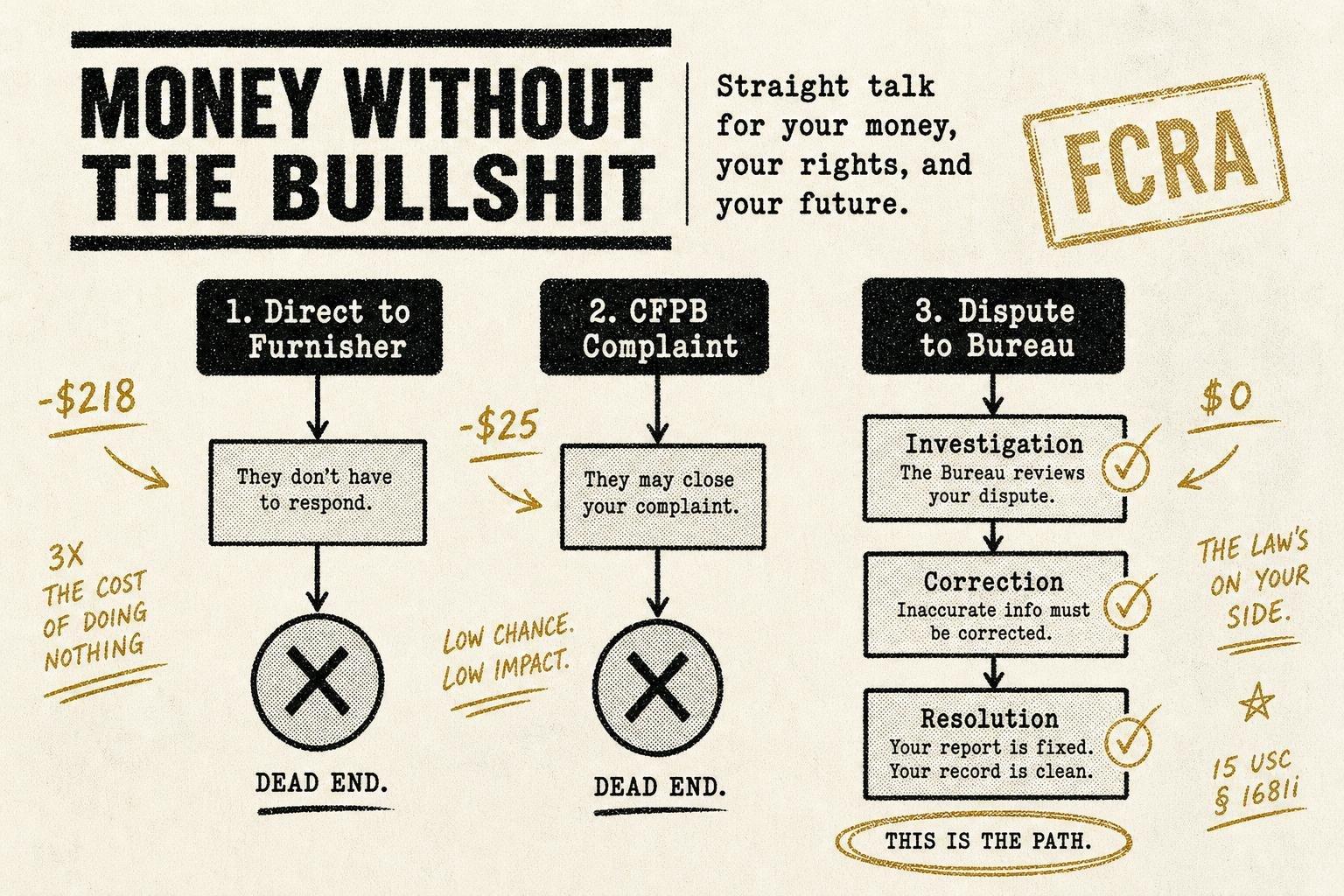

A federal judge in Maryland ruled last month that complaining to the CFPB about a credit reporting error does basically nothing to protect you legally. The consumer in that case had sent letters to a debt buyer and its servicer, then filed three CFPB complaints when they ignored him. The judge dismissed his case anyway, writing that the CFPB "is not in the business of assembling and evaluating consumer credit information," so a complaint to the agency never triggers a furnisher's duty to investigate anything (AccountsRecovery.net).
That's the part nobody tells you when they say "just file a complaint." The system has a specific pipe the dispute has to travel through, and most people are pouring water next to the pipe instead of into it.
The Dispute Has to Go Through the Bureau, Not Around It
Under the Fair Credit Reporting Act, a creditor or debt collector — what the law calls a "furnisher" — only has a legal obligation to investigate a disputed item once a credit reporting company notifies them of the dispute. Letters sent directly to the furnisher don't trigger that duty. Neither does a CFPB complaint. The judge in the Maryland case was explicit about this: FCRA investigation duties kick in only after the bureau itself forwards the dispute (AccountsRecovery.net).
That means the correct first move is disputing with Equifax, Experian, or TransUnion directly — not the lender who reported the error, and not a regulator. The CFPB's own guidance confirms this is the mechanism: you have a right to see your reports, and the formal dispute process runs through the reporting company, which is then obligated to pass the dispute to whoever furnished the data (CFPB). If you've got a disputed medical bill, a collections account from an old apartment, or a loan that got reported twice, the bureau is the gatekeeper, not a side door.
It's worth remembering there's a longer list of consumer reporting companies beyond the big three — tenant screening services, specialty bureaus that track things like checking account history — and each one has its own dispute process you may need to separately invoke if the error lives in one of those reports instead (CFPB).
The Bureaus Don't All Respond the Same Way — and That's the Actual Problem
Here's where it gets uncomfortable. One industry research tracker that compiles CFPB complaint outcomes found a striking gap in how often each bureau's disputes end with actual relief versus just a canned explanation: Experian's rate of complaints closed with relief sat far below Equifax's and TransUnion's for 2025, before rising again by the third quarter of 2026, according to that site's calculations from CFPB complaint data (Axis Intelligence Research). I'd treat the exact numbers as directional rather than gospel — it's a third-party research calculation, not a CFPB-published metric — but the underlying pattern tracks with what consumer attorneys have been reporting too: credit report dispute lawsuits are rising sharply in 2026 as consumers run into bureaus that close disputes with an explanation instead of a correction (Ginsburg Law Group).
The takeaway isn't that one bureau is secretly worse at fixing errors than another — I don't have numbers I'd stake a claim on there. The takeaway is that "I disputed it" and "it got fixed" are two different outcomes, and the system is built with enough gray area that a bureau can technically close your dispute without actually correcting your report.
What Actually Moves the Needle
If you're disputing an error, the process that has legal teeth looks like this: dispute in writing with the specific credit reporting company that has the error on file, identify the exact item and why it's wrong, and send documentation — not just an assertion. That written dispute is what obligates the furnisher to investigate once the bureau forwards it. Requesting your reports to check for errors in the first place won't hurt your score, and the CFPB recommends doing it at least annually (CFPB).
If the bureau closes your dispute without fixing anything, your next move isn't a CFPB complaint for its own sake — file it for the record, but understand it's not a legal lever by itself, per the ruling above (AccountsRecovery.net). The lever that actually works is a formal dispute letter to the bureau, followed by persistence, followed — if that fails — by a lawyer who can file under the FCRA directly rather than waiting on a regulator to referee it for you.
The error on your report isn't a customer service problem. It's a paperwork problem with a specific procedure, and skipping a step in that procedure is why so many disputes go nowhere.


