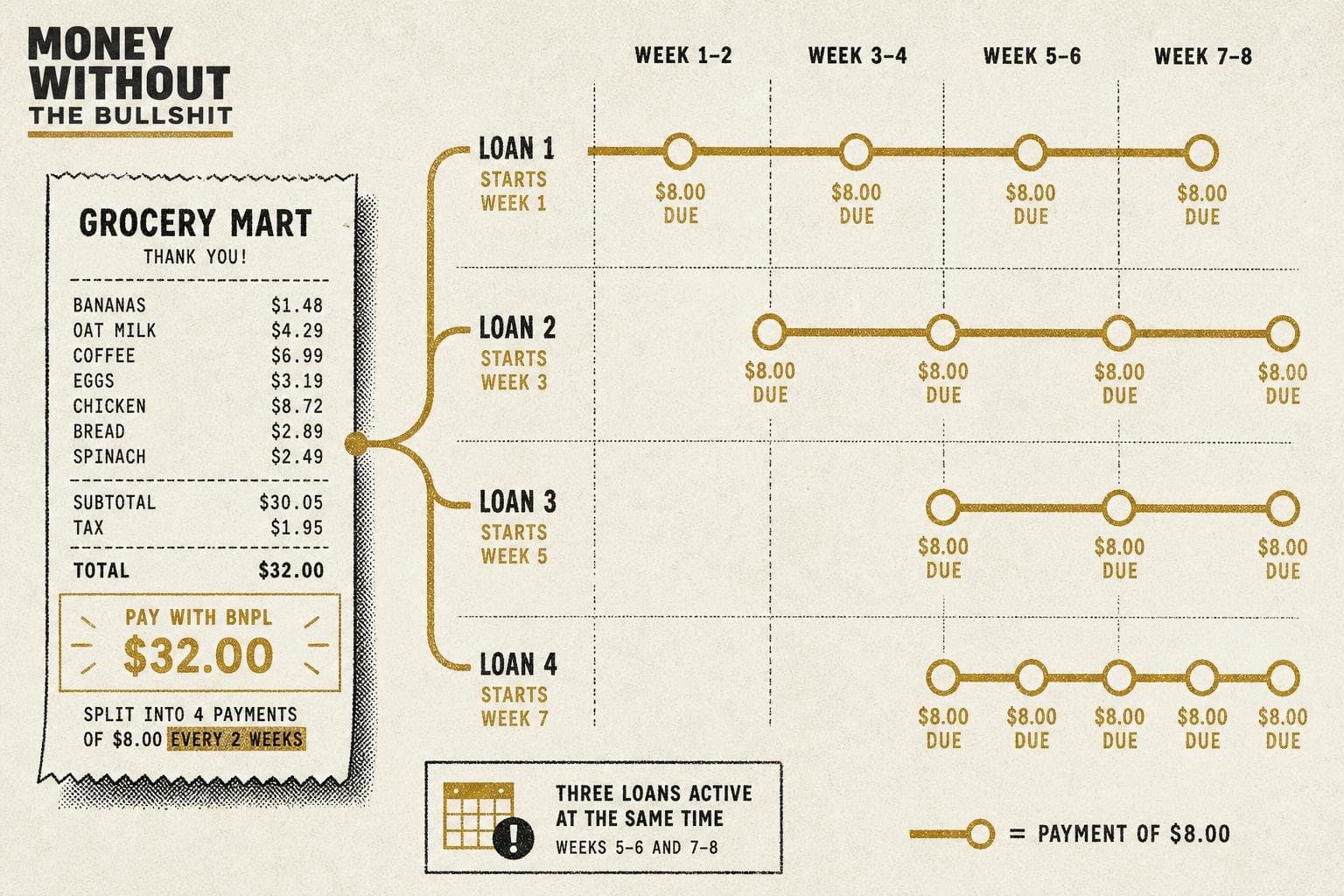

Here's a number that should stop you: 47% of BNPL users paid late on at least one loan in the past year. That's up 13 percentage points over two years. This isn't a niche product with a struggling user base — over 91 million Americans now use BNPL, and nearly a third of them are using it to pay for groceries and utilities. Splitting a $60 grocery run into four payments of $15 is not a checkout convenience. It's a warning sign dressed up as a feature.
The product has always had a tension built into it. A standard pay-in-four plan is structured as four equal, typically interest-free payments at two-week intervals — the whole balance cleared in six weeks, funded not by consumer interest but by merchant fees. No interest sounds great. But the mechanism only works cleanly if the purchase was something you could have afforded in the first place and just wanted to smooth out. When the purchase is dinner, that math doesn't close.
The Debt You Can't See Is the Debt That Kills You
The deeper problem with BNPL isn't any single loan — it's the stack. 63% of BNPL users currently carry multiple concurrent loans, and a third use more than one lender at a time. Because these loans have historically sat outside credit reporting systems, no single lender — and no credit bureau — could see the full picture. You could owe $800 across four BNPL accounts simultaneously and look, on paper, like someone with no installment debt.
Academic literature reviewed this year flags this as the defining policy problem: the absence of BNPL from US credit reports isn't accidental, it's competitive. Lenders have structural incentives not to report because doing so would expose customers' full debt loads and make approvals harder. The invisibility is a feature for the business model and a bug for anyone trying to assess whether a customer can actually afford another loan.
That's changing — slowly. Affirm now reports its loans to Experian and TransUnion, including pay-in-four plans, and FICO has built new scoring models designed to incorporate BNPL data. Whether the rest of the industry follows is still an open question, but the direction is clear: the credit invisibility era is ending.
Missing a Payment Costs More Than $10
When people think about BNPL risk, they picture a late fee. The reality compounds faster. The average late fee runs about $10, per CFPB data, and the Federal Reserve found that 64% of late payers got charged one — so the fee is the rule, not the exception. But the fee is the smallest piece.
Miss a payment with most providers and your account gets frozen. You lose access to the service exactly when financial stress has made you most likely to need it. Miss enough payments and the balance goes to collections — a mark that can sit on your credit report for up to seven years. For a product people are now using to buy groceries, that's a disproportionate consequence.
The Financial Counseling Association of America points to something else worth naming: losing track of multiple payment schedules. Pay-in-four plans run on two-week cycles, which means they don't align with monthly budgeting the way a credit card statement does. You can be technically current on three plans while a fourth one slips, and the mental overhead of tracking it is real.
The Regulatory Gap Is Real — and Getting Wider, Not Narrower
Here's the context that makes this more complicated: the CFPB, the federal regulator most positioned to set uniform BNPL rules, has significantly pulled back its supervision and enforcement activity since 2025. The agency has dismissed pending actions, reduced staff, and scaled back guidance. That doesn't mean consumer protection disappeared — it means it fragmented. State attorneys general have stepped in, hiring former CFPB staff and building their own enforcement capacity. But a state-by-state patchwork means your rights and protections as a BNPL borrower depend heavily on where you live, and the rules vary.
The practical implication: there's no federal floor right now for how BNPL providers must handle disputes, disclosures, or collections. Some states have stronger protections; others don't. If you're using BNPL and something goes wrong, your recourse is jurisdictionally uneven in ways most people don't know to check.
What to Actually Do With This
If you're using BNPL occasionally for non-essential purchases and paying on time, the product works roughly as advertised. The risk profile shifts when: you're juggling three or more simultaneous plans, you're using it for recurring necessities, or you're relying on it because cash genuinely isn't there.
The constraint to identify first isn't "should I use BNPL" — it's "how many payment obligations can I actually track across how many different due-date cycles without one slipping?" That's a systems question, not a willpower question. When the answer is "fewer than I currently have," the cost of doing nothing is a late fee today and a collections mark for the next seven years.


