


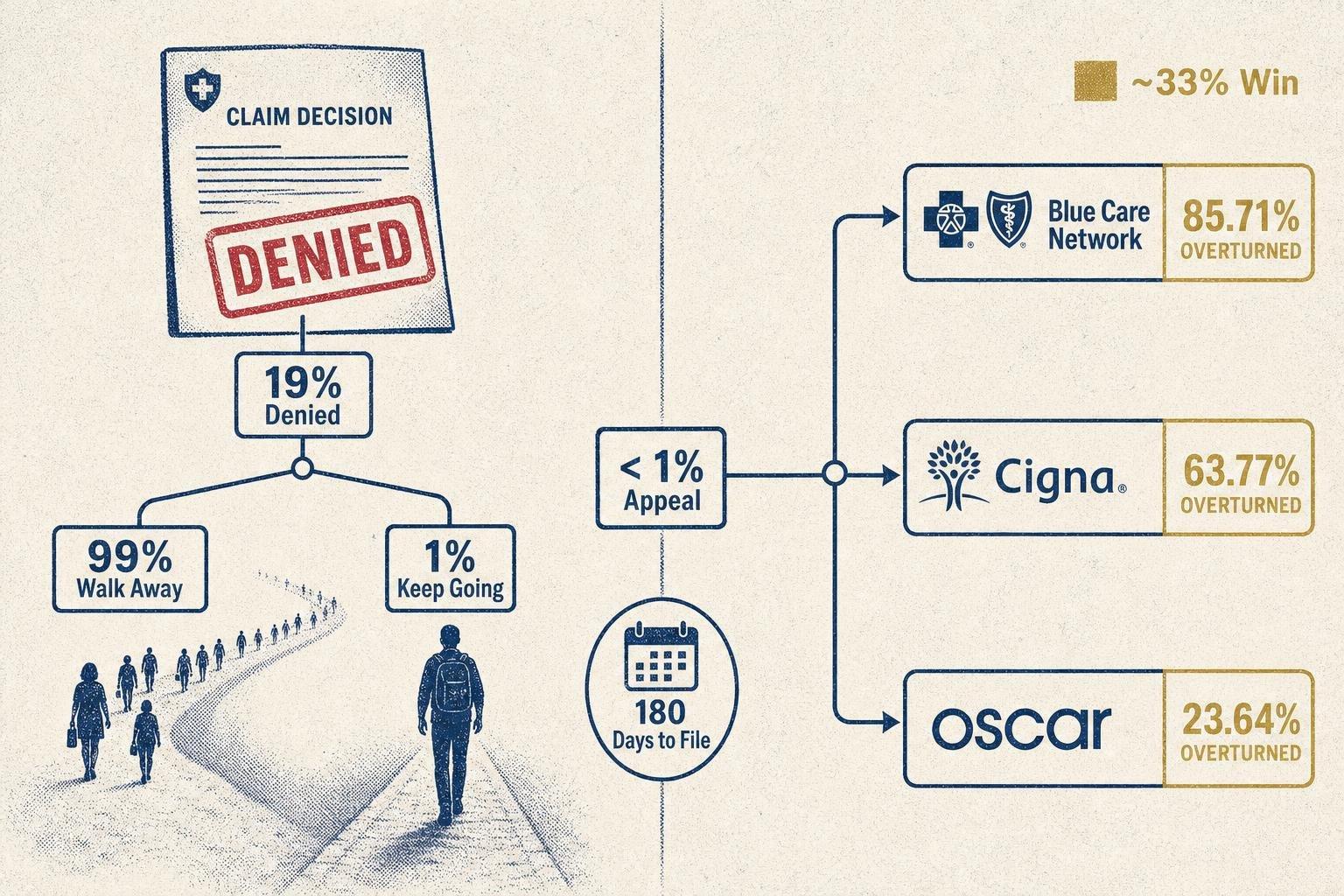

Insurers selling plans on HealthCare.gov denied 19% of in-network claims in 2024, according to a KFF analysis cited by MoneyTalksNews. Consumers appealed fewer than 1% of those denials. Of the people who bothered, insurers reversed their own decision roughly a third of the time at that first stage.
Read that again. One in five claims gets denied. Fewer than one in a hundred denied people fight back. And the people who do fight win often enough that "fewer than 1%" looks less like a sign the system is hopeless and more like a sign most people are leaving money on the table out of exhaustion, confusion, or the reasonable assumption that a denial is final. It usually isn't.
The Denial Reason Tells You Whether You're Even Fighting the Right Battle
Before you draft an appeal letter, find out what's actually being contested — because most denials have nothing to do with whether you needed the care. In the KFF data referenced by MoneyTalksNews, 36% of denials were coded simply as "other," 25% were administrative, 9% involved a missing prior authorization or referral, and only 5% were based on medical necessity. A separate compilation of the same KFF figures, from ACP Billing, breaks the denial rate down further: it ranged from 3% to 36% depending on insurer and state, and combined in-network and out-of-network denials averaged 20%.
That spread matters because it means your denial is probably a paperwork problem, not a medical argument. A wrong billing code, a missing referral, a form your doctor's office forgot to attach — these get fixed by a phone call and a resubmission, not a legal brief. Save your energy for the harder cases: the 5% where an insurer is disputing medical necessity, which is where a doctor's letter and clinical documentation actually move the needle.
The Overturn Rate Depends Entirely on Who You're Fighting
Here's where the "appeal and you'll probably win" framing gets more complicated, and more useful. A review of CMS's Transparency in Coverage data by MedPrecision Billing found that in plan year 2024, the median HealthCare.gov-state insurer overturned 35.61% of member-filed internal appeals — but individual issuers ranged from 0% to 85.71% (Blue Care Network of Michigan, the high end). Even within the same state, the gap was stark: in Texas, Cigna HealthCare of Texas overturned 63.77% of member appeals in the same period, while Oscar Insurance Company overturned 23.64% despite fielding the most appeals of any qualifying record, 38,325 of them.
That data is two years old by CMS's own design — the agency's public file always lags two plan years, per MedPrecision — so treat it as a baseline for how insurers tend to behave, not a live scorecard for 2026. But the lesson holds regardless of the exact numbers: your odds of winning an appeal aren't a fixed probability. They depend heavily on which insurer you're dealing with, something almost no one checks before they give up.
Know Your Deadlines, Because the System Is Built to Outlast You
Mark Cuban raised a fair concern on social media in October 2026 about independent review organizations — the outside reviewers who make the final call on many denials — questioning whether their financial relationships with large insurers create a conflict of interest, per MoneyTalksNews. Whether reviewers systematically favor insurers is hard to prove either way, and I won't pretend the data settles that. What's not in dispute is the clock. Under rules covering most plans, you have 180 days from the denial notice to file an internal appeal, according to HealthCare.gov as cited by MoneyTalksNews, and for urgent care the plan must decide within 72 hours under U.S. Department of Labor rules. A separate guide from ReadMyPolicy notes deadlines across the industry typically run 30 to 180 days — which means the specific window depends on your plan and your state, and you need to find your actual number rather than assume.
If you've been denied and you're inclined to just pay it or let it go, the math argument is simple: filing an appeal costs you an hour and a stamp or an email. Not filing costs you whatever the bill is. Fall open enrollment is when a lot of people are choosing 2027 coverage anyway — a reasonable moment to also go pull up your current plan's appeal deadline, before you need it rather than after.