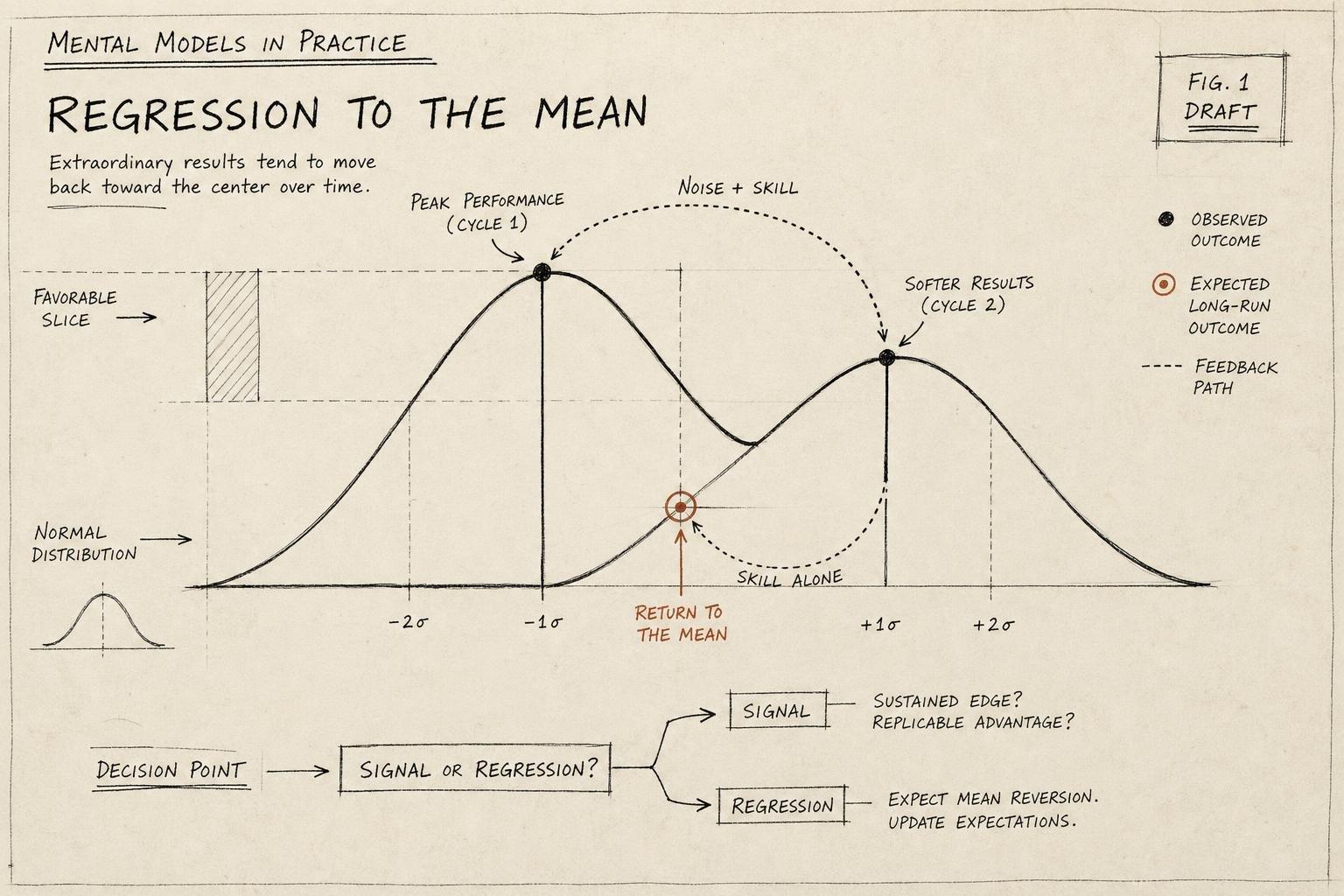

Picture the employee who crushed it last cycle — the one whose name came up unprompted in the all-hands, whose project became the case study in the recruiting deck. Six months later, their manager sits down to write the next review and the numbers look softer. No obvious screwup, no change in effort. Just... less dazzling. The easy story is decline. The harder, truer story might be math.
The Flight Instructor Who Was Wrong About Praise
Daniel Kahneman ran into this exact pattern decades before performance management software existed. Teaching flight instructors in Jerusalem that praise beats punishment, he was met with a veteran instructor's flat rejection: cadets praised for a smooth maneuver usually flew worse next time, and cadets screamed at for a bad one usually improved. Kahneman's instinct was that the instructor's data was real but his causal story was backwards. He had each participant toss two coins at a target with no feedback at all — and the best throwers on the first toss mostly did worse on the second, while the worst did better, with zero intervention of any kind (stivencatalyst.com). Praise and punishment weren't doing the work. Extremes were just drifting back toward each person's normal.
That's the mechanism hiding inside your star employee's "decline." A standout quarter is rarely pure signal. It's some real skill plus a favorable slice of circumstances — an easy project, a client who happened to be reasonable, a launch that landed at the right moment. The skill persists. The favorable slice usually doesn't repeat, and when it doesn't, the next measurement looks like a fall from grace even though nothing actually broke.
How Big a Fake Decline Can Get
The size of this illusion depends on how reliable your measurement is in the first place. One simulation cited in a recent breakdown of regression effects found that when two measurement periods agreed only weakly with each other, the group picked out as the costliest performers swung by over a thousand dollars in apparent change with no program applied at all — and shrank to under five hundred dollars of illusory movement once the two periods agreed well (stivencatalyst.com). Noisier metrics produce bigger phantom swings. If your review cycle leans on a handful of visible projects, a couple of stakeholder shoutouts, and a self-assessment written under deadline pressure, you've built a noisy instrument — and noisy instruments manufacture dramatic-looking regression.
This is the same trap product teams fall into reading A/B test dashboards: an experiment shows a 20% lift in its first days, then settles to 4% a week later with the feature completely unchanged, because the early estimate mixed a real effect with a burst of favorable randomness that an early, excited look couldn't separate out (growthbook.io). Swap "experiment" for "employee" and the trap is identical: whoever gets singled out as the biggest early winner is, almost by construction, more likely to have benefited from noise than whoever sits in the unremarkable middle.
Don't Confuse This With the Bias It Usually Travels With
Here's where it gets genuinely confusing, because regression to the mean rarely shows up alone in a review cycle — it travels with recency bias, which is a completely different mechanism doing similar-looking damage. Recency bias is a memory problem: managers weight the last few weeks of visible work far more heavily than the full period, which means anyone whose best work landed early pays for it later regardless of any regression effect at all (possibleworks.ai; 15five.com). A star who had a huge January and a quiet October can look like they're declining purely because October is what's fresh in the manager's head, with no statistical regression involved whatsoever. Regular, frequent check-ins throughout the cycle are the standard fix for that specific problem (leadingthrough.beehiiv.com).
The two problems compound badly. A genuinely noisy, regressed-toward-average quarter from your star lands right when recency bias is already primed to overweight it. And on the employee's side, a softer review often gets processed through its own distortion — catastrophizing a mixed assessment into "my career is over," when the more honest hypothesis is that last cycle was a bit lucky and this one is a bit normal (dev.to).
What Actually Separates Signal From Noise
None of this means star performers are frauds or that review cycles are theater. It means a single standout period is weak evidence about someone's true level, and a dip the following period is weaker evidence of decline than it feels. The fix isn't a better speech about bias — awareness alone doesn't restore information a manager never recorded in the first place (possibleworks.ai). It's measuring more often, over longer stretches, so no single data point — spectacular or disappointing — gets to stand in for the whole person. The next time a review reads like a decline, the first question worth asking isn't "what went wrong." It's "how many good months would I need to see before I'd believe the first one was real."


